Training Tuesdays

On the Road with Milo documents my sometimes-literal journey to understand how people and dogs can live well together. I’m learning from philosophical and scientific research on human-canine relationships; expert dog trainers, breeders, and handlers; and my own relationship with Milo the AwesomeDog.

Milo and I are companions. We train and compete in obedience and some dog sports. And we spend as much of our summers as we can camping in Canada’s national and provincial parks. My posts on this blog range from critiques of scientific papers to reviews of campgrounds, but in one way or another, they’re all about the relationship that Milo and I share, and hence about the relationship between humans and dogs.

Training is all about relationship—attention, communication, friendship, and teamwork. This spring and summer, my goal is to train with Milo more systematically. To document our progress, hold myself accountable, and regularly remind myself that the point of the training is to develop my relationship with Milo, I’ll post weekly updates about what I’m planning and how we’re doing. These will be my “Training Tuesdays” posts.

On Training Tuesdays, I’ll report what we did during the previous week, plan what we’ll do the next week, and muse about things that went well or poorly.

German Shepherd puppy wearing a graduation cap and looking at cameraMilo’s puppy kindergarten graduation photo


This week’s plan

I’ve already decided that this summer we’ll work on Rally Obedience, and train for Schutzhund obedience and tracking titles. I’m adding a “Living well” category for things Milo and I can learn that will make our lives easier and more fun. This could include tricks, house manners, and things like handing for grooming and veterinary procedures.

Rally

  • Nothing formal yet
  • We’ll just practice a sign or two on our walks

Tracking

  • Article indication off the track (2 minutes a day)

Obedience

  • Between 2 and 15 steps of focused heeling with giant rewards (5 minutes a day)

Living well

  • Paw handling with very high reward rates (2 minutes a day)

Glossary

Article indication. Milo and I will be doing Schutzhund-style tracking. In these tests, he needs to tell me when he finds articles dropped along the track by laying down with his front paws on either side of an article. I’ll teach him this in the living room. When he’s got it, we’ll take it outdoors onto a track.

Paw handling. Milo does not like getting his nails trimmed. I can wrestle him through a manicure, but I would rather not. It stresses us both out and is detrimental to our relationship. So, we’ll do some counter-conditioning to teach him that it is a good thing when I grind down his nails. All I’m going to do this week is call him to his paw trimming spot and ask him to give me a paw (he already is happy to do these two things). Then, I’ll hold his paw in the same way I would when grinding down his nails and give him a treat. That’s all. Easy-peasy. The trick is yummy treats and tiny little baby steps.

Art and the science of canine consciousness

a painting consisting of a vertical stripe of blueThe frustration I feel when I see people look at abstract art and say, “I could do that,” is tinged with hypocrisy. Why? Because when I look at paintings like Blue Column, by Morris Louis, I say it too.
I say it even though I know that Blue Column is art and is important. Afterall, even though I could have produced that painting, I didn’t. And, I love color field paintings and can gaze at them for hours.

I have to remind myself that just because the bar might seem to be set very low when we call an abstract painting “art,” it doesn’t mean that the picture is unimportant or banal.

This attitude toward art helps me be more fairminded and respectful of science. Particularly of scientific research that seems to set the bar really low for canine emotion, consciousness, and cognition.

There is lots of scientific research that seems to do this. And my initial response to that research is generally pretty snarky.

For example, Juliane Bräuer et al just published a research study titled, “A ball is not a Kong: Odor representation and search behavior in domestic dogs (Canis familiaris) of different education” in the Journal of Comparative Psychology. The paper reported that when working and companion dogs followed a scent trail produced with one toy and encountered a different toy at the end of that trail, they hesitated.

My initial disrespectful response to the paper was, “No shit Sherlock, I could have told you that.”

But that response inhibits my curiosity about the research program that produced the paper and undermines my ability to think about why the researchers did that experiment and how they might have done it better.

This experiment was designed to explore whether dogs have a mental representation, a sort of olfactory picture in their minds, of objects in their world. The researchers are interested in canine consciousness, just like me.

The researchers found that pet dogs and working dogs, some of whom were trained in search and rescue, both hesitated the first time they encountered the wrong toy at the end of a scent trail, but didn’t hesitate in subsequent trials. They also found that the working dogs followed the trail faster than the pet dogs, but again, only in the early runs of the experiment.

This experiment brings some interesting things to mind:

I’m still bothered because the researchers set the bar so low for determining whether a dog has a mental representation of what she’s smelling. From my perspective, there was no need to do this experiment because the results are obvious:

  • If we think of this from an ecological or evolutionary perspective, it’s difficult to imagine a creature who uses scent to hunt for prey not hesitating when they find a surprising item at the end of a track.
  • I do tracking with my German Shepherd, Milo. When he comes to the end of a track, which is what happened in this experiment, he hesitates and sniffs around trying to find it again. That is what dogs do, and it is what the dogs in this study did. It seems that if the researchers had collaborated with an expert dog handler, they’d have seen that this was an unnecessary experiment.

But, I sometimes forget that my perspective isn’t the only one out there. What if the researchers weren’t trying to prove this point to someone like me?

Afterall, 25 working dogs took part in this study and presumably those dogs’ handlers knew what was going on and I bet the results weren’t surprising to many of those people either.

These researchers were speaking to a scientific community in which many members are skeptical that creatures other than humans and chimpanzees have rich inner lives. (I have one friend who describes rabbits as furry machines that turn carrots into poop.) When juxtaposed against background beliefs like these, this study’s results become surprising, interesting, and important.

Also, this study might be a necessary building block for more complicated investigations of canine consciousness and representation.

Finally, some people will give scientific knowledge more authority than the experience of expert dog handlers and trainers. For example, a scientific paper might convince policymakers who would not be moved by expert testimony that we need practices and laws that respect dogs as having rich inner lives.

I didn’t need this experiment to tell me that dogs have representations of what they are smelling. But that doesn’t make the research unimportant. This experiment is much more convincing than my blustering “I could have told you that” will ever be.


Summer training plans

I’ve decided that this summer Milo and I will train for an obedience title and a tracking title, and take another Rally obedience class.

BH (Begleithund Test)

line diagram tracing a heel work pattern

BH heelwork pattern

This is the first obedience title that one can get in the sport of Schutzhund. I’m interested in a BH because it seems difficult but doable. In addition to a temperament test and a traffic test, the BH involves a long heelwork pattern. Milo and I can already do all of the elements of this pattern. The trick will be to link them together and keep him focused for the duration of the exercise.


Tracking

Tracking is on the list because Milo is an olfactory genius (proud dog mamma talking here). He loves to sniff and it seems wrong to deny him the opportunity to develop this talent. It is also a lot of fun to work with him on a project that he finds so engaging.

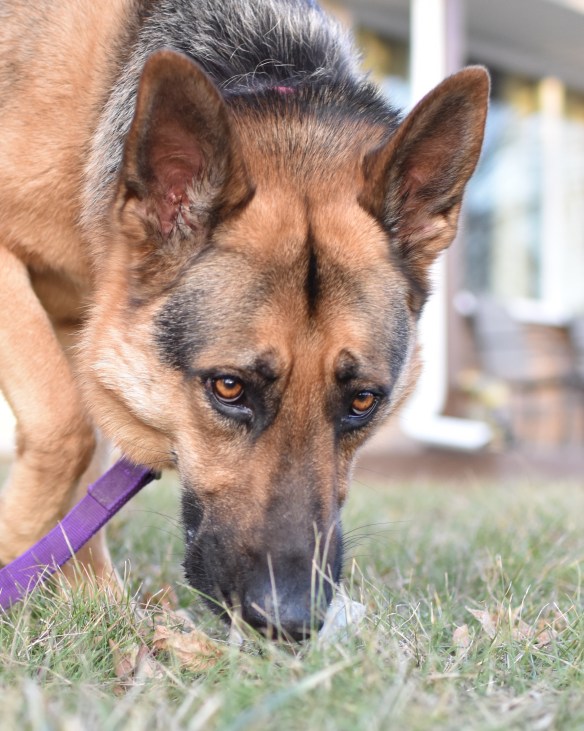
black and tan german shepherd with his nose down in green grass

Rally class

Milo and I could get some more Rally titles. But Rally classes provide more important benefits than titles. They are great socialization opportunities. These classes provide a safe and controlled environment with lots of new dogs and new people who Milo can practice ignoring. Also, this instructor helps me work on being a more confident handler. I can always use this sort of help.

I called this post “Summer training plans.” This is not yet a plan, only a list of interests. More detailed plans are on the horizon.

My plan for this week is to make the plan. I’ll:

  • look into upcoming Rally classes and Rally trials,
  • set up a weekly tracking and training date with some like-minded friends, and
  • make a first pass at dividing the BH and tracking training into tiny little manageable bits for me and Milo work on.


Taking selfies with your dog: Spatial pressure and talking without words

It was a darn near perfect Saturday afternoon–Milo and I spent hours sauntering along the Grand River. The air was crisp and the sky sapphire blue. Male blackbird songs filled the air with advertisements of nest vacancies and promises of good parenting. I had that “my cup overfloweth” feeling and wanted to commemorate the day with a selfie.

leafless tree leaning away from blue river and across blue sky

I got Milo and me positioned so that we were in good light and had something interesting behind us. But for the love of love, I couldn’t get him to look at the phone.

german shepherd with it's back to the camera licking a short-haired woman's faceThis is not new. Taking selfies with Milo is always a trial. When I put the phone in front of us instead of giving the camera a cute head tilt, he’ll look up, look down, or turn right around. I have a disturbing number of accidental pictures of Milo’s butt.
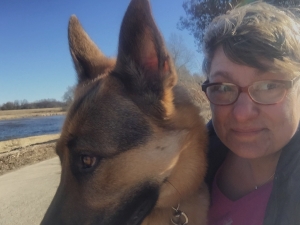
 

I always thought it was weird that such a biddable dog worked so hard to do the opposite of what I wanted him to do.

woman with short hair and german shepherd dog looking out of the pictureAnd then it hit me. He wasn’t doing what I wanted him to do, but he was doing exactly what I was telling him to do. Sometimes I forget that we don’t have a psychic connection and that Milo’s English isn’t that good.
I said, “Milo, look at the phone,” but the act of shoving the phone in his face told him to get out of there, which he did by looking or moving away. And if I stopped him from retreating while telling him to retreat, he expressed his discomfort with the tension by licking my face.

We’ve repeated this so many times that I might have taught him that the phrase ‘look at the phone’ means back up!

It’s called spatial pressure (or social pressure or body pressure), and humans use it on each other all the time. We can get each other to move without speaking and without touching. If I move into your space you will likely move away. Patrick Swayze’s character in Dirty Dancing understood this:


Trainers often exploit dogs’ tendencies to move when we get into their dance space as a training technique. In general, dogs (like people) prefer to turn around rather than walk backward. One standard method for teaching a dog to backup uses spatial pressure:


While this method might work well for you and your beloved pet, there are lots of other, and in my opinion safer, ways to teach a dog to backup. Getting into an unknown dog’s space is unpleasant for the dog, and a dog (like a person) can interpret this action as threatening. It is not difficult to teach a dog to back up without using spatial pressure.

Back to selfies.

The best we can do is wait until our dog is in a good spot and then slip in beside them and snap a few quick pics. It might help to hold a slice of cheese in the same hand as your phone, although with Milo this usually results in a phone covered with dog spit. If our dog selfies don’t turn out the way we want them to, we have to give our dogs a break.

Remember, we are always communicating with our dogs, and we often don’t realize that we are doing it or what we are saying. I actually had the thought that Milo hated having his picture taken and was stubbornly thwarting my selfie goals, when he was just responding in an entirely reasonable way to my actions.

short haired woman looking into from between a german shepherd dog's ears

With dogs, actions always speak louder than words.

The art of shutting up: When not to give dog training advice

A perceptive and mean-spirited person might describe me as a cross between a pathological helper and a know-it-all. (A nicer person would call me “empathetic and well informed.”) If I see someone with a problem, it takes a lot of work for me to refrain from telling them how to fix it, or jumping in and fixing it myself.

One of the hardest life lessons I’ve learned is how NOT to do this. I call this lesson The Art of Shutting Up.

This weekend’s mild temperatures meant that the field at Masters N’ Hounds where Milo and I usually play was muddy. The first time he gleefully skidded out in the mud, I said, “Jiminy Cricket, aren’t you a mess.” (I didn’t use those exact words.)

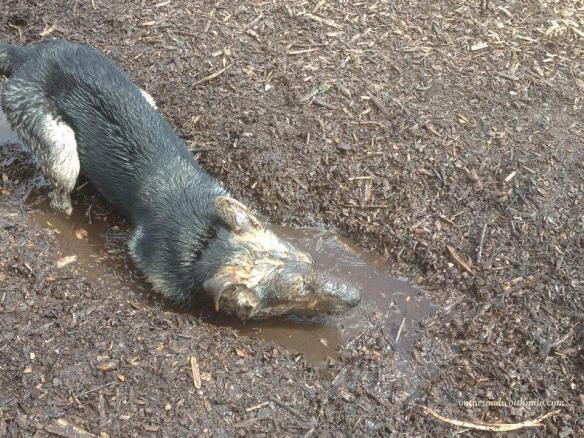
But, it was a gorgeous day, and Milo needed a bath anyway, so I decided to let him enjoy the mud, and that we’d stop by the dog wash at PetValu on our way home. Problem solved.muddy german shepherd puppy

Years earlier, at a different park, Milo already found mud irresistable.


Skip ahead to PetValu where Milo, enjoying handfuls of treats and praise from the employees who were already his friends, gets started on a gentle shampoo.

All was well until another muddy dog, a lab, and its two people moved into the dog wash station beside us. It quickly became apparent that all three of them needed help.

  • The dog didn’t know how to walk on a leash.
  • It was afraid (ears back, tail between its legs, head down).
  • It wouldn’t get into the tub, so its people picked him up, and when he started to squirm, they dropped him.
  • When they finally got him into the tub and wet him down, they started to bicker about the right way to wash him.
  • He took advantage of their fight and jumped out of the tub, trotting over to say “Hi” to Milo and me.
  • When I asked them to remove their dog, they gave me death stares. (I didn’t even say “Jiminy Cricket,” just “please remove your dog.”)

The minute they walked in it was clear that the situation was not ideal so I put Milo’s bath into super-speedy mode. Poor Milo only got the most cursory blowout before I hustled him out of the store and into the truck.

As I was leaving, I thought to myself that I could teach those folks a lot about how to bathe a dog. I could tell them that they should have taught their dog to like baths before it was an emergency that it get one and that they should use lots of rewards and take baby steps.

Instead of explaining to these strangers what they should have done, or offering to help, I practiced the art of shutting up. For me, the art of shutting up involves recognizing when speaking is not going to do any good or isn’t going to make the world a better place.

Here are some situations where I try to practice the art of shutting up:

1) When the people I’m talking to aren’t in a position to hear me or when I’m not in a state of mind to be clear and kind
Those people struggling to bathe their dog were obviously stressed out, and so was I. I would have had a hard time being kind and they would have had a hard time learning anything.

2) When speaking up is contrary to other important goals and commitments 
At that dog wash, my primary responsibility was to take care of Milo. Stressed out dogs do weird things, and I didn’t want Milo around that poor stressed out pup and its people. Also, my goal that day was to spend some fun and relaxing time with Milo, not to teach strangers about dog husbandry.

3) When I lack knowledge of the context of the situation 
It is entirely possible that those people already knew everything that I could have told them, and that they were just having a terrible day. How was I to know?

The week before a squirrel was teasing Milo. It got Milo all jazzed up and he gave a mighty tug on his leash in a futile attempt to catch it. A bystander suggested that if Milo pulls like that all the time, I should use a head halter on him. I politely thanked her for the advice in a tone of voice that clearly suggested that she put a sock in it. She had no context for her comment. She didn’t know me or Milo, and she didn’t know that he rarely pulls like that. In fact, we do use a halter sometimes, but this was not one of those times. This lady could have made the situation better by saying nothing at all.

german shepherd sticking out tongue

Milo’s response to a stranger suggesting he wear a halter.


Sometimes the art of being well spoken is about knowing when not to speak.

What the dog smells: The world of canine olfaction

Milo the AwesomeDog often punctuates our walks with fits of coughing, sneezing, and snorting. He’s not sick. He just sniffs thgerman shepherd dog trackinge ground vigorously enough to suck dirt and leaves right up into his nose. He takes his sniffing seriously and his days revolve around finding things to smell, and then smelling them.
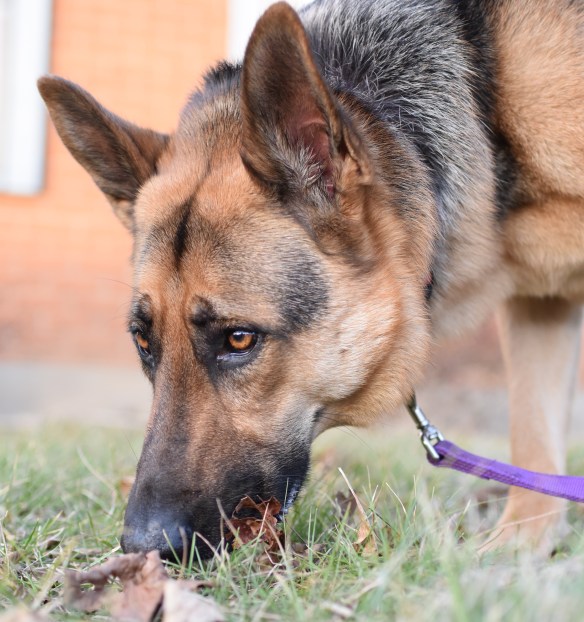

It’s difficult to imagine what it is like to be Milo because while we humans are visual creatures, dogs are sniffing creatures. Dogs live with us, some of them in our homes, but at the same time, they live in a different world, a world of smells.

Nineteenth-century biologist Jakob von Uexküll called these different worlds umwelten. An animal’s umwelt, literally ‘life-world,’ is its subjective environment consisting of objects that it can perceive and with which it can engage. In the same physical space a dog, a bat, and a human have different umwelten because they can perceive and do different things. Humans can see the color red, but dogs can’t. Bats can echolocate and fly, but dogs and humans can’t.

We can begin to understand how a creature experiences the world by investigating how its senses work. If we want to understand the inner experiences of dogs, we need to study how they smell things.

This four and a half minute video, written by canine cognitive scientist Alexandra Horowitz, does a great job explaining the complexity of dog noses and dog olfaction.  It gets us started answering the question “what is it like to be a dog?”

This video taught me that when it comes to smell, there is a bigger difference between the umwelten of a dog and a person than I initially imagined.

This difference is based on more than the fact that dogs are better sniffers than humans, although they are. Dogs can smell odors at lower concentrations than we can–100 million times lower. To illustrate the scale of this difference, Horowitz describes dogs as being able to identify the individual components of a spritz of perfume in a football stadium.

It is not just dog noses that differ from human noses, dog brains differ too. Horowitz points out that the olfactory bulb in a dog’s brain is HUGE compared to ours, and that olfaction bypasses the “thalamus to connect directly to the brain structures involving emotions and instincts.” A dog’s sense of smell is orders of magnitude more powerful than ours, AND olfaction itself is an “immediate and visceral” mode of sensation. So when you think of what it is like to be a dog, you have to imagine a powerful sense of smell, likely producing emotionally charged sensations.

Dogs can smell in stereo. Just as we can tell what direction a sound is coming from, dogs can detect the direction that an odor is coming from. They can use scent to orient themselves in the world.

Finally, a dog’s sense of smell gives them the ability to travel back and forth through time. Dogs can smell into the past to determine who you had lunch with and what you ate. And they can smell into the future, alerting you someone approaching around the corner ahead of you.

Dogs can do different things with their sense of smell than we can do with ours. This impacts their emotions, their perceptions through time, and their ways of navigating the world.

This is exciting and distressing. Exciting because it’s fun to imagine having the superpower that is a dog’s sense of smell. Distressing because the gulf between what it is like to be me and what it is like to be Milo is wider than I thought.

Even though Milo and I spend most of our time at each others’ sides, we live in different umwelten.

German Shepherd smelling grass

Hoss the Cat benefits from positive dog training

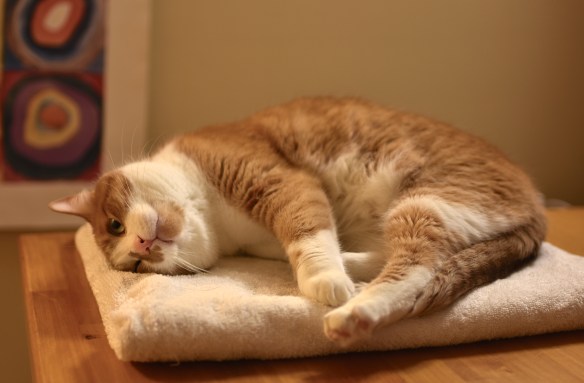
Nothing is more alluring to Hoss the Cat than an open book, the scratching of a pen on a notepad, or my fingers tapping away on a keyboard. His mission, which he chose to accept, is to get between me and whatever I’m trying to do.

He’ll saunter up and lay down on my hands as I’m writing. I pick him up and set him on the floor, and within 4 seconds he’s right back on my computer. Like the turning of the seasons, the waxing and waning of the moon, the ebb and flow of the tides, Hoss effortlessly cycles from keyboard to floor and back again.

It’s reminiscent of Milo the AwesomeDog’s desire to be underfoot when I’m cooking. After realizing that yelling at Milo to back off was entirely ineffective, I embraced a positive training approach to that problem. Now Milo has a comfy bed, where he receives lots of yummy treats, in the kitchen. Rather than being underfoot, he chooses hangout on that bed because I make the bed a more desirable place for him to be.

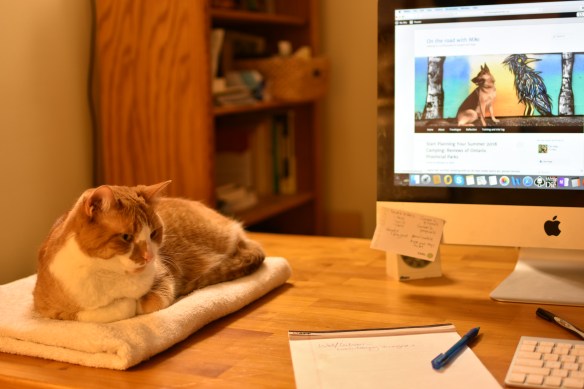
I tried the same strategy with Hoss the Cat with great success. Hoss now has a soft bed, on a corner of my desk that works for both of us.

Here’s how it worked:

Step one: Add cat bed to desktop. 

1

There is lots of room for Hoss the Cat to make himself comfotable.

Step two: Add cat.

cat on desk

Hoss the Cat immediately made himself at home.

Step three: Give cat time to consider whether this state of affairs is to his liking.

2

Hoss contemplates the consequences of abandoning the keyboard.

Step four: Realize that your clever plan has backfired because cat distracts you from work by being adorable.

9

cat bed wins


It ends up that all the creatures benefit from a positive approach to training.

10

Warm puppy: More camera fun

My last post focused on using my new AF-S NIKKOR 35MM F1.8G ED camera lens to document Milo’s snowy shenanigans. Is it dopy that it bugs me that those pictures look so cold?

I have to admit that I prefer being cozy and taking cozy looking pictures, which the new lens does a good job on as well. (It helps to have a handsome model.)

I’m taking a photography workshop next month, and hopefully, my pics will continue to improve.  You can be the judge.
DSC_0564DSC_0560

Any tips or tricks for taking good dog pics with a shallow depth of field? I would love to hear them.

Animals in our lives: Teaching the Philosophy of Companion Animals

This semester I’m teaching a university class on the Philosophy of Companion Animals called “Animals in our Lives.” Wow. I feel so lucky to do this! My students are hardworking, engaged, and good-natured, and together we are doing great work. Thanks gang!

Developing and teaching a new course takes up every spare moment. After getting my work done, going to the gym, and training and exercising Milo, I’m usually finished for the day. So, I’ve been posting here less frequently than usual.

Thank heavens I have my students’ permission to post about our class.

For starters, here is an excerpt from the syllabus that explains a little bit about what we are up to.

Animals in our Lives, Philosophy 271

Course Description
This class explores the science and ethics of human relationships with companion animals.

Course Outcomes
In this class you will:
1. Explore the social influences on, and impacts of, scientific research
2. Develop an understanding of the relationships between humans and companion animals from scientific, philosophical, and practical perspectives
3. Acquire the skills and confidence to learn, assess, and use scientific information

Discussion Topics
Unit 1: The science of emotion and the role of emotion in science
• The neurobiology of canine love
• The impact of human emotion on animal research
• The movement of scientific knowledge from the lab to the public

Unit 2: Anthropomorphism or anthropodenial
• The sense of smell and what it’s like to be a dog
• Consciousness and animal minds
• Folk psychology across species

Unit 3: Do good animal handlers and trainers need science?
• Is clicker training scientific?
• The media and celebrity dog trainers
• Different kinds of expertise and the public understanding of science
In each unit, we will explore readings from scientific, philosophical, and popular sources.

So far we’re just getting going on the unit on love.

I’ll update you as we move through the class.

What do words mean to your dog?

OELI’m reading Patricia McConnell’s excellent book, The Other End of the Leash. In this book, McConnell frames the challenges of dog training and human-dog relationships in terms of the kinds of communication typically used by primates and canids. She’s not just talking about differences between creatures that rely on vision and creatures that rely on olfaction. She gets into things like grammar, volume, repetition, and pitch of vocalizations.

McConnell points out that even though we know it’s important to consistently use the same words, in the same way, we often don’t. In states of frustration, I’ve told Milo to “lay down, down, get down.” These disco lyrics are not exactly what even a generous person would call good handling. Milo is biddable, smart, and patient and so usually complies with my desires even when I express them poorly. But, what if I had a dog who was slightly less awesome? (The results would not be so good.) And how much better could Milo and I be if I was more consistent and clear? (The results could be fab.u.lous.)

To sharpen my game I made a list of words that Milo knows, along with a description of what I am asking him to do when I use those words.

Here’s Milo’s vocabulary list:

  1. Milo: pay attention to me and approach me
  2. Look: make eye contact with me
  3. Sit: bum on ground, front legs straight
  4. Stand: legs straight, four paws on the ground
  5. Down: bum and elbows on the ground
  6. Stay: don’t move until I give a release or another command
  7. Come: snap your head toward me, approach me quickly, sit in front of me, and let me grab your collar
  8. Wait: pause until I’m gone or I tell you to do something else or I release you.
  9. Drop: let go of what you are holding in your mouth
  10. Easy: do less of whatever you are doing
  11. Let’s go: keep up with me when we are loose leash walking
  12. Hup hup: forge ahead and lean into your leash/collar
  13. Heel: keep your shoulder aligned with my knee, keep your body parallel to the direction I’m facing and sit if I stand still
  14. Back: step backward in a straight line
  15. Around: get into heel position by walking behind me
  16. Get in: Get into heel position by swinging yourself around on my left. This is also a reminder to tuck his butt toward me when we are making a left turn.
  17. Switch: walk behind me and stand or sit quietly on my right side
  18. Crate: get in your crate
  19. Mat: go lay on your nearest bed, or the bed I’m pointing at
  20. Hoover: eat what’s on the floor
  21. Leave it: stop sniffing or eating
  22. Out of it: stop staring
  23. Break: release from a sit, down, stand, or his crate
  24. Yes: functions as a click and is a release
  25. Good: keep doing what you are doing
  26. Nope: try it again
  27. Up: jump onto what I’m pointing at
  28. On: put your front paws on what I’m pointing at
  29. Touch: touch your nose to my open palm
  30. Over: jump over a high jump
  31. Jump: jump over a broad jump
  32. Tunnel: go through an agility tunnel
  33. Kiss: lick my face
  34. Paw: put your paw in my hand
  35. Toys: all the things that he plays with and live in his toy box
  36. Kong: red rubber toy that I fill with food
  37. Ball: any tennis ball sized ball
  38. Clean up your toys:  picks up your toys and puts them in your toy box

He also knows some German words, but I don’t use them regularly because I’m much pickier about precision when I use these commands:

  1. Sitz
  2. Fuss
  3. Platz
  4. Hier

I learned a lot from this list.

First of all, I didn’t realize that Milo knew so many words or so many kinds of words. Some of these words are verbs, some are nouns, some are general terms. I use some of these words to ask him to move or move faster, and some of them to ask him to stop or slow down.

Second, “wait” and “easy” are interestingly vague. Milo does what I want him to do when I use these terms. But I wonder how much of “easy” has to do with my tone of voice. And I wonder how much of “wait” has to do with my body language that blocks him from moving. I need to think about those words.

compliance

Even when I’m sloppy, Milo is a good sport and tries to figure out what I want. Thanks buddy!

Finally, this exercise made me wonder what these words mean to Milo. For example, does “sit” mean drop your bum to the ground or does it mean be in a sitting position? In other words, when I ask Milo to sit am I asking for the movement or the final result? This is important because some folks will reinforce a long sit or down by repeating the command every so often–maybe every minute or two. If the command is for a motion, then saying the command when you want the dog to stay still is giving the dog an instruction that it is impossible to follow.

I’m interested in this for two reasons. First, I want to communicate as clearly as I can. Second, I’m curious about what it is like to be Milo, and I’d love to know what these funny sounds we humans make mean to him.

I’d love to know what you think your dog thinks when you give commands.