Doggy desires, training, and vulnerability​

Have you ever wished that you didn’t want something?
chocolate cakeFor me, it is chocolate cake. Not fudgy chocolate tortes, but Devil’s Food Cake. I can’t imagine saying ‘no’ to an offer of chocolate cake. I wish I didn’t want chocolate cake, but I do.

Philosophers call these two kinds of wanting first and second order desires. I have a first order desire for chocolate cake, and I have a second order desire that I not want chocolate cake. First order desires are what a person wants. Second order desires are what a person wants to want.

Here are some things Milo the AwesomeDog frequently wants to do:

  • Play
  • Chase things
  • Eat
  • Chew bones
  • Snuggle
  • Sniff things
  • Please me

These are some of his first order desires.
 

chase

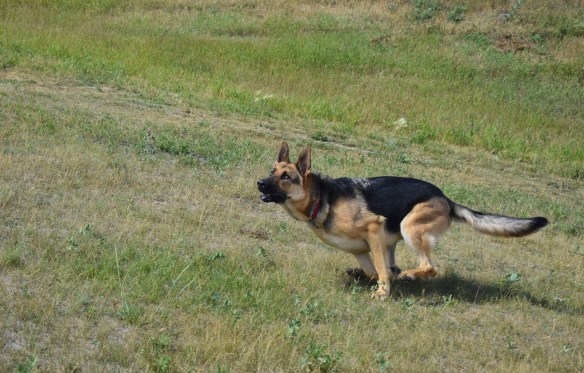
Milo’s a pretty intense chaser of things.

But what about second order desires? Can Milo want to want something?

He has conflicting desires. For example his desire to chase things and please me almost always conflict. You can see this in his behavior. When I ask him to sit in the absence of anything ‘chaseable,’ he plops his bum down and looks up at me with soft eyes. He is alert and relaxed.

When I ask him to sit while a skateboard whizzes by, he sits but hums with tension. His whole body focuses on the potential chasee. Hips tense like a runner in the starting blocks. One paw lifted anticipating his first bound. If I released him, he’d be off like a rocket. But, he restrains himself, because I ask him to.

He and I do all sorts of exercises to help him learn self-control, and you can frequently see him wanting to do something, and not doing it.

But, wanting two conflicting things, or wanting something and not acting on that desire, can be different from having a second order desire. I doubt Milo is thinking anything like, “Boy, I sure wish I didn’t want to chase that dude on the skateboard.”

However, if I consider Milo and me as a unit, I am the part of that unit with the second order desires. In other words, I think that MY desires can play the role of second order desires for Milo and here is where his vulnerability and my responsibility come into the picture.

Humans foster first order desires in dogs in lots of different ways:

  1. Herding and hunting dogs are bred to be biddable. A biddable dog wants to please its handler. A dog bred to work with a person to herd livestock needs to figure out what its person wants it to do and do it. Milo is biddable—he wants to please me—in large part because he’s a German Shepherd Dog, and through careful breeding, humans made German Shepherd Dogs biddable.
  2. Milo and I have a healthy relationship. I took a workshop from a hardcore Schutzhund trainer, and she commented, “He really loves you.” What a great compliment! I work hard on Milo and my relationship, which isn’t difficult because he’s an angel. We love and respect each other. This relationship contributes not to his general biddability, but to his biddability to ME. I nurtured his first order desire to please ME.
  3. Training a dog involves manipulating its desires. In all strictness, I don’t train Milo to sit. I train him to want to sit when I tell him to. I pay close attention to what he values, and by controlling his access to those things, I can make him value other things.

Here’s how all this plays out. Milo has first order desires to please me and to chase skateboards. I have first order desires for chocolate cake and for Milo NOT to chase skateboards. So, if we think of the two of us as a unit, he and I both individually have first order desires. Additionally, I have second order desires for both of us, and I can manipulate Milo’s first order desires. I am the one who wants him to want things. I can make him want to sit more than he wants to chase.

Vulnerability and responsibility.

Sometimes we humans manipulate dogs’ desires to make them perform dangerous work. Police dogs, military dogs, and even search and rescue dogs put their lives on the line for us.

I don’t put Milo in danger, in fact, most of his training is to keep him safe, but I do manipulate his desires. I don’t just have the power to confine him physically. I have the power to confine him psychologically and emotionally, not with harsh punishments, but by controlling what he values, and what he desires.

I have to admit that he trains me as well: how can I not desire to scratch his head when he lays it on my lap and looks up at me with his big brown eyes? But when I train him I have science, coaches, and 150 years of selective breeding on my side.

This makes him vulnerable to me, which is a responsibility that I take seriously.


Staying safe on winter walks

v5

Milo loves the snow

While there are things that worry me about walking with Milo in the Canadian winters, the cold isn’t one of them. With good gear and common sense, the cold is not that hard to manage. Besides, Milo loves it, or at least he loves the snow. He frisks like a puppy when he sees the white stuff falling. But I do worry about

  • slipping on the ice,
  • Milo hurting his paws, and
  • getting hit by a car.

Here’s how I minimize those risks:

To protect myself slipping on icy streets I wear Yaktrax, which are traction devices that attach to the soles of your boots. I like this brand because they tend to stay attached and they’re not sharp, so you won’t accidentally cut yourself (or your dog).

I apply Musher’s Secret, a good paw wax, to Milo’s paws before we head out. This protects him from sharp ice and rock salt, and slows down the build-up of snow between his toes. It is worth the cost because I want him to be comfortable and the thought of restricting Milo’s exercise while his paws heal makes me shudder.

v2

Please drive carefully!

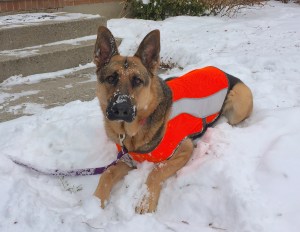
In my part of the country and in my neighborhood, drivers speed. Although this sort of irresponsible behavior makes me angry, it actually makes me furious, aside from shaking my fist there is not much I can do. Add slippery streets and the fact that in midwinter it’s dark by 5 PM, to the scofflaw speeders, and walking in my residential neighborhood becomes downright dangerous. Milo and I both have dark coats, so I put a reflective vest on him, and I wear a blaze orange touque. When people see us, they might think we look bizarre, but at least they see us! Milo loves his vest because it reliably predicts a winter walk.

BTW, as I was working on this post, I came across a similar article over at Maplewoodblog.  You should check out how she manages her winter walks. Hint: she likes Musher’s Secret and Yaktrax too.

What do you do to keep safe on your winter walks?


Animals in our lives: A philosophical investigation of the science of companion animals

I am terribly pleased to announce that I’ll be teaching Philosophy 271: Animals in our Lives, a new course offered by the Philosophy Department at the University of Waterloo in Ontario, Canada.

This class is a philosophical analysis of contemporary scientific research on companion animal (mostly canine) cognition, emotion, and training.

The students and I will explore:

  • how this scientific research is embedded in contemporary culture,
  • the practical influences on, and impacts of, this research, and
  • the role of values and ethics in the creation and use of this new scientific knowledge.

I’ll keep you posted as I develop and implement this course. I am So. Excited.

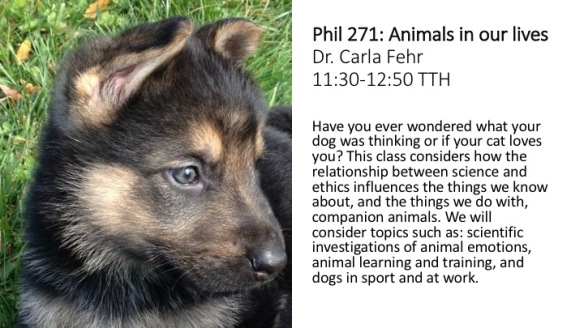
Phil 271 Animals in our lives

Learning how to play fetch with Milo: We only play games we both want to play!

Generally, a game of fetch involves a person throwing a ball, and a dog running after it and returning it to the person. Imagine my surprise when my Fitbit informed me that I walked a kilometer and a half during a short game of fetch. It seemed Milo and I were doing this wrong.

So, the next time we played fetch, I pretended to be an anthropologist observing this game while we were playing it. “What are these strange creatures doing with that round yellow thing on a string?”

I observed that Milo and I weren’t playing one game, we were playing two. The first game looked a lot like fetch. He’d go chasing after the ball and bring it back to my general vicinity. The second game included two things he loved: hanging onto the ball and being chased by me.

pls throw

The trouble is that while Milo loves both games, I only want to play the first one. That clever, clever dog had me playing a game I had no desire to play. Hmmm.

Here is what I did:

I made up some rules for our game.

  • I throw the ball. If he brings it back to me and stays close enough for me to grab his collar, I throw a little happy party for him and immediately toss the ball again.
  • If he doesn’t bring it back to me and stay close, I go get him. But when I go get him, I quietly snap on his leash and we walk off the field for a couple of minutes.
  • His choice: play fetch by the rules, or not play at all.

Within 40 minutes, he was choosing to play by the rules. I was shocked at how fast this happened.

I noticed a neat thing when he started playing by the rules. He’d bring the ball back to me, and then move his head, or move one front paw, like he was starting the Keep-Away Game, and then he would stop and settle back down right close to me as I grabbed his collar. His conflicting desires were revealed by those small movements. I would love to know what it was like for him inside his doggy mind as he stopped himself from making a choice that would not get him what he wanted.

Here are some things I am going to try to remember from learning how to play fetch with Milo:

  1. I need to stop, watch, and think about Milo and my interactions.
  2. It is good to take a bit of time to make a plan.
  3. Milo and I will only play games that we both want to play.

handsome Milo


Gift ideas for people who love dogs (and science)!

Books! Books! Books! I went from being a shy nerd in high school to being a proud nerd in university. I loved university so much that, except for one mercifully short semester waiting tables, I never left. Proud nerds like to give and receive books. I haven’t read all the books that about dogs and science, but I’ve read lots of them. Here are some that would make good gifts:

My top pick:

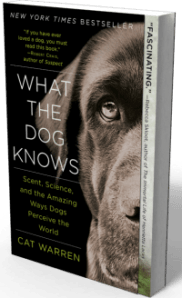
what the dog knowsWhat the Dog Knows: Scent, Science, and the Amazing Ways Dogs Perceive the World, by Cat Warren
What the Dog Knows is one of those books that you sit down to read for half an hour, and suddenly three hours have gone by, you’re starving, and it’s dinner time. It’s a page-turner about working dogs who use their sense of smell for a living. Cat Warren, a journalist turned university professor, guides us on a tour of the science of the canine sense of smell, the history of scent detection and tracking, and the practice of training and working with dogs by telling the story of searching for dead people with her cadaver dog, a German Shepherd named Solo.

Runner-up:

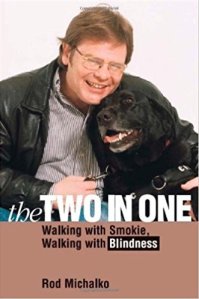
the two in oneThe Two in One: Walking with Smokie, Waking with Blindness, by Rod Michalko
This memoir documents sociologist Rod Mechalko’s changing understanding of his own blindness through his relationship with his service dog, Smokie. Although there are places where this book can be a very dense read, it is also touching, and at times funny.

Stranger: Is that one of those blind dogs?

Mechalko: “I hope not!”

The story of the developing trust and respect between this scientist and his dog changed how I think about working guide dogs. And, Michalko’s changing relationship with his blindness made me think about disability not as a lack or absence, but as a different way of being in the world.

Third place:

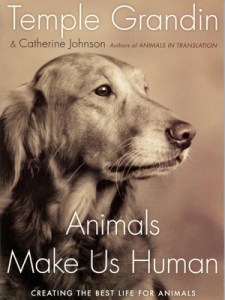
animals make us humanAnimals Make Us Human: Creating the Best Life for Animals, by Temple Grandin and Catherine Johnson

As usual, Grandin encourages us to pay close attention to the creatures around us. With clear and concrete prose the authors explore the emotional architecture of different kinds of animals to figure out how to maximize their emotional welfare. There are three things that I especially love about this book. First, the authors respect both scientific and practical experts in animal behavior and combine insights from both groups of people. Second, this book highlights the work of field scientists, and the importance of keeping science open to researchers with a wide range of experiences, perspectives, and skills.  Finally, this book is premised on the notion that humans are animals too. The authors use their emotional framework to advocate for creating environments that encourage humans to treat animals in ways that maximize animals’ emotional well being. That is clever and demonstrates an interesting sort of integrity.

Tied for fourth place:

How Dogs Love Us: A Neuroscientist and His Adopted Dog Decode the Canine Brain, By Gregory Berns

The Genius of Dogs: How Dogs are Smarter than you Think, by Brian Hare
how dogs love usThese books offer the reader a glimpse of what scientists actually do. Gregory Berns offers a fascinating discussion of the research ethics involved in training pet dogs to participate in fMRI experiments. He treats his canine research subjects with the same ethical consideration that is mandated for research with human children. Cool.

the genius of dogsWhat grabs me most about Brian Hare’s book is that he doesn’t just explain his experiments, he explains how he developed those experiments and why he ran the experiments the way he did. Reading this book can help a person understand how to think like a scientist. These two books aren’t written with the same grace as my top three picks, but they are both good picks for people who want to think about science and ethics as well as learn something about canine cognition and emotion.
What books would you add to this list?


This blog is about RV travel, dogs, and science.  Here is my RV travel-themed gift list, and here is my German Shepherd Dog-themed gift list. Happy holidays!

Gift ideas for German Shepherd lovers

Are you having trouble coming up with gift ideas for the German Shepherd lover in your life? Here are some possibilities:

Gifts for the dog.

Love me, love my dog. When people buy my dog Milo presents, I find it adorable. What to get though?

Dog treats and chews! Just remember that GSD’s can have finicky stomachs, so it’s a good idea to snoop around and see what your friend usually gives her dog. Or, you can ask for her advice on good treats and chews, and she’ll likely tell you all you need to know.

  • Bully Sticks are great chews but can be pricey, so they make a great gift.

Toys! My dog is a pretty typical GSD in that he goes through toys like a wood chipper and so new toys are always appreciated. If you like the person, avoid squeakers!

Consumables. 

Admittedly these gifts are utilitarian instead of romantic. But a dog lover can always  use things like:

Coupon book for dog chores.

To have a German Shepherd is to love a German Shepherd, but these dogs are a lot of work. One gift idea is to make a coupon book for dog chores that you’re willing to help out with. Warning, this only works if you have zero responsibility for the dog. It’s not a gift if it is something that, in all fairness, you should be doing already. Here are some ideas for the coupons:

  • Walk dog on a cold day
  • Walk dog on a rainy day
  • Clean up poop in the yard
  • Bathe dog
  • Dremel dog’s nails
  • Vacuum furniture
  • Vacuum house
  • Vacuum the car

German Shepherd themed stuff.

German Shepherds are the second most common dog breed in North America, and our make-a-lot-of-junk industrial complex has capitalized on this fact. You can buy German Shepherd themed everything–seriously you can find pictures of German Shepherds on everything from pot holders, salt shakers, and coffee mugs, to leggings, hats, and hoodies, to keychains, mousepads, and Christmas tree ornaments. Type “German Shepherd” into the search fields on etsy.com or amazon.com and you’ll have more ideas than you can throw a stick at.

Why not get a cute German Shepherd tote bag, and fill it up with all sorts of fun doggy things?

Walking in a winter wonderland.

German Shepherds take their people on long walks in all sorts of weather. Anything that takes the sting out of cold winter walks will be appreciated: gloves, hats, scarves, socks, insulated coffee mugs, you get the picture.

Jewelry.

It is easy to find all sorts of GSD themed jewelry. Most of it is cute, but much of it is of questionable quality. Remember that you get what you pay for.

What about a locket with a picture of your friend’s dog in it? eBay always has an excellent selection of lockets that won’t break the bank. And if you have money to burn, you can’t go wrong with Tiffany’s!

Photos from the heart.

Do you have a great shot of your friend and their dog? If you do, put it in a frame and wrap it up! You could also find a high-quality pet photographer in your area and treat your friend to a professional photo shoot.

Worst Present EVER.

Are you a risk taker? Some people call German Shepherds “German Shedders.” These dogs leave clouds of fur, all over the house, all year long. If you’re brave and have zero romantic hopes about the dog lover in your life, you might consider giving them a vacuum.

What items would you add to this gift list?

This blog is about RV travel, dogs, and science. Click here for my RV travel-themed gift list and stay tuned for my science-themed gift ideas 😉

Shaking dogs: It’s Physics!

There are lots of neat slow-motion videos of dogs shaking. But this one is probably the best. Why? Because it features David Hu, a mechanical engineer from Georgia Tech, who explains his research on shaking dogs AND how that research can be applied to all sorts of things ranging from solar panels, to cameras, to planetary rovers (OMG, this pun just made itself 😀 ).

The video is 2 minutes long. Don’t let the mouse in the first frame deceive you, it’s about dogs. It really is full of adorable shaking dogs.


This is a great example of scientific research with applications that wouldn’t, at least immediately, come to mind for most of us.

To some people, research on dogs seems wasteful.

But, research on canine health has resulted in huge improvements human health and human medicine. And David Hu’s research on shaking dogs, a topic that at first glance seems whimsical and even silly, could someday help us humans explore other planets.

Shaking dog

Thanks buddy!

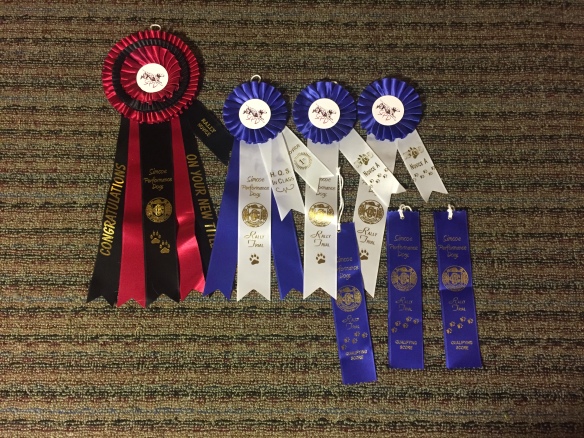
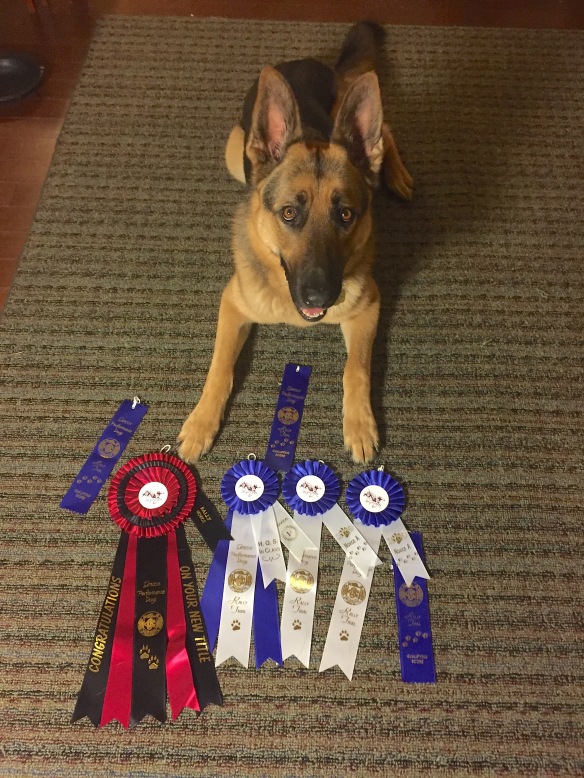
Who’s got four paws and a CKC Novice Rally Obedience Title?

THIS GUY!

12


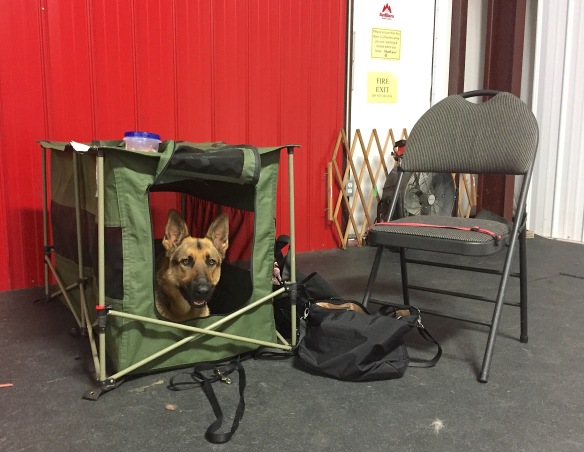
We arrived early and got a good spot in the corner. This is where we hung out between runs, and where Milo rested while I walked the courses and chatted with the other hoomins.

boy's home

Milo, chilling out between runs.


Can you believe that he earned all this bling? I might have to make a quilt or something.bling c


And here is my angel from heaven barely resisting tearing off this his ribbons.

bling a

I am very proud of my boy! ❤


White Lake Provincial Park, Ontario: Home away from home

White Lake Provincial Park felt so much like home, or at least how I’d like my home to be, that I extended my stay.

First of all, it smelled good. You have no idea how important this is when you’ve spent three months sharing 144 square feet of living space with a 90-pound dog. The campground, like the rest of the park, was full of pine trees, and smelled nice and piney—not Pine-Sol piney, it just had the sort of fresh crispness that invites a person to take a big stretch and a deep breath.

view from the beach

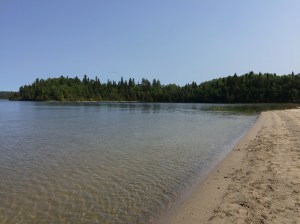
Here is the view from the beach.

Second, although the campsites were all very private, the campground felt like a little community. There’s a big gold mine near the park and a lot of people who work in the mine set up a seasonal campsite at White Lake—it gives them a shorter commute and they can go fishing every night if they like.

I enjoyed the fact that folks knew each other and chatted on the paths and in the laundry room. And because they had to get up in the morning to go to work, the place was quiet and calm at night. These are my kind of neighbours. I got a lot of writing done at White Lake.

white lake beach

That is some good sand!

Third, the lake is sandy, clean and clear, and is an outstanding place to take your dog swimming. Dogs are allowed off-leash at the boat launch. When I let Milo the AwesomeDog out of the truck, and he saw that in addition to the lake, there was a dock, he spun in circles and jumped for joy. Let’s just say that he is fond of dock diving.

And finally, Milo wasn’t the only mischievous critter in the park. There were signs on all the bulletin boards warning of a meddlesome fox, who was sneaking around stealing shoes. I was a bit was sorry not to get a chance to see Ms Fox and wish I had some old shoes along that I could’ve given her for keeps.

meddlesome fox sign

I am NOT the rogue copy editor.

I was sad to leave this park. It felt like home.


Life with a recovering reactive dog​: Part two

Note: This is part two of a two-part post. Click here to read part one.

Now.

A couple of months ago I signed Milo and me up for a research project investigating canine fear and aggression in veterinary settings. I jumped into this survey eagerly, sure that Milo’s jackassery would provide them with some interesting data. They wanted to know about dogs acting out, and boy could tell them about a dog acting out.

I don’t think I was ever so pleased to be so disappointed about an experiment.  You see, the survey questions all had a time index.


What sorts of fear behaviour did Milo exhibit at his last vet visit? None.

During that visit did he show any aggressive behaviours when:

  • Getting weighed? No.
  • Touched? No.
  • Vaccinated? No.
  • Having his ears examined? No.
  • Having blood drawn? No.
  • Having his temperature taken? OK, Yes. He growled at the vet tech when she tried to stick a thermometer up his bum. Fair enough. We didn’t get a temperature that day.

If those questions were about my worst vet visit or any vet visit three years ago, the answers would have been different. When I sat down to take this survey, I was ready to give those three-year-old answers. But, in the last three years Milo, and I, have changed. He’s a more confident dog. I’m a calmer person. And we’re a stronger team.

I caught myself living in the past again when Milo and I were camping at Killbear Provincial Park. Our campsite was beside what must have been an intergenerational, extended family camping trip. There were at least seven children under the age of five, they yelled a lot, and all of them, except the newborn, seemed to think that running while yelling was the thing to do.

Screaming creatures darting around—the kind of game that Milo was always keen to join, except that he weighed more than any three of those kids combined. I steeled myself for a couple of days of barking and a complaint from the Park Office.

Would you like to know what happened?

Nothing.

Milo started staring at one of the kids, and I told him to knock it off and that we don’t bark at silly things. He knocked it off and did not bark at the silly things. There were a bunch of people with dogs at that campground. And every single dog that walked by reacted to those children more than Milo did, every single one.

People came by my site and complimented Milo on being such a good boy.

One person even told me that I was “lucky” to have such a good dog. I let that one slide on by.

I will always be careful and respect the fact that Milo is a formidable animal. We’ve done a tremendous amount of work together over the years, developed a fantastic relationship, and things got better.

I love him to distraction. I just have to remember to love the dog he is right now.

2