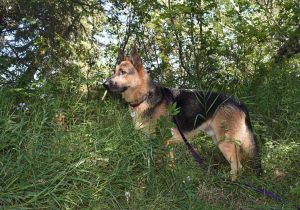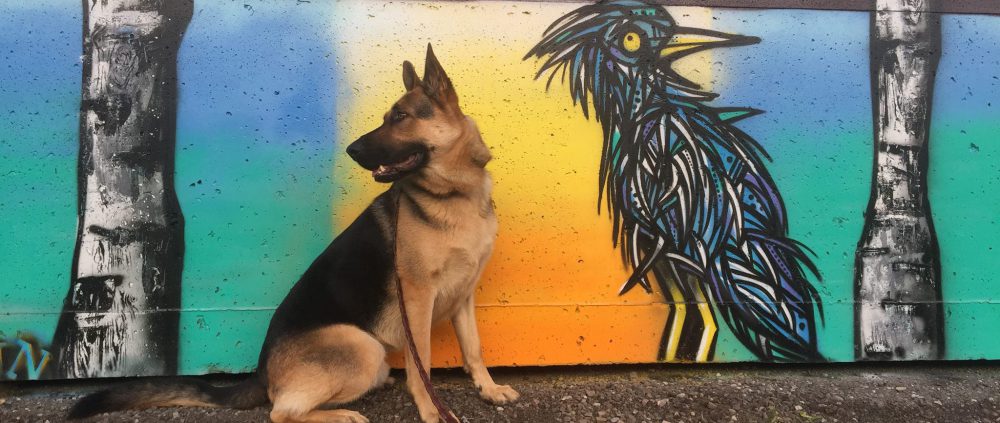
Life with a recovering reactive dog​: Part one

Note: This is the first half of a two-part post.

Then.

The damn snow was dragging at my feet, and I knew I wasn’t going to make it to my car before I started to cry. Milo and I were not at our finest on that winter day more than three years ago. Fifteen dog-handler teams had arranged themselves in a big circle on a snowy country field, and we were taking turns walking our dogs around the group. The idea was to keep your dog paying attention to you, and not to the other dogs or people or bunnies in attendance. The accomplished teams heeled with quiet precision around the field. But most of us newbies kept our dog’s focus with a steady stream of happy chatter. We could have used food treats for this, but it is hard to hand out treats when wearing mittens and it was cold enough that mittens were mandatory.

Milo and I were doing fine until another male gave him a glance that asked: “Wanna dance?” Milo looked back: “Sure, let’s go.” And off came the gloves. The other dog snarled. Milo lunged. My feet broke through the crust on the snow, and I was stuck.

It all took a very long heartbeat. Friends swooped in to take care of Milo, and I clambered out of my hole. Everything was OK, except for my blood pressure and my pride. This was life with a reactive dog. It just took a wrong look. He didn’t fight. I saw to it that Milo never got into a fight. But both of us were bundles of stress.

Milo and I retreated to an adjacent field where we could cool down. We played a bit, did some obedience, and practised calmly watching those other dogs from a distance. I’d been working on Milo’s reactivity for a while already, but this exercise was a bit too much and a bit too soon.

What put me in tears that afternoon wasn’t just Milo’s reaction, it was the supportive kindness of the people around us. We were training with the Kitchener-Waterloo German Shepherd Club. These people know GSDs, and many of them went through similar challenges with their pups.

After a few minutes on our own, the club president came over to check on Milo and me.

“We’re going to work on recalls now, do you and Milo want to join us?”

“Really? Seriously?”

“Sure, we’re all paying attention. It will be fine.”

It was more than fine. Milo was perfect. I left him with another handler at one end of the field, ran about 30 metres away, and called him. They released him, and he was in flight, skidding into a beautiful sit in front of me. Folks cheered.

As we were packing up for the afternoon, one by one, people came up to me. They said things like:

  • “It gets better.”
  • “He’s a beautiful dog.”
  • “I’ve been there, and I know it’s hard.”
  • “Good for you for working so hard with him.”
  • “Half a dozen dogs here used to react like that, and look at them now.”

I needed this support and encouragement, but darn it, I was at the end of my rope, and I knew this kindness was going to make me cry. I just wanted to get to my car before I lost it.

IMG_0126I was in an all-positive obedience class at the time, and someone there asked me if Milo was abused as a pup. That question took the wind right out of my sails. I adopted him at eight weeks, and his ‘abuse’ was patience, loving-kindness, and outrageously expensive grain-free food.

When Milo and I went on walks, I took to telling people that I was rehabilitating him. The phrase turned many frowns to smiles. After all, rehabilitating rescue dogs was god’s work. It was not a lie. I was rehabilitating him. I didn’t tell them he was a rescue; I just didn’t tell them he wasn’t.

Milo and I worked hard to get his reactivity under control. We went on weekly pack walks with the German Shepherd Club, I learned about counter-conditioning and desensitisation, and I worked on keeping control of my own emotions. I had to be calm to help him be calm–this it turned out, was the most difficult part of the whole procedure. I started working on obedience and scent detection with him. These sports taught him self-control and were something positive, fun that we could excel at together. Both of our confidence soared. He is a smart and biddable dog and was always a joy to work with, in isolation.

Things were slowly getting better, but they weren’t where I needed them to be until a fellow German Shepherd Club member and friend recommended that I take Milo to the trainer who helped her reactive dog. Finally, I found a trainer who understood Milo. It sounds simple, but she taught me not to permit Milo to be, what I have come to call, a jackass. We didn’t do anything dramatic or mean; I just learned to hold him to a set of high standards and how to properly handle such a big, strong, and strong-willed dog.

This whole process took about two years. Milo is a different dog now, but sometimes I forget how far we’ve come.

IMG_5095

Click here for the rest of our story and to see where we are at now.
RV life with a 90-pound dog: The bathroom

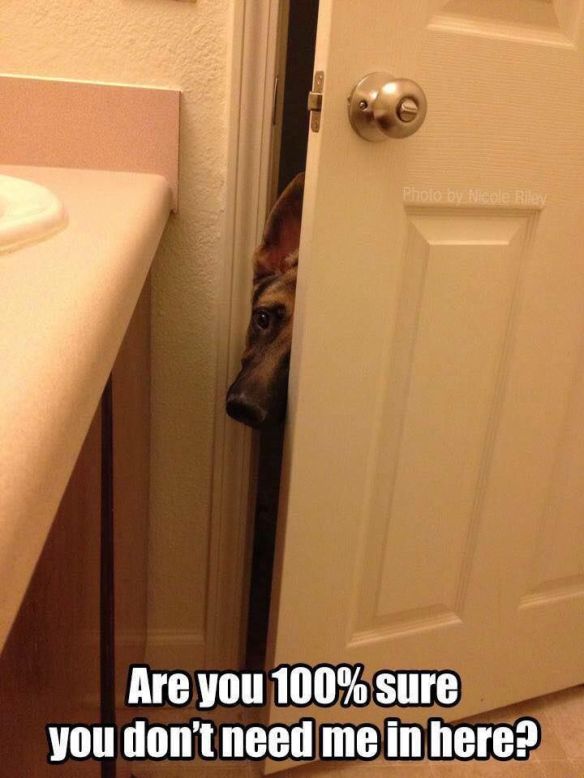
Loyalty can have its drawbacks. Milo, being a typical German Shepherd, doesn’t want many friends, but the few he has he loves deeply and keeps close. Really close. All the time.

If I discover that someone is a German Shepherd guardian I can count on three topics of conversation because these dogs shed clouds of fur, were adorable as they grew into their ears, and don’t understand why people close the bathroom door.

dog in bathroom

Milo is no exception. Sometimes I’ll be in the shower, and he’ll just poke his big head in to say:

Just checkin’ that you’re OK. Everything alright? You sure? I’m gonna sit down right here and keep you safe. By the way, you know you’re not gonna smell like nothin’ when you get outta there right? I mean it’s your choice, but it takes a while to get a good smell cookin’ and you’re gonna have to start all over again now.

To avoid this constant bathroom company, you can, of course, close the door.  But you are going to trip over him as you’re leaving. Is he guarding? Is he lonely? After all, you were in there for minutes and lonely dogminutes. Is he just blocking cold drafts? Who knows. But, he will be right there.
My travel trailer has nine square feet of bathroom space. There’s not enough room for Milo to lay down. So, for someone camping alone you’d think that the primary purpose of the bathroom door would be to hide the loo from view when it’s not in use.  Not if you have a German Shepherd.

“Watch ya doin’ in here?”

“None of your business.”

“Want some company?”

“No.”

“I bet you actually do.”

“No, Milo, you won’t fit.”

“Sure I will. Watch. I’ll just back in over here, like this, humph.”

“Seriously Milo, get out.”

“Just a sec, I think I got it. Now I’m gonna skootch sideways like this, and wiggle my back end this way, and my front end that way.

“Milo, you’re testing my last nerve.”

“Wait, I almost got it. One little hop. There! Done! You see, no problem. We’re both in here. And we even get some lap time.”

Of course, training is an option, but it would require that I not laugh. I’m just glad he can’t open doors.

Kakabeka Falls Provincial Park: Great for people, stinky for dogs

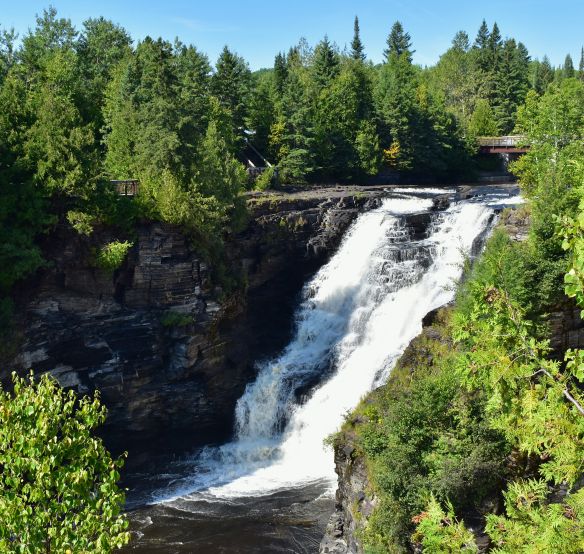
In Kakabeka Falls Provincial Park the Boardwalk and Portage Trails offer spectacular views of the falls, and even when you can’t see them, their gentle murmur follows you as you hike.kakabeka 1 These trails are cleverly integrated into the landscape in a way that invites you to notice the waterfall, not the path or the people. The people we did meet were vocal about Milo’s handsomeness and good manners, which is enough to make me love walking barefoot on hot city pavement. Add lovely scenery to this sort of Milo admiration and you, or at least I, are in store for a pleasant afternoon.

kakabeka 2

The park has a dog beach/ off-leash area on the river above the falls. There is a people beach as well. The people beach is unremarkable, and the dog beach is icky. Milo left tracks three inches deep in smelly mud, slimy algae (I hope it was algae) clung to the entire shoreline, and the water was not deep enough to wash any of that green muck off. Milo and I walked there, took one look, and left. This did not please Milo in the slightest. He wanted to swim. Mud, slimy scum, stinky water–for him they are features, not bugs. I tried to convince him that he should blame the beach rather than me for his unfulfilled desire to swim, but he was too irritated to listen to reason.

danger at kakabeka

“Danger!” It means nothing to Milo the AwesomeDog, literally.

It is easy to get to Kakabeka Falls, the park is just outside of Thunder Bay, and the Trans Canada Highway runs right through it. If I were visiting again, I wouldn’t camp. I’d buy a pass and spend an afternoon checking out the falls and the trails. This park made me feel a little bit like Chevy Chase at the Grand Canyon because really, there is only so much time you can spend looking at a waterfall.

Fitness and flourishing: The benefits of attending to your dog’s mental health

They say that a tired dog is a good dog and, generally, they’re right. This is a little bit concerning because although this summer with its camping and hiking and swimming has been good for both of us, Milo is getting physically fitter than I am. Each day the gap between what I can do to tire him out and what it takes to tire him out gets a little bit wider.

tired dog

Milo and I have been camping for 11 weeks now. He started out strong and is getting stronger–swimming more days than not, playing a vigorous game of fetch on most days, and hiking almost every day. He’s a great big muscle with outstanding endurance.

I’m sure I’m much fitter now than I was at the beginning of this trip too. First of all, Milo never hikes alone. Many hikes have the word “lookout” in their name. I guess people like a view, and you need high ground for that sort of thing. So, lots of this summer’s hikes involved an uphill trek. I grew up in a part of Canada that’s so flat that people say you can watch your dog run away for three days. As a result, whenever I put on any vertical metres it feels like a serious (and somewhat exotic) workout. It seems like I’ve been walking uphill all summer, and I’ve noticed that it takes more to get me huffing and puffing than it used to.

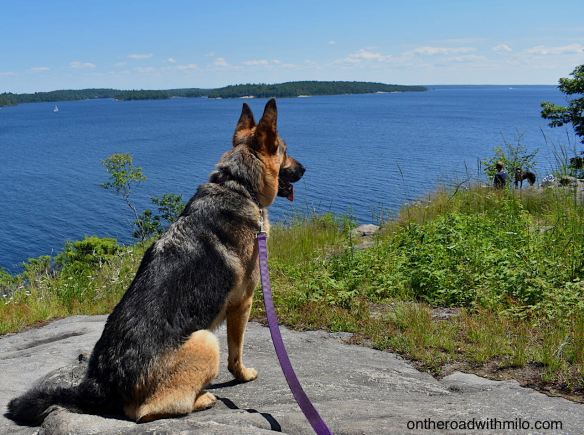
German shepherd sitting on a rock looking out over a deep blue bay

Milo at Lookout Point.

There are other ways my daily activity has increased. For one thing, Milo and I travelled across the country which means I’ve hitched and unhitched my trailer many many times. Setting up the trailer involves deploying five, yes five, jacks, and none of them is electric. I’m getting some serious pipes.

Playing with Milo provides a good workout as well. When we play tug, there are times when I am yanking on my end of the toy as hard as I can. He is strong enough to pull me over, and I have to pull back. It is fun and exhausting and we’ve been doing lots of it this summer.

Except for my Fitbit saying that my resting heart rate is nine beats a minute lower than it was at the beginning of the trip, I don’t have a way to measure my increased fitness. But I know I feel good, and that is better than numbers.

However, even though I feel great, I get tired before Milo does, every single time we play or hike or swim. We are often a tired person and a slightly winded dog duo. This has not turned out to be a problem though because although it is true that a tired dog is a good dog, a mentally fit dog is a good dog too.

I’ve been thinking about physical fitness in terms of how much exercise it takes to make me and Milo tired, but fitness also includes mental fitness, or psychological well-being, or mental health, or whatever you want to call it. This summer our mental fitness has been improving in step with our physical fitness, and that helps him be a good dog and helps me be a good person.


German Shepherd laying on a grey rock.

Milo’s the good dog.


In addition to getting more exercise, we’ve been eating good food, spending time in nature, enjoying long hours of restful sleep, and experiencing very little stress. Milo has a guardian who is more centred, and I have a dog who is calmer. It seems like neither of us is sweating the small stuff as much as we used to.

For example, the last people who used the campsite we’re in right now left a week’s worth of stinky trash and recycling in the fire pit. That is the sort of thing that used to make me fume. But this time I just thought “some people make it easier to leave the place better than I found it than others.” It only took about 90 seconds to clean it up, and now I’m enjoying a campfire. Milo is laying on the ground beside the picnic table I’m using as a desk.  He’s keeping tabs on the neighbours, and paying attention to dogs walking by in a way that’s alert but relaxed. In other words, he’s being a German Shepherd Dog.

It’s not that he’s too tired to get in trouble, it’s that he is physically and mentally fit. His needs are being met and his life is full enough for him to enjoy being good–good in the sense of being well behaved, and good in the sense of flourishing.

This trip with Milo has helped make my life full enough to enjoy being good too!

Caliper Lake Provincial Park: Needs hobbits

I lived in North Carolina for six years, and while I was there, I dated a forester. He was cute, and a kind man, but (not and) was a bottomless well of tree trivia. I guess that my back porch offered a view of about five kinds of oak trees, as well as cedars, spruce, and pines and he was keen on teaching me all about these trees:

“Carla, what kind of tree is this one here? And this one? And that one?”

The trouble was that although my interest in the forester was high, my interest in the forest was low. To amuse myself, I developed my own tree taxonomy:

What kind of tree is this one?

Christmas tree.

What kind of tree is that one?

Not-Christmas tree.

Things didn’t work out with the forester.


As I was hiking along Caliper Lake Provincial Park‘s Nature Trail, I realised that I’d developed another binary taxonomic system, one didn’t involve passive aggressively needling a boyfriend. You see, I saw a spot and thought, “that spot there, would be a perfect place to have a second breakfast.” At that moment I realised that there were Elf forests and there were Hobbit forests and that I was in a Hobbit forest. What made it a Hobbit forest was the abundance of nooks and crannies ready-made for naps and picnics.


4

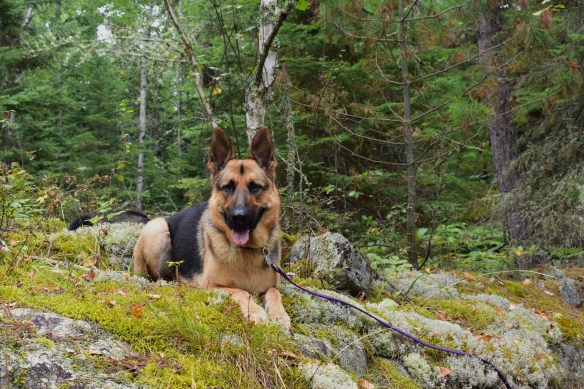
Milo’s good at finding comfy spots.


This second breakfast spot was a cosy cubby, nestled beside a boulder and blanketed with thick, soft, dark green moss. The sun shone through the leaves of a Not-Christmas tree, creating a dappled shade that promised good napping after breakfast.

This forest has trails winding through a thick understory. If you explore the Nature Trail, you’ll clamber over slippery rocks and scramble up a couple of steep hills, so wear good shoes. And bring a breakfast or two.


2

Although not a hobbit, Milo does enjoy a second breakfast.


Fall RV camping: Staying warm and happy

I’ve been living in my RV for 10 weeks now. I liked every day of it and I’m still happy to be on the road.

In June, when I packed for this trip, I had two comfort concerns: staying cool and keeping the bugs off.

It dropped down to four degrees Celsius last night. It being September, this is hardly unexpected. I saw my first yellow leaf of the season last week and today the trees around my campsite have yellow polka dots. It is beautiful, and sort of sad too since it signals the end of the season.

6

These four-degree nights mean that keeping cool and keeping the bugs off are no longer issues. Staying warm, however, is. I love comfort. I don’t need luxury, but a soft bed, good food, and a good book, all in a safe and simple space are important.

Here are three things keeping me happy during the September chapter of this trip:

  • A little electric heater. I have a ceramic one with a thermostat and it turns off if it gets too hot or tips. You have to use your common sense here and stay safe. Running it, even on a low setting, keeps things toasty when the temperature drops at 2AM. My RV has a furnace that heats the place up quickly. But it burns through a tank propane in a flash. For temperatures like these, that are chilly but not freezing, a little electric heater does a nice job.
  • Fleece. Right now, I’m wearing a fleece tuque, fleece socks, and a fleece sweater. Fleece is lightweight, soft, and dries fast. I also have fleece pjs. Yes, they make them and they are very cozy.
  • A large snuggly dog. If you have such a dog, and you let it sleep on your bed, you’ve got a personal, heartwarming furnace.

September is the month when you can see purple flowers and yellow leaves on the same hike.


Fall camping is great. No bugs, pretty leaves, fewer people, earlier nights for enjoying the stars and northern lights and camp fires, and cocoa tastes better when you wrap chilly hands around a warm mug.

2


All you need to keep warm and happy: a fleece tuque, a fleece sweater, and a big dog!


Keep warm and keep camping!

Riding Mountain National Park: It’s big

After being on the road with Milo for nearly eight weeks, I’ve turned us around and we’re meandering back to Ontario. This means we have to traverse Manitoba. I don’t have anything against Manitoba, but if I’m going to be on the prairies I feel like I ought to be at my Mom and Dad’s place in Saskatchewan. So Manitoba ends up being the province I sprint across. On Milo and my trip west, we spent a night at a truck stop outside of Winnipeg. On our way back east I thought it might be nice, instead of trying to sleep to the low rumble of a Peterbilt, to listen to some laughing loons. We traded a sleepless night at the Husky for a few days at Riding Mountain National Park.

black and tan German shepherd dog standing in profile against a green forestThe first thing to know is that Riding Mountain National Park is big. It covers almost 3000 square km, and has 400 km of hiking trails, a bunch of lakes, and a whole town where you can buy gas, groceries, and ice cream. There are also 14 million cabins. I didn’t actually count them, but if I had to guess I’d say 14 million. The developed part of the park feels like a resort. There is smooth pavement and clear signage, and flower arrangements mark the campground entrance.

Although the park is big, most of the people are in a tiny part of it. Happily, you don’t have to go that far to get away from them. As a result, the dog situation here is really different from other places I’ve visited. I asked at the guy at the campground kiosk about a dog exercise area. He looked at me like I was from Mars.

No there aren’t ‘off leash areas.’ Just go where there’s no people. Of course, you might wanna think twice because of the bears.

Well, OK then. It seemed like I’d have to use my own darn common sense.

The size of the park is overwhelming, almost paralyzing. It’s hard to know where to start, and so it’s hard to start at all. Milo is a big help here. He has to move, has to walk. So we just picked a direction, and went.

I was hoping for solitude and we found it right away. We discovered a warm, clear little lake and spent the whole afternoon playing in the water. By the way, then name of the place is actually Clear Lake.

Milo must have been a retriever in a past life, or maybe a seal. The dog just wants, even needs, to swim.

a

“What on earth is this toy doing just sitting here in the shallow water?”

Finding this spot made the first day of our stay at Riding Mountain a success.


Milo as GSD ambassador to Big Hill Springs Provincial Park

My sister, Ondrea, took Milo and me hiking at Big Hill Springs Provincial Park, which is just outside of Calgary, Alberta. You can learn more about the park by checking out her blog, Walking Calgary.

A gnarled stick with green moss on it.

After spending the entire summer with Milo, I’ve come to appreciate a pretty stick!

It’s always good to have a local guide, and even better when that guide is Ondrea! As you might guess from the name of the park, it has a big hill and a spring. Ondrea started us out on a steep ascent. This was smart because we got the difficult climbing out of the way right off the bat. Of course, Milo is always a big help on the uphill sections of hikes. I give him a little “hup, hup” and he gladly returns to the days of his leash pulling youth. This makes those steep grades easier for me and has the added benefit of pooping him out just a wee bit more.

As you might expect of a place this close to Calgary, there were quite a few people on the trail. Early in the hike, we passed a woman who froze, clearly terrified, when she laid eyes on Milo. I did what I always do on a narrow path or sidewalk. Milo and I took two steps off the trail and I put him in a sit-stay. As this poor woman slipped by, I made sure she could see that the leash was short and I stood between her and Milo.

school picBeing Canadian, and a woman, I apologized to Ondrea for making her wait for the 20 seconds it took to complete this manoeuver.
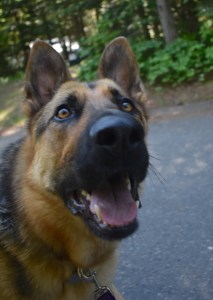
All she said, “I appreciate how considerate you are of how other people may react to him.”

That was a kind thing to say.

Even though Milo is the apple of my eye, I know that he is big and strong and can look scary. I also know that there are some irresponsible breeders who produced dogs with nervous and unstable temperaments, and that some German Shepherd guardians never learn to properly handle these powerful dogs. As a result, there are circles in which this breed has a bad reputation. I work hard to help people see that German Shepherds can be great dogs.

Every time Milo is polite, like he was on this hike, it is a win for German Shepherds in general. I try to help him be a first-rate ambassador for the breed.

When Ondrea noticed this, it made my day. And that good feeling stayed with me for the rest of our hike.

big hill springs

Big Hill Springs is full of pretty little waterfalls.

The tail end of the hike was wonderful. Ondrea ushered us along a gentle descent graced by a series of little waterfalls. The stream and the falls are fed by cold, clear spring water and we often stopped, watched, and listened to the water cascading alongside us as we walked down the hill.

If you get the chance, I recommend taking a couple of hours to check out Big Hill Springs.

It is lovely.

Our first Rally trial: Wish us luck!

Crazy Tails Canine Services is hosting a Canadian Association of Rally Obedience trial later this month in Saskatoon, Saskatchewan and Milo and I will be in it!  It will be our first trial.

headshot of a black and tan German shepherd with bright amber eyes and a big smile

Hey guys, I’m going to a CARO trial!

It feels like this roller coaster is just about to head down that first breath-taking plunge and Milo, silly boy, is laying at my feet snoring—it’s probably a good thing he doesn’t realize just how exciting this is or he’d be pacing around looking for what’s got me all aflutter.

We have two weeks to get ready and we’ll need it. There are three organizations with sanctioned Rally trials in Canada: the Canadian Kennel Club Rally, the United Kennel Club Rally, and the Canadian Association of Rally Obedience (CARO). The rules and exercises are a little bit different for each organization, and CARO is the one I’m least familiar with. I’ll try to line up a lesson or two before the trial just to make sure that we’re on target.

By the way, Saskatoon is my home town, and there is a good chance that my family will come out and see Milo and I strut our stuff.

If you have any advice for our first trial I’d love to hear it.


Training outcomes July 25 – August 2: We know the novice rally signs

Milo and I spent the last week heeling through figure eights, and weaves, and spirals. I am happy to report that we can do all the Novice Rally exercises and I can read all the signs.

The biggest challenges for me will be keeping track of our left and right turns (I’m not joking) and remembering to speed up when Milo starts to lag. This feels backwards. When Milo starts to slow down my tendency is to slow down as well and tell him to hustle up. But, he catches up more quickly if I ignore him and walk faster.

I’ve heard people give different reasons for why this works. Some say

  • that it adds more forward energy to the exercise,
  • that the dog doesn’t want to be left behind,
  • that it makes the exercise more interesting for the dog, or
  • that the dog imitates the handler.

All that I know is that if I slow down, he slows down even more, and that if I surge ahead, he’ll break into a trot to keep up. It’s a case of do as I do, not as I say.

I wish I had video of me and Milo. In my imagination we look like this team when we go through a serpentine weave: