Please, leash your … children

Over the last four days, three children have charged Milo. They squealed, threw their arms in the air, and ran, full tilt, right at him. In the olden days, this is when natural selection would happen.

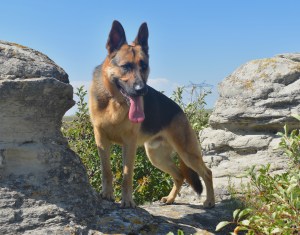
back and tan German Shepherd Dog standing on a rocky outcrop against a blue sky

This is Milo, the dog those children charged.

These situations turned out OK because Milo and I have practiced staying calm around children. I kept the kids off Milo and Milo under control, but those kids gave him a fright. He barked at one of them (so did I actually) and the parent gave me the evil eye as they collected their progeny.

I am proud to say I adulted very well. I ignored  the parent and put Milo through a little obedience routine. I wanted him to remember that although kids can be irritating they are not a big deal, and that he and I have more interesting things to do than attend to them. I also wanted the parent to see that Milo is a serious and well-trained dog.

It is common to be more strongly influenced by bad events than by events that make you happy, so common in fact, that psychologists have named the phenomenon. They call it negativity bias. I bet Milo and I have met hundreds of kids and hundreds of dogs on this trip and that most of them were perfectly fine. However, my memories of the good interactions are not nearly as strong as my memories of the bad interactions.

And you know what? Dogs dogs suffer from negativity bias too. The kids who disrespect and frighten Milo are going to make a disproportionate impression on him. Just like negative interactions are more likely to stick in your mind, they are also more likely to stick in a dog’s mind. A bad experience with a child can make it more difficult for a dog guardian to nurture a dog who is friendly and behaves well around children.

The bottom line is that if you happen to have access to a child, Milo and I would be very grateful if you taught them how to respect dogs. This makes it easier for people like me to teach our dogs to respect children.

To learn more, check out the American Society for the Prevention of Cruelty to Animals webpage where you’ll find information about how to respect dogs and help children and dogs live well together.

Milo as GSD ambassador to Big Hill Springs Provincial Park

My sister, Ondrea, took Milo and me hiking at Big Hill Springs Provincial Park, which is just outside of Calgary, Alberta. You can learn more about the park by checking out her blog, Walking Calgary.

A gnarled stick with green moss on it.

After spending the entire summer with Milo, I’ve come to appreciate a pretty stick!

It’s always good to have a local guide, and even better when that guide is Ondrea! As you might guess from the name of the park, it has a big hill and a spring. Ondrea started us out on a steep ascent. This was smart because we got the difficult climbing out of the way right off the bat. Of course, Milo is always a big help on the uphill sections of hikes. I give him a little “hup, hup” and he gladly returns to the days of his leash pulling youth. This makes those steep grades easier for me and has the added benefit of pooping him out just a wee bit more.

As you might expect of a place this close to Calgary, there were quite a few people on the trail. Early in the hike, we passed a woman who froze, clearly terrified, when she laid eyes on Milo. I did what I always do on a narrow path or sidewalk. Milo and I took two steps off the trail and I put him in a sit-stay. As this poor woman slipped by, I made sure she could see that the leash was short and I stood between her and Milo.

school picBeing Canadian, and a woman, I apologized to Ondrea for making her wait for the 20 seconds it took to complete this manoeuver.

All she said, “I appreciate how considerate you are of how other people may react to him.”

That was a kind thing to say.

Even though Milo is the apple of my eye, I know that he is big and strong and can look scary. I also know that there are some irresponsible breeders who produced dogs with nervous and unstable temperaments, and that some German Shepherd guardians never learn to properly handle these powerful dogs. As a result, there are circles in which this breed has a bad reputation. I work hard to help people see that German Shepherds can be great dogs.

Every time Milo is polite, like he was on this hike, it is a win for German Shepherds in general. I try to help him be a first-rate ambassador for the breed.

When Ondrea noticed this, it made my day. And that good feeling stayed with me for the rest of our hike.

big hill springs

Big Hill Springs is full of pretty little waterfalls.

The tail end of the hike was wonderful. Ondrea ushered us along a gentle descent graced by a series of little waterfalls. The stream and the falls are fed by cold, clear spring water and we often stopped, watched, and listened to the water cascading alongside us as we walked down the hill.

If you get the chance, I recommend taking a couple of hours to check out Big Hill Springs.

It is lovely.

The high cost of doggy weight loss

There are a lot of fat dogs out there. The rate of canine obesity, like the rate of human obesity, seems to be climbing. According to the Association for Pet Obesity Prevention 53.9 percent of dogs are overweight or obese, and the Canadian Veterinary Medical Association tells us that the most important thing we can do to lengthen our pet’s lives is to control their weight.

Our concerns about pet welfare easily transform into concerns about pet weight loss. So, perhaps it is not that surprising that human diet cultures and weight loss industries are reiterated with respect to our canine companions.

There are many things that we can do and buy to get a dog’s weight under control, and some of them sound a lot like things we can do and buy to get a person’s weight under control.

You might have heard of the Hollywood Diet, but have you heard of the Show Dog Diet? One article on the American Kennel Club webpage actually recommends the Show Dog Diet, which involves feeding your dog one ‘normal’ meal in the morning, and then feeding her low sodium green beans with a bit of kibble later in the day. After the initial weight loss resulting from feeding your dog beans this diet recommends that owners switch their dogs to commercial weight loss dog food. And there is a plethora weight control and weight loss dog foods to choose from– Science Diet, Royal Canin, Iams, Arcana, Purina One, the list goes on and on.

How can you tell if your dog is a healthy weight? Purina helps veterinarians and pet guardians alike make this determination with their Body Condition Score chart.

A chart showing pictures of dogs ranging from fat to thin from the top and side.

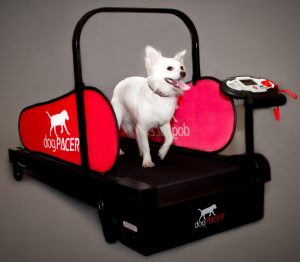
In addition to high quality, and high price, dog food pet guardians can also purchase exercise equipment for their fat dogs. If you have an extra thousand or so dollars laying around you can even invest in a treadmill for your pudgy pooch.

small white dog on a black treadmill with red rails.

We can also buy exercise equipment for our pudgy pups. Canine treadmills are often advertised as tools for canine weight control and obesity prevention.

After trying the diets, special foods, and exercise equipment, dog guardians can turn to pharmaceuticals to help their dog lose weight. “Doggy diet pills: Are they safe?” tells the story of Dirlotapide, a drug that “tricks [a dog’s] brain into feeling the dog is full after a smaller meal.” The article goes on to say that while taking this drug a “high-quality commercial diet is recommended” to ensure the dog gets adequate nutrition. It’s a good thing there are so many high quality commercial diets on the market. This article assures us that “side effects, if any, tend to be mild, and can include vomiting, diarrhea, and lethargy.” Other sources, however, tell us that “All pharmacologic weight-management aids should be considered short-term interventions, may have significant side effects.”

In addition to the products we can buy to help our dogs lose weight, there is a wide range of books available about how dogs and their humans can get thin and fit together. Wouldn’t it be a nice to spend an evening curled up with a bowl of ice cream reading Walk a Hound, Lose a Pound: How You and Your Dog Can Lose Weight, Stay Fit, and Have Fun Together?  

The special food, exercise equipment, drugs, and books all cost money. Some of them cost a lot of money. On one hand, if someone finds a way to separate rich people from their cash that’s fine with me. But on the other hand, I’m sad to see yet another way that a person’s income impacts the health of the creatures (both the humans and the nonhumans) in their lives.

Can stories about fat dogs hurt people?

I was snooping around the American Kennel Club website when I came across an article called “The Biggest Loser: Canine Edition.” Before I knew it I was scrolling through a set of ‘success stories’ of extreme dog weight loss; stories that included stats, before and after pictures, and heart wrenching personal narratives. The first pup was Denis from Ohio, who went from a hefty 56 to a svelte nine pounds. Before his weight loss we see a picture of Denis sitting alone, beside a tennis ball. After Denis loses the weight and goes through surgery to free him of two pounds of excess skin, we see him happy in the arms of a smiling woman. Fat, sad, lonely Denis became thin, happy, and loved. It is tempting to cheer for Denis, that is until a person realizes how this story reinforces serious and harmful negative stereotypes about weight.

This sort of heroic dog weight loss narrative litters the internet. In addition to the AKC “Biggest Loser: Canine Edition,” the American Dog Club has a “The Biggest Loser: Doxie Edition,” which tells the story of Obie, the 77 pound Dachshund. Obie’s handler hopes Obie “can be an inspiration to any person or animal trying to lose weight.” If you google “biggest loser pet” you can spend an entire afternoon (believe me I know) reading stories, scrolling through facebook pages, and exploring contests and prizes for extreme dog weight loss. The internet, it seems, is very concerned about fat pets.
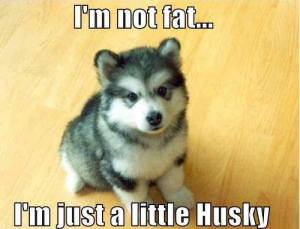
a very cute grey and white puppy sitting on a hardwood floor. the caption reads, "I'm not fat... I'm just a little Husky."This internet concern echoes warnings from veterinary medicine and science. Alexander German of the University of Liverpool Institute of Ageing and Chronic Disease writes that “obesity is now recognized as the most important medical disease in pets worldwide.” And the Canadian Veterinary Medical Association (CVMA) identifies “weight control/management as the number one thing a pet owner can do to increase the length of their pet’s life.” The CVMA documents a parade of health horribles resulting from pet obesity including problems such as high blood pressure, increased risk of kidney, heart and vascular diseases, and increased incidence of arthritis, all of which are also health risks faced by obese people.

Some veterinarians draw explicit connections between human health and fitness, and pet health and fitness. For example, the Association for Pet Obesity Prevention‘s mission is to make “the lives of dogs, cats, all other animals and people healthier and more vital.” Founder, veterinarian Ernie Ward, is committed to “developing and promoting parallel weight loss programs designed to help pet owners safely and effectively lose weight alongside their pets.” It is not surprising that my doctor and my dog Milo’s vet are both pleased that Milo and I spend so much time walking together.  We both need the exercise. This focus on the relationships between overweight pets and overweight people, as well as how we think about overweight pets and overweight people, extends from the clinic to the scientific laboratory.

There is a growing body of veterinary research on pet obesity. One concern among veterinary researchers is the absence of a clear standard for what counts as a healthy weight for dogs. Dr. Christopher Byers begins his review article, “Obesity in Dogs,” with a discussion of Body Mass Index (BMI), a research and diagnostic tool developed for humans. Byers points out that the lack of a BMI-like standard for dogs makes it difficult to conduct objective research. This desire for a doggy BMI is troubling because the problems with using BMI as a human health indicator are legion.

But, we can put that worry aside for now because instead of figuring out a dog’s BMI, veterinarians assign a dog a Body Condition Score (BCS) based on their observations of its fat, muscle, and overall shape. Vets will keep track of a dog’s BCS and weight as measures of its overall health and to track health changes over time. The body condition system that I’ve come across most frequently was developed by Nestle Purina in 1997.

A chart showing pictures of dogs ranging from fat to thin from the top and side.Based on this system my vet complimented Milo on being a four or five. I balked, “What do you mean a five, he’s a 10!” My vet quietly let me know that the scale only goes up to nine, and that a four or five is ideal. I’m not the only dog guardian who identifies, maybe a bit too closely, with her pup. The last time I was at the vet’s office, a portly golden retriever came in for her weekly weigh in. The golden’s guardian left the clinic crestfallen—her dog didn’t lose any weight that week. Thankfully, the dog was not fazed by this apparent failure, because losing weight and keeping it off is really difficult for dogs, and for people too.

Back and Tan German Shepherd, standing in profile against a background of green grass and trees. The dog's tummy is tucked up behind its ribcage.

Milo’s body condition score indicates that you can easily feel his ribs and vertebrae when you pet him, you can see his waist from above, when you look at him from the side you can see that his abdomen is tucked up behind his ribcage, and he is well muscled.

Complementing Biggest Loser style online narratives of canine weight loss, the internet provides generous guidance for how to help your dog lose weight. Two themes run through this advice. The first is that we humans have a responsibility to make sure that our dogs aren’t fat, and the second is that weight loss is a matter of calories in and calories out. In her article “The big fat truth about canine obesity,” Christie Keith, science writer for The Bark, tells us that

While healthy, permanent weight loss in humans is hard to achieve, it’s much easier with dogs. They don’t eat a container of Ben and Jerry’s after a stressful day, and they rarely hit the drive-through instead of making a healthy dinner. As long as the human in the relationship manages not to overfeed and under-exercise the dog, weight-loss programs for canines are surprisingly successful.

lets-get-fat-dogsWhile it’s true that most of our dogs eat what we give them, and exercise when we walk them, when we shift our focus from popular to more scientific sources of information it becomes apparent that achieving and maintaining weight loss for dogs and for people is more complicated than avoiding fast food and ice cream. With respect to people, some research indicates that, in the long run, it may be better not to diet at all because most dieters gain back more weight than they initially lose. This often leads to yo-yo dieting, otherwise known as weight cycling. And there is initial evidence that weight cycling may be an issue for dogs as well. Dr. Byers reports a study on weight loss and gain in beagles. He writes that this study

demonstrated weight cycling in dogs in which rapid regain of body weight occurred after successful weight loss. These findings support the phenomenon of metabolic down regulation of energy needs with weight loss, which continues after target weights have been achieved.

With both dogs and humans, there is a significant mismatch between popular and scientific accounts of weight loss. This does not surprise me because the popular story of discipline, hard work, and responsibility spelled out in a heroic personal narrative is catchier than talk of metabolic down regulation and weight cycling. We love our heroic stories, and they sell.

The heroic narrative is foundational to The Biggest Loser TV shows. The trouble with these shows is that they ended when most of the characters had lost a lot of weight. These shows did not reveal how excruciatingly difficult it was for contestants to maintain their weight loss or how many of them regained significant amounts of weight. Research indicates that this is because after their weight loss, contestants burned fewer calories than other people their size, and developed hormone imbalances that left them feeling continually hungry. People, as well as beagles, experience metabolic down regulation after weight loss.

Unfortunately, if we accept weight loss as simply a matter of discipline, work, and responsibility it becomes easy think of not losing weight or regaining weight, as failures of discipline, work, and responsibility. The science shows that this is false. However, this misleading story is common and supports negative attitudes about fat people being lazy and irresponsible.


Our stories, the science, and cultural stereotypes about canine weight and fitness, and human weight and fitness are intertwined. As a result, the way we think about one influences the way we think about the other.


I think trying to keep ourselves and our dogs as healthy as possible is a great goal. Milo and I walk, for miles, every day. We need and love the exercise.

2017-01-01 20.42.10

Milo gets me out hiking, even in the middle of winter.

However, the goal of promoting health and fitness is undermined by negative attitudes and stereotypes about fat people.

It is common and easy for stories about fat pets to reinforce these negative attitudes and stereotypes. For example, one of the fat dog stories on the American Dog Club website features a funny/ not funny picture of a roly-poly white bulldog, wearing a towel, and reclining on a sofa with a plate of muffins. The dog’s head is covered in pink curlers and the caption under the image reads, “dogs can become couch potatoes too.” The connection with people is pretty clear: the dog represents the stereotype of a fat, lazy, and ill groomed woman.

flabby cat and slobby dog

Even the names of the characters reinforce negative stereotypes about fat people.

This sort of stereotype is the basis for prejudice and damaging inequalities, inequalities that are stronger for fat women than they are for fat men (the men have to be fatter before they kick in). Fat people get worse medical care, have lower job security, lower earnings, and slower career advancement than thin people. This is not just unfair, it also leads to stress, which can lead to weight gain.

Negative weight stereotypes impact children as well as adults. The book Flabby Cat and Slobby Dog is an example of negative stereotypes about fat pets and people directed at children. In this book, Flabby and Slobby go on a difficult quest and lose weight because

When they were hungry, they had to hunt for food. So they couldn’t eat and eat and eat. When they were thirsty, they had to look for water. There was no time to sleep and sleep and sleep. They were too busy trying to stay alive.

You don’t have to dig too deep in this book to find the message that being fat is the same as being a slob, and that it is worth risking your life to be thin. This is troubling because research in Canada, Iceland, Australia, and the US reveals that overweight children are not just a target of bullying, but comprise the group of children most likely to be bullied, and that adolescent girls who engage in strict dieting are significantly more likely to develop an eating disorder than those who don’t. This book might be intended to help fight childhood obesity, but it reinforces negative and dangerous attitudes toward fat people and weight loss.

Pets are part of our lives and part of our culture. Negative weight stereotypes hurt people. Why on earth would we add to this problem by invoking these stereotypes with respect to our dogs?  The things we do with our dogs, what we say about them, and what we write about them are not separate from the rest of our lives or from our culture. In fact, for many of us, our dogs are an integral part of our homes and our families, and a rare source of unconditional love.

I want our dogs to be healthy and happy, but we need to be careful to talk about canine weight and fitness in a way that enhances human, as well as canine, health. The way we talk about and relate to dogs reflects and reinforces values in our culture because, whether or not we’re a dog guardian, dogs are part of our lives.
How does pet ownership contribute to population health? An interview with Melanie Rock

Check out this interview where Dr. Melanie Rock, an anthropologist at the University of Calgary, reveals how pet ownership contributes to human health.

Dr. Rock starts out on familiar ground explaining some of the concrete human health benefits arising from companion animals. For example, simply being exposed to a dog can lower a person’s blood pressure and walking a dog is good exercise. This makes sense to me, my German Shepherd Milo keeps me calm, happy, and on the move.

However, this interview really caught my attention when Dr. Rock started talking about the significance of human-animal relationships. She gave examples ranging from farm animals to pets, from rural settings to cities, and from the Global North to the Global South of how our sense of our own identities and our health, and our sense of belonging in a place are tied to our relationships with animals. This has a significant impact on human well being.

Dr. Rock says,

If it’s true that even in resource poor countries in which food is a daily concern, that people establish effective relationships with pets and relate to a dog as a friend, as a member even of the family in some cases, then those relationships are important to take into account when we are designing and delivering health services and broader population health initiatives. … so far we have not really come to grips with the fact that our society is not purely human.


Melanie [Rock] is an anthropologist and social worker whose research focuses on the societal and cultural dimensions of health, with an emphasis on the importance of nonhuman animals for mental, physical, and social well-being. She is an Associate Professor at the University of Calgary, where she serves as Associate Scientific Director in the O’Brien Institute for Public Health. Her primary appointment is in the Cumming School of Medicine’s Department of Community Health Sciences, and she holds a joint appointment in the Department of Ecosystem and Public Health, Faculty of Veterinary Medicine. In addition, she has supervisory privileges in the Department of Anthropology and Archeology, Faculty of Arts and in the Faculty of Social Work. Honorary affiliations include the Institut de recherche en santé publique de l’Université de Montréal and the Human-Animal Research Network (HARN) at the University of Sydney.


From The Science Dog: Do dogs have negativity bias?

Sometimes, psychological similarities between dogs and people can be bad for dogs. Linda Case at The Science Dog provides insightful analysis of research on how dogs mirror emotions displayed by humans and other dogs. She writes,

Negativity bias – We all suffer from it.

This is the phenomenon in which we naturally pay more attention to and give more weight to negative information and experiences compared with those that are positive. It is this particular cognitive bias that causes us to be more hurt or discouraged by insults or criticism than we are pleased or encouraged by compliments and shining reviews.

Case points out that human negativity bias is common in training relationships: handlers are more likely to notice and correct unwanted canine behaviours, than they are to notice and praise desirable canine behaviours.

However, the study Case analyzes looks at this issue from a dog’s point of view. Researchers recorded dogs’ responses to positive and negative vocalizations produced by people and by other dogs. They found that when dogs heard negative sounds from either species they

froze in place more often, remained immobile for longer periods, and showed more signs of stress and arousal than when they listened to positive vocalizations from either a human or another dog.

Case points out that dogs may experience negativity bias. This means that our poor pooches get a double whammy–not only are we likely to respond disproportionately to our dogs’ bad behaviour (our negativity bias), but our dogs are likely to respond disproportionately to our negative reactions (their negativity bias).

Case has a clear take-home message:

Knowing that dogs are naturally more sensitive to negative information (and emotions) than to positive and also knowing that dogs react to the negative emotions of others with stress, then it is a no-brainer to conclude that we should avoid aversives when we train and interact with our dogs. There are of course many reasons that we should focus on positive reinforcement and reduce or eliminate the use of aversives in training. This research just adds one more – negative emotions (harsh voice, hard stares, anger) emotionally bleed into our dogs and cause them to be unhappy and stressed. Not only are they aware of these emotions in us, they may be more sensitive to them than we have previously realized.

This motivates me to renew my efforts to notice, be grateful for, and reward my dog’s good behaviour. Milo the AwesomeDog is laying nicely on his bed right now. I’m off to give him a cookie.

Make camping fun for your dog too!

Too many dogs were getting yelled at in my campground today. They were barking, whining, and generally carrying on. Parents and kids both were shouting for their dogs to “knock it off.”

I get that camping with a family and with pets is overwhelming. And I get that these dogs were irritating. I found them irritating, from a distance. But the yelling wasn’t working. The dogs kept on doing the irritating things they were doing.

And the yelling wasn’t fair either.

Those parents sent their kids to the beach, the whole family went bike riding, there were campfires and s’mores. I bet there were coloring books and decks of cards at the ready in case of rain. Most of those kids had other kids to play with, and were having a great time.

The dogs on the other hand, were relegated to a pen or tie out, alone, in an out of the way corner of the campsite. It is no surprise they were acting up. They were in solitary confinement and were bored. For some of them, the yelling was probably the most interesting part of their day.

So, I got to thinking about what folks could do to help Rover be less of a pain, and to save themselves from all that yelling. Here are some ideas for making a camping trip fun for your dog:

  • Set up your dog’s pen near the action. Put it next to your hammock or beside the picnic table so that your dog doesn’t have to be alone.
  • Crate train your dog and bring the crate along. For many dogs, their crate is their happy place. Why not bring it? It’s a good way to confine your pet in a safe and comfortable place. And for some dogs, it helps them stay calm.
  • Make sure your dog gets lots of exercise. A tired dog is a good dog. Look for a campground with a dog beach or a big pet area so that the two of you can enjoy a good game of fetch, and Rover can burn off some energy.
  • Bring along things for your dog to do. Bringing a range of interesting chew toys for your dog is like bringing along a deck of cards for the kids. The idea is the same, keep them busy doing something that you want them to do.
  • Or, how about challenging your kids to teach Rover some new tricks on the camping trip? That way you can keep them both happy and busy.

Sometimes it’s just too much to manage kids and a dog. That’s OK, we’re only human. Maybe the right thing to do is leave your pup with a friend or relative or at a trusted kennel. After all, camping is supposed to be fun!

Do you have any suggestions for keeping your dog be happy and well behaved when camping?

Dogs in MRIs: Science, brains, and love

Dr. Gregory Berns and his team at Emory University are trying to figure out how dogs’ brains work by training them to lay perfectly still inside a MRI machine. The researchers measure the way a dog’s brain ‘lights up’ when she thinks about different things. I just read an article about this research by Gregory Berns and Peter Cook called “Why did the Dog Walk into the MRI?” What grabbed me most about this article was the justification for doing this research in the first place.

Berns and Cook point out a bunch of good reasons for studying dog cognition and neurobiology.

They note that humans and dogs have evolved to be partners and learning about dog brains can help us understand these evolutionary processes.

They also note that dogs are a good study species because humans are part of dogs’ ‘natural habitat.’ Most of the species we study, rats, pigeons, and monkeys, are in unnatural conditions, which can have a big impact on their behavior and lead to unreliable scientific results. In this respect Berns thinks we can actually do better science on dogs than on species that we don’t naturally interact with.

While I think that the idea of a ‘natural habitat’ is not very clear, and there certainly isn’t much that is natural about putting a dog in an MRI machine, humans do have a long history, an evolutionary history, of collaborating with dogs. In this sense, the training that is part of these experimental protocols is more ‘natural’ for dogs than for likely any other non-human species. I find this interesting.

Finally, Berns and Cook think that because of the close relationship between our species dogs could provide useful models for research on human social behavior, and they might even be useful models for studying human medical disorders such as depression or anxiety.

Dog brain question

my rendition of Milo’s brain

Given all of these scientific benefits, it is surprising that we don’t know much about dog brains. The authors suggest two reasons for this gap in our knowledge. First, dogs are our friends and so there is a cultural aversion to conducting invasive experiments on them. And second, most dog research is based on a citizen science model—everyday people bring in their pets to take part in the experiments. So, of course we can’t actually look in those dogs’ heads.

“Mommy, why is Fido laying so still?”

“We donated his brain to science dear.”

Not a research model likely to get much traction. [Although, I have to admit on days when Milo is engaging in what I call ‘high-jackassery’ this seems tempting. “You want to look at Milo’s brain? Go ahead and take it, he’s not using it. By the way, you’ll need tweezers.”]

MRI lets researchers check out what is going on with a dog’s brain while it is still inside the dog’s head. In other words, it is a non-invasive research method and Fido can go home, play fetch, and cuddle when the experiment is finished.

What’s love got to do with it?

One of the things that philosophy of science investigates is what makes scientific research a good way of producing knowledge. The philosopher of science in me is intrigued because the reasons Berns and Cook give for using their method of studying dog brains arise from the relationships between dogs and people, relationships that can include engagement, respect, and love. There is a tendency for people to assume that good science, objective science, requires that researchers be emotionally detached from whatever they are studying.

But, here is a case where our relationships with dogs, as a group, and as individual creatures, drove scientific creativity. Because we love them, we want to know about them and don’t want to hurt them. This lead researchers to develop a new experimental protocol (the whole dogs in MRIs thing) that has the potential to help us learn interesting and important new things. Love lead to good science. I wonder what different things we might know if we loved rats and monkeys like we love dogs?


For the love of god leash your darn dog

A post like this is silly because it has already been written about 14 million times. Pretty much all the dog trainers and all the dog professionals and all the municipal codes tell people to leash their dogs. leash

I’m writing it again because Milo and I were charged by a little schnauzer. I scared the little dog off and the schnauzer’s person got angry at me for yelling at their dog. What the what? I know that people respond weirdly when flustered. But seriously, that little dog charged my German Shepherd and I intervened before my dog did. That, my friend, deserves thanks. In fact, it deserves ice cream. Heck, it deserves a bottle of scotch.

This is not a rare event. Milo and I have been charged by Golden Retrievers, Poodles, little terriers, and a bunch of other pups.

I don’t care if the pup is a Yorkie or Mastiff, a puppy or senior dog, or a dog that’s an angel straight from heaven. I really don’t care if the dog is friendly. Even if the handler knows their dog can heel past a butcher shop, I don’t know that, and off leash dogs worry me.

Milo and I worked very hard, for years, to help him stay calm around other dogs. He is gigantic and now his behavior is, mostly, pretty good and so a person might not expect him to be stressed by a charging dog. He is. And so am I.

  • A little dog who reacts to Milo and me is not cute or brave, and does not think it is a big dog. It is probably scared, or perhaps stupid.
  • Yes, I know that Milo could ‘take care of himself,’ but I don’t want him to have to. And, who would want that to happen?
  • No, I don’t want the dogs to ‘work it out.’ That’s a project that could cost 1000’s of dollars.
  • And actually, I don’t want our dogs to say ‘hello.’ If we’re friends and I know your dog, then maybe. But my dog doesn’t play with strangers.

Where there are leash laws, please leash your dog. It’s the decent thing to do.