
My method is scientific 5: Responsible use of science

There is a very high bar for claiming that a dog training method is scientific. Not only does there have to be peer-reviewed research studies, but there also has to be a bunch of them, and they need to directly refer to the training method in question. It is a difficult standard to meet.

Just because it is difficult to meet this standard, it most certainly doesn’t mean that we should abandon scientific research on dog training. What the high standard does mean is that we need to be careful, responsible, about how we use scientific information.

In the rest of this post, I’ll explore just how high that bar is, and give you an alternative way, a responsible way, to think about and use scientific information about dog training methods.

What the heck is a body of evidence anyway?

The idea is that there needs to be a bunch of studies and that you need to be on the lookout for studies that support your training method AND studies that don’t. It’s not immediately clear how many studies make a bunch, or how to balance the studies that support and that don’t support a particular method. Most of the time a person has to rely on scientific experts to get an overall idea of the degree of support for particular methods.

Philosopher Heidi Grasswick has argued that it should be part of the job of science to sift through the evidence it generates and provide us with usable, significant information. However, there is not much motivation for individual scientists to do this time-consuming work. Thankfully, when it comes to veterinary and human medicine and public health, there are professional and government organisations we can turn to for this sort of expertise.

For example, the Canadian Veterinary Medical Association has a Humane Training Methods for Dogs position statement. In this statement, they recommend reward-based methods, and discourage aversive methods, and do not recommend aversive methods unless reward-based methods have failed and unless the aversive methods are used by a skilled person. They provide citations to the scientific literature supporting their claims, and you can use those citations to track the research papers down for yourself. However, even this position statement is not especially specific about particular training methods. It pretty much advises us to be as humane as possible.

Is the evidence ever directly about what you do with your dog?

If a person wants to call a dog training method scientific, then the scientific research should be about the dog training method they are actually talking about. This seems obvious, but in fact, there is rarely, some might even say never, a direct connection between the research and dog training practice. One reason for this mismatch is that studies are conducted under controlled experimental conditions, and dog training happens ‘in the wild,’ or at least in the more complicated everyday situations that we find ourselves in. The context the dog-handler team is working in, the skill of the trainer, the temperament and experience of the dog, all make a difference. Also, sometimes, a lack of communication between scientists and dog trainers can result in them using the same name to describe what are, in practice, different training methods.


The bottom line is that it is difficult to be justified in claiming that a training method is scientific. But don’t give up on scientific approaches to dog training.


A matter of degree

Instead of thinking of the scientific nature of a training method as an all or nothing sort of thing, we need to think of it as a matter of degree. Some training methods are supported by more evidence than others, and the scientific research can be more or less like what we actually do with our dogs.

When we point to a method as being scientific, our usual goal is to justify our use of it or recommend it to others. More evidence that is closer to our training method, justifies us in giving a stronger endorsement or recommendation of the method as scientific. It’s not an on/off switch; it’s a volume control knob.

Take care though, because scientific evidence can’t give us 100% certainty that a method is the best possible method. In addition to the tricky nature of evidence and the fraught relation between science and practice, science can only test what we have dreamed up in the first place. It is completely possible that someone will come up with a new method that is better than anything we have right now. Also, science is trustworthy because it depends on the experiments we’ve actually done and the measurements we’ve already taken. This means that we always need to be open to changing our minds in the face of new experiments and new evidence.


Responsible use of scientific information means calibrating our endorsement of a method as scientific to the quality of the evidence supporting that method.


Note: this is my fifth post in a series on scientific dog training methods.

  1. “My method is scientific” 1: “That’s right, I said ‘SCIENTIFIC’!”
  2. “My method is scientific” 2: What does this even mean?
  3. “My method is scientific” 3: The trouble with clicker training
  4. “My Method is scientific” 4: Science, goodness, and goals
  5. “My method is scientific” 5: Responsible use of science

Dock diving

Yesterday our human friends Jess and Liz, and dog friends Stark and Zefra, invited Milo and I out for an adventure. It was a lovely afternoon, let’s take the dogs dock diving! Hurray dock diving!

Picture a 20 by 40 foot salt-water pool with warm, crystal clear water. A 40 foot dock, and two exit ramps, both covered in astroturf, abut a short side of the pool.

Milo takes one look at this setup and goes bonkers, pulling like an ox toward what he knows is a fun time. Ideally, I put him in a sit-stay at the far end of the doc, walk to the waters’ edge, release him, toss a toy in the water as he thunders down the dock and flings himself through the air and into the pool. I say ‘ideally,’ because that sit-stay is exceedingly difficult for a dog who is part German Shepherd and part otter.

dockdivingBut no matter how he hits the water, he swims out, retrieves the toy, swims back, hauls his panting, dripping self onto the dock and is ready to go again. Not before, of course, striking a pose, head up, chest out and grinning, at the top of the ramp giving all of us a chance to compliment his powerful jumping and excellent swimming. He’s smart, but the joy of jumping drives any sense of self-preservation out of his doggy mind, and eventually I have to force him to take a break.
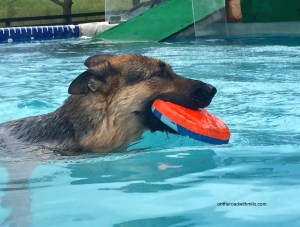
dock diving 2After all the dogs had a few turns, we enjoyed a little swim together and then it was time to dry off, pile back in the van, and take ourselves home. The laughing, cheering, dog wrangling, and of course jumping, leaves everyone pooped. Well, not everyone.


As we were chatting and loading the van Milo leaned into his leash toward the pool, clearly suggesting that there might be time for another dive.

I had to remind him “Milo, you just had a long swim. You’re tired.”

But he explained, “Mom, I was tired 6 minutes ago. It is now a whole new day, and I don’t know if you remember, but there is a pool, right there. If you wouldn’t mind opening that gate, we could, you know, swim.”

I pretended not to understand, a trick he knows well.

A moment later I was distracted and Milo saw his opening. He was off! It was a full on lung toward the pool. I leaned back, and holding on to that leash like a waterski towrope left heel tracks in the gravel in the direction of the pool. Dang dog. I didn’t have the heart to tell him that he was being a bad bad boy. Once I got us both anchored again, he figured out that there was definitely no more swimming that day, and settled back into being a good dog.

One the way home we stopped for burgers and fries at a roadside stand, Milo, Stark, and Zefra laying angelic at our feet. They were happy and tired, and clearly enjoying a steady stream of fries. This is the kind of thing Saturdays were made for. When Milo and I are on the road, we are going to miss these good friends.

“There is no Nobel Prize for fact checking.”

A particular sort of delightful demoralization washed over me when I saw comedian John Oliver sum up years of my research in 19 hilarious minutes. Here are some things that you will learn from this segment:

  • science is difficult,John_Oliver_November_2016
  • not all scientific research is fabulous,
  • scientists are pushed to publish new and striking results, and are not rewarding for double-checking other peoples’ research,
  • scientific research can be manipulated in ways that sacrifice its integrity,
  • science is often distorted by the media to make it more newsworthy,
  • people tend to be more interested in easily-digested, exaggerated, glamorized science, than in the nuts and bolts of how science actually works,
  • and, farts don’t cure cancer.

These things undermine the credibility and authority of scientific research.  We need excellent, credible, and authoritative scientific research to address public health challenges, environmental problems, climate change, and a host of other significant issues. This is one reason why it is important to think critically about how we produce, share, and use scientific knowledge.

John Oliver says all of this in a way that might not be safe for all workplaces, but is really funny.

What do we owe our dogs?

Understanding our moral obligations to another person is tough. Contemplating our obligations to a dog, a member of another species, can be overwhelming.

Sometimes, only occasionally these days, I give Milo a pretty harsh correction. He is big and strong, and we need rules. Bikes are NOT prey. I know some people think these corrections are wrong.

Sometimes I’ve seen people who I like and respect treat their companion animals in ways that strike me as just plain wrong too.

It can be useful to flip our focus from sorting out what might be wrong, to thinking more clearly about what is right.

Philosopher Jean Harvey’s view of our moral obligations to our companion animals resonates with me. Here is the gist of her position:

It is part of the nature of most dogs and cats (yes, cats) to give love and loyalty to the human companion. As with anyone who loves, it makes them vulnerable—to the hurt of not being loved at all, to being manipulated, exploited, or traumatically abused or abandoned. The nature of this relationship is central to the ethics of companion animals, or at least dogs and cats: the deep and abiding affection the animals give and seek, the profound emotional and physical vulnerability they face because of it, and the blunt fact that humans in general control the relationship and have the power either to treasure or betray their animal companions. … The primary moral obligation we have with respect to companion animals is to develop, nurture, respect, and protect this relationship.

Jean Harvey, “Companion and Assistance Animals: Benefits, Welfare Safeguards, and Relationships” 2017

This helps me think more clearly about my obligations, my moral obligations, to Milo. Am I protecting our relationship? Am I being responsible in the face of the power imbalance between us? Am I treating his love and vulnerability with respect?

More and more it seems to me that the project of developing a philosophy of dogs and people boils down to love.


Go forth good people, “develop, nurture, respect, and protect” the relationship between you and your dog!


“My method is scientific” 4: Science, goodness, and goals

brown cartoon dog, standing on hind legs, with a surprised expressionI bet if a person gave their puppy an excruciating correction every time he laid a foot on the carpet, they could train that dog to stay off the rug in a heartbeat. But, I wouldn’t train a puppy that way. And even if I found a hundred scientific papers demonstrating the success of this method I still would not use it, nor would I recommend it to anyone else. I think it’s wrong. It goes against my values.


Often, when we latch onto the ‘scientificness’ of a training method, we’re trying to justify and recommend its use. Why should you use this method? It must be good. Science says so!

What kind of ‘good’ are we talking about?

The connection between science and goodness is complicated. While we’ve used scientific knowledge to cure disease, improve public health, and build bridges, we’ve also used it to build bombs and torture people.

When we’re talking about the scientific goodness of a dog training method, we’re not talking about moral goodness. Rather, we’re talking about practical goodness or effectiveness. Practical goodness or effectiveness demands the question, “Good at what?” In this sense, a person can be a good doctor or a good torturer (or a good dog trainer). It just means that whatever they’re doing, they’re doing it well. This kind of goodness is relative to a set of goals.

By praising a training method for being scientific, we’re justifying it, or recommending it, because there is scientific evidence demonstrating that it meets a set of training goals better than alternative methods.

This doesn’t say anything about what your training goals should be. That is up to you.

What kind of goals are we talking about?

Generally, we want our dogs to be happy and perform their jobs well. But, there is a wide range of specific goals we could pick. Here are just a few ways our goals can vary:

Goals vary with respect to projects

Is someone working on rehabilitating a rescue dog, or training a lap dog, a protection dog, or a guide dog? They’ll definitely teach these dogs different behaviours and might teach these behaviours using different methods. Teaching a good strong bite isn’t a goal of most people training lap dogs. Specific goals depend on the projects a person and their dog are working on.

Goals can vary in terms of mastery: reliability and precision

Trainers can have different goals about the level of mastery their dog needs to attain.

When someone asks a pet dog to heel, they usually want it to walk in the general vicinity of their left side. In an obedience competition a dog that gets a step ahead or behind the handler, or drifts away from parallel to the direction the handler’s facing, loses points. In some cases, precision is more important than others.

Or, imagine teaching a dog ‘out.’ ‘Out’ means drop whatever is in your mouth. When a pet dog hears “out” it usually means “drop that ball.” When a police dog hears “out” it can mean “let go of that person.” In some cases, reliability is more important than others.

Teaching new behaviour is different from extinguishing an entrenched, self-rewarding behaviour

Milo doesn’t really care if he is standing or sitting. I used marker training to teach him to sit on command. It went like this:

Carla: “Milo, sit.”
Milo sits.
Carla: “YES!” Gives Milo a cookie.

Milo learned an easy way to get cookies. Sometimes he walks up and offers a sit and an intent gaze. He’s clearly saying, “Hey lady, I’m sitting here, and I’m short on cookies.”

On the other hand, I had to teach Milo not to chase bikes. He has huge prey drive, which means that, to him, chasing is its own reward. When he chases, he is giving himself his favourite cookie, a cookie better than prime rib.

Teaching Milo to sit and teaching him not to chase are two very different goals that required different methods.

But, aren’t some methods effective at achieving a bunch of different goals?

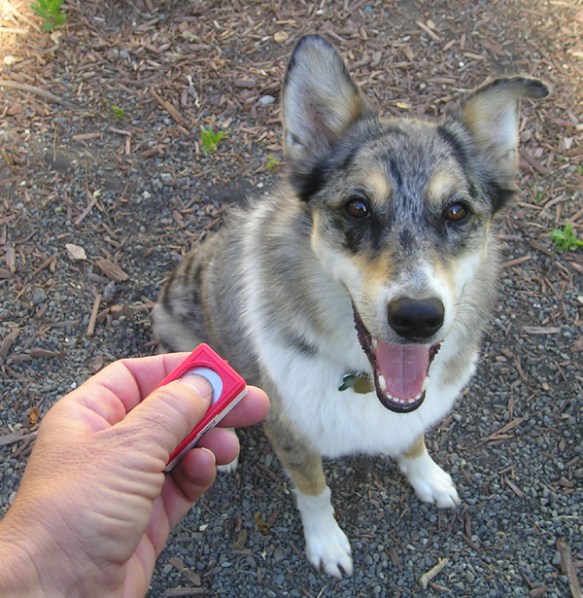
Yep. Lots of people successfully train agility dogs, protection sport dogs, and pet dogs using clicker training (aka marker training). Clicker training is all the rage. I use this method with Milo whenever I can.

But, funnily enough, there isn’t as much scientific evidence demonstrating clicker training’s effectiveness when applied to dog training in general, or to specific training goals in particular, as you might think. There is scientific theory showing that we expect it to work, but not direct scientific evidence showing that it does with dogs. The evidence that it works in a wide range (but not all) situations doesn’t come from scientists, as much as it comes from expert trainers with a track record of practical success.


The bottom line


Just because scientific evidence shows that a method meets one set of training goals, it doesn’t mean that it must meet a different set of training goals.  

And, even if scientific evidence shows that a training method meets a set of goals, a person can decide not to use, or recommend it, if it conflicts with their values.

You can’t decide what the scientific evidence is, but you must decide on your goals and values.


Note: In these posts on scientific dog training, I’m setting a high standard for calling a dog training method scientific. I’ll explain why in my fifth “My method is scientific” post, “Responsible use of science.”

  1. “My method is scientific” 1: “That’s right, I said ‘SCIENTIFIC’!”
  2. “My method is scientific” 2: What does this even mean?
  3. “My method is scientific” 3: The trouble with clicker training
  4. “My Method is scientific” 4: Science, goodness, and goals
  5. “My method is scientific” 5: Responsible use of science

“My method is scientific” 3: The trouble with clicker training

Clicker training, sometimes called marker training, is all the rage. I use it with Milo all the time. Linda Case, over at The Science Dog, points out that even though clicker training is based on scientific theory, is incredibly popular, and has a track record of success

…there is surprising little published research regarding its application to dog training. … Even more surprising is the fact that the results of the dog studies that are available are not unequivocally in the “Yay, Clicker Training!” camp. Rather, their results have been lukewarm at best, with some showing only limited (or no) benefit.

Dog_clicker_training

So, how do we explain, and what do we do about, this conflict between the scientific evidence and the practical success of using clicker training with dogs? Case examines a scientific paper by Lynna Feng et al. that does an excellent job sorting out this problem. The paper’s title says it all: Comparing trainers’ reports of clicker use to the use of clickers in applied research studies: methodological differences may explain conflicting results.

In her analysis of this paper, Case writes that

One possible reason that dog trainers, many who believe emphatically that clicker training is a highly effective tool, are at odds with the less than stellar results of the published studies is that perhaps we are not talking about the same things. In other words, the way in which clicker training has been studied with dogs (and, one could argue, with other species as well), is not the way in which clicker training is actually used in practice. Several important differences were identified in Lynna’s study. The two most important are: (1) In practice, clicker training takes place over extended periods of time; (2) It almost always includes an established and positive relationship between the trainee (the dog) and the trainer (usually the owner).

The primary point that I came away with from this paper was that despite some continued attempts  to make it so,  clicker training as applied with dogs is not a purely behavioristic methodology. Rather, if one considers all of the new information that we have regarding the dog’s cognitive abilities, including their well-documented ability to read and understand human communication signals, then it is likely that the actual practice of clicker training involves much more than a rigid application of CT without any personal (relationship), cognitive, or emotional component. Since the studies that are in existence have studied clicker training using highly controlled behavioristic methodologies, perhaps they did not effectively measure or capture the depth and complexity of the phenomenon that is taking place when we use clicker training with dogs.

Remember that saying that a training method is scientific means that there is a body of peer-reviewed, publicly available, scientific evidence demonstrating that the method they are referring to meets their training goals better than alternative methods.

Case’s and Feng’s discussion of the science of clicker training shows that there was a mismatch between the research testing the application of this method to dog training, and what the trainers using this method actually do. In other words, the evidence was not referring to the actual method in question.

Scientific experiments often look at what they are studying in a strictly controlled way, and sometimes they look at a part of a training method instead of the whole thing. On the one hand, this is good because it helps researchers figure out precisely what is going on. On the other hand, it means that we need to use our judgement when applying scientific research to real-world situations.


When looking for scientific support for a dog training method, consider how closely the scientific evidence refers to what you are actually doing.


Two things stand out about this research on clicker training. 

First, Feng’s research sorting out this conflict is an example of science working just the way it should. The public availability of the scientific research on clicker training dogs allowed scholars like Feng and Case to evaluate the science and offer suggestions for making it better.

Second, I really like Feng’s study because she treats the expert dog trainers’ knowledge with respect. There are lots of different kinds of experts. Scientists are one kind of expert and people who have successfully trained lots of dogs are another kind of expert. Sometimes, but not very often, a person has both of these kinds of expertise. Most of the time though, scientific and practical experts need to work together.


Note: This is the third post in a five-part series about what makes a dog training method scientific.

  1. “My method is scientific” 1: “That’s right, I said ‘SCIENTIFIC’!”
  2. “My method is scientific” 2: What does this even mean?
  3. “My method is scientific” 3: The trouble with clicker training
  4. “My Method is scientific” 4: Science, goodness, and goals
  5. “My method is scientific” 5: Responsible use of science

On watching action movies with sensitive dogs

Last movie night I was looking forward to watching Terminator Genesis. I had the whole evening booked off and was curled up with four pillows and Milo. (No snacks or drink though, you’ll see why in a moment.) Lovely evening right?terminator pic

Wrong. I am a bit of a goof when comes to suspense and action movies. This is probably why I love them. When things are scary I hold my breath and get twitchy. When things are surprising I yell. I’ve been known to jump out of my seat and toss my popcorn over my shoulder (hence the lack of snacks and drink on this evening). Tense, jumpy, twitching, and yelling–not a good way to be when you are the guardian of a recovering reactive GSD.

Movie night was no exception. I held my breath and Milo’s head came up and he started scanning the room. I twitched and he jumped to his feet. I yelled and he was off, pacing through the house, searching for the evil. He was going to find it and end it.

It took some work to get him calm and happy again.

  • I had to call him to me and softly sooth him: “There, there, baby, there, there.”
  • We did some easy obedience to calm his mind: Sit, stand, down, sit, down, stand, down, sit.
  • We did some difficult obedience to refocus his attention. He practiced cleaning up his toys.
  • After that it was a treat and a cuddle and we were good to go watch Gilmore Girls.

So, I have more action movie watching constraints. No snacks, no drinks, and Milo gets a bone to chew on in the other room.

This was a good reminder, you need to stay on top of your state of mind when you’re with a sensitive dog.


“My method is scientific” 2: What does this even mean?

When someone calls a dog training method scientific they should mean that there’s


a body of peer reviewed, publicly available, scientific evidence demonstrating that the method they are referring to meets their training goals better than alternative methods.


There’s a lot packed into this definition, so let’s take it apart and figure it out piece by piece: woman-with-magnifying-glass

  1. there is a body of scientific evidence
  2. the evidence is peer-reviewed and publicly available
  3. the evidence relates to the method they are using
  4. the evidence shows that the method they are supporting is better than the alternatives
  5. the evidence shows that the method meets their training goals.

For the rest of this post, I’ll think about what it means for there to be a body of peer-reviewed, publicly available scientific evidence.  In the next post in this series, I’ll consider other parts of the definition, the ones that relate to particular dog training methods.

Body of evidence

It is not enough to find one experiment that supports what you already believe is true. One experiment can be mistaken or be inappropriately influenced by a unique experimental setup or idiosyncratic features of a particular scientist or laboratory.

There are too many cases where one or two scientific research studies support one side of a debate and hundreds of research studies that support the other side of a debate. For example, a 1998 research study suggested a link between childhood vaccination and Autism, but since then there have been many studies demonstrating that there is no such connection. Unfortunately, there are still people who point to that one study as an argument for not vaccinating our children, even though there is an overwhelming body of scientific evidence showing that we should. This sort of mistaken use of scientific research is not uncommon.

One experiment or one scientific publication should, at most, give you something to consider. Before you start drawing conclusions about what you, or anyone else, ought to do, you need to be able to draw on a bunch of scientific experiments, and you need to make sure that you are fairly considering all the evidence.


One way to make sure that you are considering the evidence fairly is to spend as much time searching for scientific studies that are critical of your training method as you spend searching for scientific studies that support it.


Peer-reviewed and publicly available

Peer review and public scrutiny are crucial tests for scientific knowledge. Peer review means that the research was sent to experts in the field who carefully and critically checked it for errors and assumptions. They evaluate things like the theoretical perspective underlying the research, the choice of experimental methods, the way the experiment was conducted and the data collected, the way that the data was analysed, and whether the conclusions that the authors make are justified by their data.

It is worth noting that mistakes can still get through the peer review process.  But it is an important quality control mechanism that makes scientific knowledge as reliable as possible.

Public availability is also important. It should be possible to go to the library or go online and get the actual research publications. This lets the scientific community (and you if you feel like it) see how the researchers got their results and test those results for themselves.

Peer review and the public availability of research are important because they make scientists show their work–everyone is invited to check the facts and reasoning that researchers use to support their conclusions.


If someone tells you that a method is scientific, you should be able to find the research publications supporting that method yourself and those publications should be in peer-reviewed scientific journals.


So what?

This way of thinking about what it means for a training method to be scientific emphasises the fact that science is never about one person or about one experiment. Science is a public, social activity. It depends on lots of studies, conducted by lots of people, in lots of places. These studies are performed by groups of people, they are reviewed by different groups of people, and they are available to anyone who wants to read them. This makes scientists, and the research they produce, accountable to the broader scientific community and accountable to you and me as well.


Note: This is the second post in a five-part series about what makes a dog training method scientific.

  1. “My method is scientific” 1: “That’s right, I said ‘SCIENTIFIC’!”
  2. “My method is scientific” 2: What does this even mean?
  3. “My method is scientific” 3: The trouble with clicker training
  4. “My Method is scientific” 4: Science, goodness, and goals
  5. “My method is scientific” 5: Responsible use of science

“My method is scientific” 1: “That’s right, I said ‘SCIENTIFIC’!”

If you want to see a good internet fight, just toss out the question “What method should I use to train my dog?”  People go all cap locks on each other in no time, no time at all.

internet fightSometimes these fights are about very specific training methods, but most of the time they boil down to disagreements about whether dogs should ever be given corrections or punishments. People want you to train your dog their way.

Why should you do it their way? The same set of answers pop up over and over again. You should do it their way because:

  • your dog will be happier
  • your dog will learn faster
  • your dog will love you more
  • your dog will respect you more
  • your dog will be safer
  • your dog will be less stressed

and then out comes the big gun

  • because SCIENCE says so.

I am a beginner dog trainer, but I am an expert on evaluating and using science—in fact, I’m a philosopher of science and so that’s my day job. And let me tell you, “because science says so,” is a troubling answer.

It bothers me when “science” is thrown into a conversation as a way to end debate. ‘Science says so, smart people defer to science, so take your pick: agree with me or be stupid.’

The trouble is, scientists disagree with each other ALL the time. In fact, one of the main things that scientists do is try to prove other scientists wrong.

Calling something scientific should be an invitation to open and respectful discussion of different kinds of evidence, of our experiences, and of the values and assumptions that are part of scientific practice. When someone demands unquestioning faith in science, something is messed up. Science doesn’t work that way.

Don’t get me wrong. Science is AWESOME. It is a tool we’ve used to figure out all sorts of interesting and useful things. I’m writing this post on a really nice computer. Thank you Science. But, just like any other tool, it takes time and energy to figure out how to use it responsibly. Using it responsibly means using it in a way that is honest, morally good, and practically useful.

We should use all of the tools and resources we can to figure out how to best work with our dogs. After all, we want to do the best we can to treat our dogs with respect, develop good relationships with our dogs, help them be safe, happy, and fulfilled, and to develop public policies and laws that are good for the dogs and people in our communities.

Scientific research can provide excellent resources to help us meet these goals. But, if we are going advocate for scientific dog training methods we need to ask ourselves:

  1. What does it even mean to say that a dog training method is scientific?
  2. Is a scientific method automatically good?
  3. How can you tell if folks are right when they say a method is scientific?
  4. How do you make the jump from scientific theory and evidence to doing what is best for the dog in front of you?

There aren’t foolproof answers to these questions. Philosophers disagree with each other all of the time too.  But, if you are going to use scientific information responsibly, you need to think carefully about these questions.

Note: This is the first post in a five-part series about what makes a dog training method scientific.

  1. “My method is scientific” 1: “That’s right, I said ‘SCIENTIFIC’!”
  2. “My method is scientific” 2: What does this even mean?
  3. “My method is scientific” 3: The trouble with clicker training
  4. “My Method is scientific” 4: Science, goodness, and goals
  5. “My method is scientific” 5: Responsible use of science

Who is Milo? Just the facts

  • Full name: Milo the AwesomeDoggerman shepherd with an alert expression in front of a pond
  • Registered name: Milo Fehr
  • Breed: German Shepherd Dog
  • Origin: Farm in southwestern Ontario
  • Titles: S.P.O.T., CGN, RN, BH
  • Pedigree: Unknown
  • Height: 27 inches
  • Weight: 87 pounds
  • Colour: Black and tan
  • Birthday: September 9, 2012
  • Sign: Sagittarius
  • Favorite food: Green tripe
  • Regular food: Raw meat, bones, and offal
  • Weirdest thing eaten: SOS pad
  • Grossest thing eaten: I can’t bring myself to write it down
  • Favorite toy: Kong frisbee
  • Languages: English and German
  • Sports: Scent Detection, Rally Obedience, Schutzhund Obedience, and a bit of Agility
  • Hobbies: Swimming, hiking, playing with Hoss the Cat
  • Aliases: Mtad, Buttercup, Angel Face, The Boy, Buddy, and Sweet-darling-angel-from-heaven