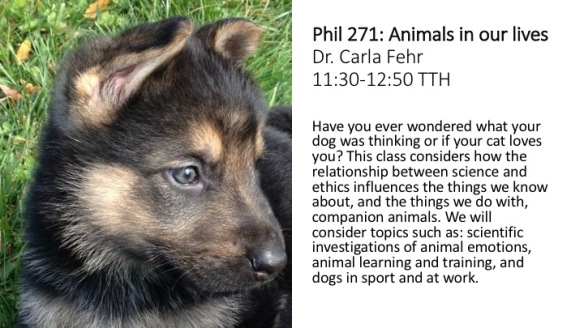
Animals in our lives: Teaching the Philosophy of Companion Animals

This semester I’m teaching a university class on the Philosophy of Companion Animals called “Animals in our Lives.” Wow. I feel so lucky to do this! My students are hardworking, engaged, and good-natured, and together we are doing great work. Thanks gang!

Developing and teaching a new course takes up every spare moment. After getting my work done, going to the gym, and training and exercising Milo, I’m usually finished for the day. So, I’ve been posting here less frequently than usual.

Thank heavens I have my students’ permission to post about our class.

For starters, here is an excerpt from the syllabus that explains a little bit about what we are up to.

Animals in our Lives, Philosophy 271

Course Description
This class explores the science and ethics of human relationships with companion animals.

Course Outcomes
In this class you will:
1. Explore the social influences on, and impacts of, scientific research
2. Develop an understanding of the relationships between humans and companion animals from scientific, philosophical, and practical perspectives
3. Acquire the skills and confidence to learn, assess, and use scientific information

Discussion Topics
Unit 1: The science of emotion and the role of emotion in science
• The neurobiology of canine love
• The impact of human emotion on animal research
• The movement of scientific knowledge from the lab to the public

Unit 2: Anthropomorphism or anthropodenial
• The sense of smell and what it’s like to be a dog
• Consciousness and animal minds
• Folk psychology across species

Unit 3: Do good animal handlers and trainers need science?
• Is clicker training scientific?
• The media and celebrity dog trainers
• Different kinds of expertise and the public understanding of science
In each unit, we will explore readings from scientific, philosophical, and popular sources.

So far we’re just getting going on the unit on love.

I’ll update you as we move through the class.

What do words mean to your dog?

OELI’m reading Patricia McConnell’s excellent book, The Other End of the Leash. In this book, McConnell frames the challenges of dog training and human-dog relationships in terms of the kinds of communication typically used by primates and canids. She’s not just talking about differences between creatures that rely on vision and creatures that rely on olfaction. She gets into things like grammar, volume, repetition, and pitch of vocalizations.

McConnell points out that even though we know it’s important to consistently use the same words, in the same way, we often don’t. In states of frustration, I’ve told Milo to “lay down, down, get down.” These disco lyrics are not exactly what even a generous person would call good handling. Milo is biddable, smart, and patient and so usually complies with my desires even when I express them poorly. But, what if I had a dog who was slightly less awesome? (The results would not be so good.) And how much better could Milo and I be if I was more consistent and clear? (The results could be fab.u.lous.)

To sharpen my game I made a list of words that Milo knows, along with a description of what I am asking him to do when I use those words.

Here’s Milo’s vocabulary list:

  1. Milo: pay attention to me and approach me
  2. Look: make eye contact with me
  3. Sit: bum on ground, front legs straight
  4. Stand: legs straight, four paws on the ground
  5. Down: bum and elbows on the ground
  6. Stay: don’t move until I give a release or another command
  7. Come: snap your head toward me, approach me quickly, sit in front of me, and let me grab your collar
  8. Wait: pause until I’m gone or I tell you to do something else or I release you.
  9. Drop: let go of what you are holding in your mouth
  10. Easy: do less of whatever you are doing
  11. Let’s go: keep up with me when we are loose leash walking
  12. Hup hup: forge ahead and lean into your leash/collar
  13. Heel: keep your shoulder aligned with my knee, keep your body parallel to the direction I’m facing and sit if I stand still
  14. Back: step backward in a straight line
  15. Around: get into heel position by walking behind me
  16. Get in: Get into heel position by swinging yourself around on my left. This is also a reminder to tuck his butt toward me when we are making a left turn.
  17. Switch: walk behind me and stand or sit quietly on my right side
  18. Crate: get in your crate
  19. Mat: go lay on your nearest bed, or the bed I’m pointing at
  20. Hoover: eat what’s on the floor
  21. Leave it: stop sniffing or eating
  22. Out of it: stop staring
  23. Break: release from a sit, down, stand, or his crate
  24. Yes: functions as a click and is a release
  25. Good: keep doing what you are doing
  26. Nope: try it again
  27. Up: jump onto what I’m pointing at
  28. On: put your front paws on what I’m pointing at
  29. Touch: touch your nose to my open palm
  30. Over: jump over a high jump
  31. Jump: jump over a broad jump
  32. Tunnel: go through an agility tunnel
  33. Kiss: lick my face
  34. Paw: put your paw in my hand
  35. Toys: all the things that he plays with and live in his toy box
  36. Kong: red rubber toy that I fill with food
  37. Ball: any tennis ball sized ball
  38. Clean up your toys:  picks up your toys and puts them in your toy box

He also knows some German words, but I don’t use them regularly because I’m much pickier about precision when I use these commands:

  1. Sitz
  2. Fuss
  3. Platz
  4. Hier

I learned a lot from this list.

First of all, I didn’t realize that Milo knew so many words or so many kinds of words. Some of these words are verbs, some are nouns, some are general terms. I use some of these words to ask him to move or move faster, and some of them to ask him to stop or slow down.

Second, “wait” and “easy” are interestingly vague. Milo does what I want him to do when I use these terms. But I wonder how much of “easy” has to do with my tone of voice. And I wonder how much of “wait” has to do with my body language that blocks him from moving. I need to think about those words.

compliance

Even when I’m sloppy, Milo is a good sport and tries to figure out what I want. Thanks buddy!

Finally, this exercise made me wonder what these words mean to Milo. For example, does “sit” mean drop your bum to the ground or does it mean be in a sitting position? In other words, when I ask Milo to sit am I asking for the movement or the final result? This is important because some folks will reinforce a long sit or down by repeating the command every so often–maybe every minute or two. If the command is for a motion, then saying the command when you want the dog to stay still is giving the dog an instruction that it is impossible to follow.

I’m interested in this for two reasons. First, I want to communicate as clearly as I can. Second, I’m curious about what it is like to be Milo, and I’d love to know what these funny sounds we humans make mean to him.

I’d love to know what you think your dog thinks when you give commands.

Doggy desires, training, and vulnerability​

Have you ever wished that you didn’t want something?

chocolate cakeFor me, it is chocolate cake. Not fudgy chocolate tortes, but Devil’s Food Cake. I can’t imagine saying ‘no’ to an offer of chocolate cake. I wish I didn’t want chocolate cake, but I do.

Philosophers call these two kinds of wanting first and second order desires. I have a first order desire for chocolate cake, and I have a second order desire that I not want chocolate cake. First order desires are what a person wants. Second order desires are what a person wants to want.

Here are some things Milo the AwesomeDog frequently wants to do:

  • Play
  • Chase things
  • Eat
  • Chew bones
  • Snuggle
  • Sniff things
  • Please me

These are some of his first order desires.
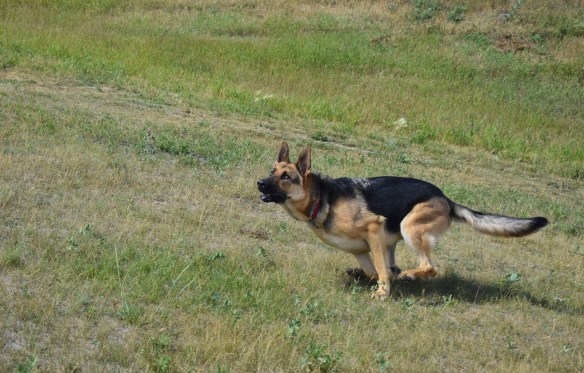
 

chase

Milo’s a pretty intense chaser of things.

But what about second order desires? Can Milo want to want something?

He has conflicting desires. For example his desire to chase things and please me almost always conflict. You can see this in his behavior. When I ask him to sit in the absence of anything ‘chaseable,’ he plops his bum down and looks up at me with soft eyes. He is alert and relaxed.

When I ask him to sit while a skateboard whizzes by, he sits but hums with tension. His whole body focuses on the potential chasee. Hips tense like a runner in the starting blocks. One paw lifted anticipating his first bound. If I released him, he’d be off like a rocket. But, he restrains himself, because I ask him to.

He and I do all sorts of exercises to help him learn self-control, and you can frequently see him wanting to do something, and not doing it.

But, wanting two conflicting things, or wanting something and not acting on that desire, can be different from having a second order desire. I doubt Milo is thinking anything like, “Boy, I sure wish I didn’t want to chase that dude on the skateboard.”

However, if I consider Milo and me as a unit, I am the part of that unit with the second order desires. In other words, I think that MY desires can play the role of second order desires for Milo and here is where his vulnerability and my responsibility come into the picture.

Humans foster first order desires in dogs in lots of different ways:

  1. Herding and hunting dogs are bred to be biddable. A biddable dog wants to please its handler. A dog bred to work with a person to herd livestock needs to figure out what its person wants it to do and do it. Milo is biddable—he wants to please me—in large part because he’s a German Shepherd Dog, and through careful breeding, humans made German Shepherd Dogs biddable.
  2. Milo and I have a healthy relationship. I took a workshop from a hardcore Schutzhund trainer, and she commented, “He really loves you.” What a great compliment! I work hard on Milo and my relationship, which isn’t difficult because he’s an angel. We love and respect each other. This relationship contributes not to his general biddability, but to his biddability to ME. I nurtured his first order desire to please ME.
  3. Training a dog involves manipulating its desires. In all strictness, I don’t train Milo to sit. I train him to want to sit when I tell him to. I pay close attention to what he values, and by controlling his access to those things, I can make him value other things.

Here’s how all this plays out. Milo has first order desires to please me and to chase skateboards. I have first order desires for chocolate cake and for Milo NOT to chase skateboards. So, if we think of the two of us as a unit, he and I both individually have first order desires. Additionally, I have second order desires for both of us, and I can manipulate Milo’s first order desires. I am the one who wants him to want things. I can make him want to sit more than he wants to chase.

Vulnerability and responsibility.

Sometimes we humans manipulate dogs’ desires to make them perform dangerous work. Police dogs, military dogs, and even search and rescue dogs put their lives on the line for us.

I don’t put Milo in danger, in fact, most of his training is to keep him safe, but I do manipulate his desires. I don’t just have the power to confine him physically. I have the power to confine him psychologically and emotionally, not with harsh punishments, but by controlling what he values, and what he desires.

I have to admit that he trains me as well: how can I not desire to scratch his head when he lays it on my lap and looks up at me with his big brown eyes? But when I train him I have science, coaches, and 150 years of selective breeding on my side.

This makes him vulnerable to me, which is a responsibility that I take seriously.


The recall and things that go bump in the night

via Daily Prompt: Calling

Anyone will tell you that a rock-solid recall is one of the most important things to teach your dog. It keeps them safe—safe from cars, dog fights, rain-swollen streams, and all manner of spooky things in a dangerous world.

And, it saves you from being that person chasing after their own dog. Face it, most dogs are faster and agiler than most humans, and whether you use your pudding voice, your Darth Vader voice, or your squeaky voice, if they don’t want to come to you, they won’t. You see it all the time at the park, when a person wants to leave and their dog doesn’t, the process of leaving can take half an hour.

But don’t forget that in addition to calling our dogs to keep them safe and calling our dogs because there’s a task to do, there’s also calling our dogs because we want to be with them.

Sometimes I call Milo the AwesomeDog for the same reason I call my sister. I want to spend some time with this creature who loves me.

If I’m watching TV, and Milo’s laying in the other room, sometimes I call him. He’ll come running in, and I’ll grab his collar and give him a treat. But then he gets to decide what to do. Most of the time he makes the choice I’m hoping for and sticks around to keep me company.

And sometimes, when things go bump in the night, I call him. It is nice to know that, as the Scots almost say

From Ghoulies and Ghosties,
And long-leggity Beasties,
And all Things that go bump in the Night,
A Good Dog delivers us.

silhouette of a German Shepherd Dog against sunset on a lake


Staying safe on winter walks

v5

Milo loves the snow

While there are things that worry me about walking with Milo in the Canadian winters, the cold isn’t one of them. With good gear and common sense, the cold is not that hard to manage. Besides, Milo loves it, or at least he loves the snow. He frisks like a puppy when he sees the white stuff falling. But I do worry about

  • slipping on the ice,
  • Milo hurting his paws, and
  • getting hit by a car.

Here’s how I minimize those risks:

To protect myself slipping on icy streets I wear Yaktrax, which are traction devices that attach to the soles of your boots. I like this brand because they tend to stay attached and they’re not sharp, so you won’t accidentally cut yourself (or your dog).

I apply Musher’s Secret, a good paw wax, to Milo’s paws before we head out. This protects him from sharp ice and rock salt, and slows down the build-up of snow between his toes. It is worth the cost because I want him to be comfortable and the thought of restricting Milo’s exercise while his paws heal makes me shudder.

v2

Please drive carefully!

In my part of the country and in my neighborhood, drivers speed. Although this sort of irresponsible behavior makes me angry, it actually makes me furious, aside from shaking my fist there is not much I can do. Add slippery streets and the fact that in midwinter it’s dark by 5 PM, to the scofflaw speeders, and walking in my residential neighborhood becomes downright dangerous. Milo and I both have dark coats, so I put a reflective vest on him, and I wear a blaze orange touque. When people see us, they might think we look bizarre, but at least they see us! Milo loves his vest because it reliably predicts a winter walk.

BTW, as I was working on this post, I came across a similar article over at Maplewoodblog.  You should check out how she manages her winter walks. Hint: she likes Musher’s Secret and Yaktrax too.

What do you do to keep safe on your winter walks?


Rally Obedience: E​ngagement and trust

Milo and I just earned a score of 96 / 100 at the mock trial that was the final exam in our advanced Rally Obedience class.

I wish Milo the AwesomeDog could read because this post is all about thanking him for being such a wonderful partner.

attentionMilo was super engaged during the trial. This means that he was paying attention to me with laser focus. He was not asking, but demanding, that I give him a job to do and he put his whole self into doing what I wanted. He didn’t just walk, he pranced. He didn’t just jump, he leaped. He was beautiful, and we were a team.

One of my classmates praised him for being so “sharp.” She said, “his eyes are always on you, even when you’re talking to someone else.” I don’t think she realized how grand, and complicated, this compliment was.

It is not just his nature to pay attention like this. He and I worked through some difficult things together, and we developed a solid relationship. We both know that we have each other’s backs and that the world is better and safer when we’re a team.

Also, we practice engagement almost every day. We spend more time training this than anything else. I say “look,” he looks me in the eye, and I give him a treat or a game of tug or a cuddle. We do this before breakfast, on walks, when we go to new places, and when we’re watching TV at night. You can train a dog to pay attention to you. When you have that under your belt, everything else gets easier.

When Milo is engaged it is a big deal–he’s 90 pounds of muscle and smart as a whip. It’s a big deal because he’s trusting me and putting all of his brains and brawn at my service. That trust and willingness to work for me with his whole magnificent self is a gift for which I am profoundly grateful.

Thank you, Milo.


Animals in our lives: A philosophical investigation of the science of companion animals

I am terribly pleased to announce that I’ll be teaching Philosophy 271: Animals in our Lives, a new course offered by the Philosophy Department at the University of Waterloo in Ontario, Canada.

This class is a philosophical analysis of contemporary scientific research on companion animal (mostly canine) cognition, emotion, and training.

The students and I will explore:

  • how this scientific research is embedded in contemporary culture,
  • the practical influences on, and impacts of, this research, and
  • the role of values and ethics in the creation and use of this new scientific knowledge.

I’ll keep you posted as I develop and implement this course. I am So. Excited.

Phil 271 Animals in our lives

Learning how to play fetch with Milo: We only play games we both want to play!

Generally, a game of fetch involves a person throwing a ball, and a dog running after it and returning it to the person. Imagine my surprise when my Fitbit informed me that I walked a kilometer and a half during a short game of fetch. It seemed Milo and I were doing this wrong.

So, the next time we played fetch, I pretended to be an anthropologist observing this game while we were playing it. “What are these strange creatures doing with that round yellow thing on a string?”

I observed that Milo and I weren’t playing one game, we were playing two. The first game looked a lot like fetch. He’d go chasing after the ball and bring it back to my general vicinity. The second game included two things he loved: hanging onto the ball and being chased by me.

pls throw

The trouble is that while Milo loves both games, I only want to play the first one. That clever, clever dog had me playing a game I had no desire to play. Hmmm.

Here is what I did:

I made up some rules for our game.

  • I throw the ball. If he brings it back to me and stays close enough for me to grab his collar, I throw a little happy party for him and immediately toss the ball again.
  • If he doesn’t bring it back to me and stay close, I go get him. But when I go get him, I quietly snap on his leash and we walk off the field for a couple of minutes.
  • His choice: play fetch by the rules, or not play at all.

Within 40 minutes, he was choosing to play by the rules. I was shocked at how fast this happened.

I noticed a neat thing when he started playing by the rules. He’d bring the ball back to me, and then move his head, or move one front paw, like he was starting the Keep-Away Game, and then he would stop and settle back down right close to me as I grabbed his collar. His conflicting desires were revealed by those small movements. I would love to know what it was like for him inside his doggy mind as he stopped himself from making a choice that would not get him what he wanted.

Here are some things I am going to try to remember from learning how to play fetch with Milo:

  1. I need to stop, watch, and think about Milo and my interactions.
  2. It is good to take a bit of time to make a plan.
  3. Milo and I will only play games that we both want to play.

handsome Milo


Gift ideas for people who love dogs (and science)!

Books! Books! Books! I went from being a shy nerd in high school to being a proud nerd in university. I loved university so much that, except for one mercifully short semester waiting tables, I never left. Proud nerds like to give and receive books. I haven’t read all the books that about dogs and science, but I’ve read lots of them. Here are some that would make good gifts:

My top pick:

what the dog knowsWhat the Dog Knows: Scent, Science, and the Amazing Ways Dogs Perceive the World, by Cat Warren

What the Dog Knows is one of those books that you sit down to read for half an hour, and suddenly three hours have gone by, you’re starving, and it’s dinner time. It’s a page-turner about working dogs who use their sense of smell for a living. Cat Warren, a journalist turned university professor, guides us on a tour of the science of the canine sense of smell, the history of scent detection and tracking, and the practice of training and working with dogs by telling the story of searching for dead people with her cadaver dog, a German Shepherd named Solo.

Runner-up:

the two in oneThe Two in One: Walking with Smokie, Waking with Blindness, by Rod Michalko

This memoir documents sociologist Rod Mechalko’s changing understanding of his own blindness through his relationship with his service dog, Smokie. Although there are places where this book can be a very dense read, it is also touching, and at times funny.

Stranger: Is that one of those blind dogs?

Mechalko: “I hope not!”

The story of the developing trust and respect between this scientist and his dog changed how I think about working guide dogs. And, Michalko’s changing relationship with his blindness made me think about disability not as a lack or absence, but as a different way of being in the world.

Third place:

animals make us humanAnimals Make Us Human: Creating the Best Life for Animals, by Temple Grandin and Catherine Johnson

As usual, Grandin encourages us to pay close attention to the creatures around us. With clear and concrete prose the authors explore the emotional architecture of different kinds of animals to figure out how to maximize their emotional welfare. There are three things that I especially love about this book. First, the authors respect both scientific and practical experts in animal behavior and combine insights from both groups of people. Second, this book highlights the work of field scientists, and the importance of keeping science open to researchers with a wide range of experiences, perspectives, and skills.  Finally, this book is premised on the notion that humans are animals too. The authors use their emotional framework to advocate for creating environments that encourage humans to treat animals in ways that maximize animals’ emotional well being. That is clever and demonstrates an interesting sort of integrity.

Tied for fourth place:

How Dogs Love Us: A Neuroscientist and His Adopted Dog Decode the Canine Brain, By Gregory Berns

The Genius of Dogs: How Dogs are Smarter than you Think, by Brian Hare
how dogs love usThese books offer the reader a glimpse of what scientists actually do. Gregory Berns offers a fascinating discussion of the research ethics involved in training pet dogs to participate in fMRI experiments. He treats his canine research subjects with the same ethical consideration that is mandated for research with human children. Cool.

the genius of dogsWhat grabs me most about Brian Hare’s book is that he doesn’t just explain his experiments, he explains how he developed those experiments and why he ran the experiments the way he did. Reading this book can help a person understand how to think like a scientist. These two books aren’t written with the same grace as my top three picks, but they are both good picks for people who want to think about science and ethics as well as learn something about canine cognition and emotion.

What books would you add to this list?


This blog is about RV travel, dogs, and science.  Here is my RV travel-themed gift list, and here is my German Shepherd Dog-themed gift list. Happy holidays!

Gift ideas for German Shepherd lovers

Are you having trouble coming up with gift ideas for the German Shepherd lover in your life? Here are some possibilities:

Gifts for the dog.

Love me, love my dog. When people buy my dog Milo presents, I find it adorable. What to get though?

Dog treats and chews! Just remember that GSD’s can have finicky stomachs, so it’s a good idea to snoop around and see what your friend usually gives her dog. Or, you can ask for her advice on good treats and chews, and she’ll likely tell you all you need to know.

  • Bully Sticks are great chews but can be pricey, so they make a great gift.

Toys! My dog is a pretty typical GSD in that he goes through toys like a wood chipper and so new toys are always appreciated. If you like the person, avoid squeakers!

Consumables. 

Admittedly these gifts are utilitarian instead of romantic. But a dog lover can always  use things like:

Coupon book for dog chores.

To have a German Shepherd is to love a German Shepherd, but these dogs are a lot of work. One gift idea is to make a coupon book for dog chores that you’re willing to help out with. Warning, this only works if you have zero responsibility for the dog. It’s not a gift if it is something that, in all fairness, you should be doing already. Here are some ideas for the coupons:

  • Walk dog on a cold day
  • Walk dog on a rainy day
  • Clean up poop in the yard
  • Bathe dog
  • Dremel dog’s nails
  • Vacuum furniture
  • Vacuum house
  • Vacuum the car

German Shepherd themed stuff.

German Shepherds are the second most common dog breed in North America, and our make-a-lot-of-junk industrial complex has capitalized on this fact. You can buy German Shepherd themed everything–seriously you can find pictures of German Shepherds on everything from pot holders, salt shakers, and coffee mugs, to leggings, hats, and hoodies, to keychains, mousepads, and Christmas tree ornaments. Type “German Shepherd” into the search fields on etsy.com or amazon.com and you’ll have more ideas than you can throw a stick at.

Why not get a cute German Shepherd tote bag, and fill it up with all sorts of fun doggy things?

Walking in a winter wonderland.

German Shepherds take their people on long walks in all sorts of weather. Anything that takes the sting out of cold winter walks will be appreciated: gloves, hats, scarves, socks, insulated coffee mugs, you get the picture.

Jewelry.

It is easy to find all sorts of GSD themed jewelry. Most of it is cute, but much of it is of questionable quality. Remember that you get what you pay for.

What about a locket with a picture of your friend’s dog in it? eBay always has an excellent selection of lockets that won’t break the bank. And if you have money to burn, you can’t go wrong with Tiffany’s!

Photos from the heart.

Do you have a great shot of your friend and their dog? If you do, put it in a frame and wrap it up! You could also find a high-quality pet photographer in your area and treat your friend to a professional photo shoot.

Worst Present EVER.

Are you a risk taker? Some people call German Shepherds “German Shedders.” These dogs leave clouds of fur, all over the house, all year long. If you’re brave and have zero romantic hopes about the dog lover in your life, you might consider giving them a vacuum.

What items would you add to this gift list?

This blog is about RV travel, dogs, and science. Click here for my RV travel-themed gift list and stay tuned for my science-themed gift ideas 😉