Aaron Provincial Park, Ontario, Canada

This park was stinky. Literally. I pulled into a campsite generously decorated with dog poop. While I was cleaning up it occurred to me that I had a neighbour who either lets their, evidently large, dog run loose, or is the sort of person who watches their dog poop in someone else’s campsite and thinks, “I’m just gonna leave that sitting right there.” I was looking forward to meeting this person, and their dog. It was going to be great. I knew it.

Sure enough, on Milo and my first walk two retriever-ish looking dogs galloped toward us while their owners yelled from their camp chairs, you guessed it, “don’t worry, they’re friendly.”

I yelled back, “I’m not.” It just popped out, no mincing of words at all. And at that moment, it was true. “Those dogs need to be on leashes.”

The indignant response was, “I don’t know why you’re upset. We haven’t had any problems.”

I saw this as invitation to describe the poop, and, you know, the law, which didn’t go over so well. Who would’ve thought? The best part was when they explained to me, and my fabulous gigantic German Shepherd Milo, that if I didn’t like dogs, I probably shouldn’t go camping. Oh boy, time to walk away. That time was actually long past, but as they say, better late than never. Some people.

In case you are wondering, here are some relevant bits of law:

Domestic and other animals

6. (1) No person in control of a domestic animal shall permit the animal to be,

(a) in a provincial park unless the animal is secured on a leash that does not exceed two metres in length;  …

(4) No person shall permit a domestic animal, while in a provincial park, to

(a) make excessive noise;

(b) disturb other persons;

(c) damage Crown property or vegetation;

(d) chase or harass wild animals or birds;

(e) injure, or attempt to injure, a person or other domestic animal.  O. Reg. 347/07, s. 6 (4).

(5) The person in control of a domestic animal shall immediately dispose of excrement from the animal in such manner and at such location that it will not cause a health hazard or public inconvenience.  O. Reg. 347/07, s. 6 (5).  …

I am sure these people are not a permanent fixture at Aaron Provincial Park, but I let them colour my experience of the place more than I should’ve. Thank heavens I discovered the group campground, a grassy field with picnic tables, empty. Milo and I spent a lot of time there romping, playing tug, training, and reading magazines (Milo didn’t read magazines as much as sat there and chewed a toy).

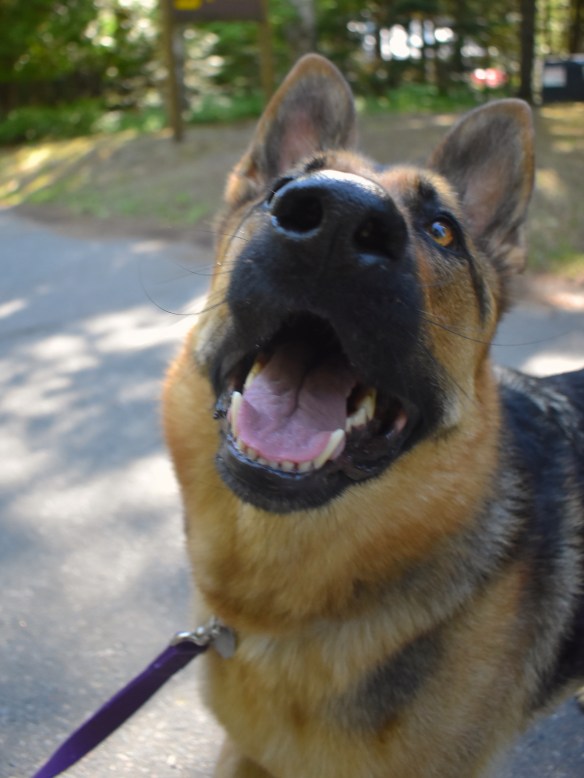
a black and tan German shepherd dog looking up at the camera. Fis shiny black nose is the highlight of the picture.

I can’t stay mad when I look at this big happy nose. Also, notice the leash…

Aaron Provincial Park is conveniently located on the Trans Canada highway just East of Dryden, Ontario. It lacks a sanctioned off leash pet exercise area.

Training plan for the week of July 25: The novice rally signs

As I’ve said before, my goal is to earn a Novice Rally Obedience Title with Milo. In a Novice Rally trial, the judge creates a course of 10-15 obedience exercises and evaluates a dog-handler team as they work through those exercises. According to the Canadian Kennel Club

The chief objective of rally is to provide a fast-moving and motivational activity that demonstrates the competency of handler and dog in performing basic obedience exercises without requiring exact precision for success. 

This German Shepherd earned a perfect score on a novice course.

Most of these exercises Milo and I have been doing for ages. The fancier heeling patterns will need some attention, and I need to keep working on Milo’s engagement in new and distracting environments.

Also, there are signs that indicate which exercises a team needs to perform. Some of them are pretty obvious, and some aren’t. I need to study.


So, the plan for this week is pretty straightforward:

  1. Practice engagement in distracting spots.
  2. Work on our Figure 8 heeling pattern.
  3. Familiarize ourselves with the signs indicating various exercises.


Training log: Road trip potty breaks as training opportunities?

If you’re new to this blog, you should know that I’m in the midst of a massive road trip with my German Shepherd Dog, Milo. So far this month we’ve put on about 2 000 km.

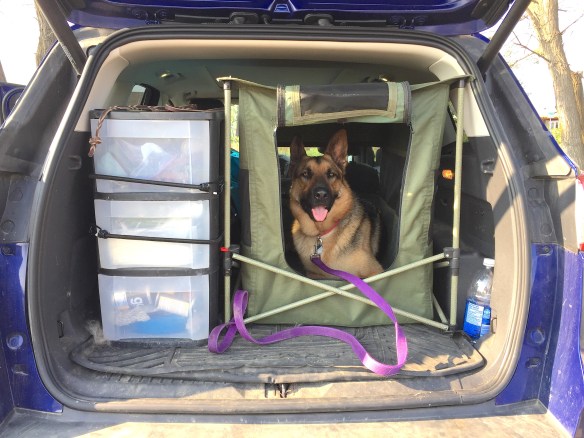
Black and tan German Shepherd Dog in a green canvas crate in the back of a dirty SUV.

Milo happy in the vehicle.

At times, Milo can be like the Energizer Bunny on Speed, so it is surprising how good he is on these long rides. He’ll whine with excitement if he thinks we’re going swimming, but other than that he settles down pretty quickly for a nap. Every hour and a half or so I pull over, give him a bathroom break, a drink, a quick walk or a game of tug, and off we go again.

It occurred to me that I was missing some pretty good training opportunities with these breaks. After an hour in the truck Milo is a little bored, a little lonely, and super drivey–why not make use of that?

So, breaks are now mini-training sessions. They look like this:

I pull over, pop on his leash, and let him have a quick sniff and a pee. Then, right away, we do a bit of focused heeling and he gets a mighty game of tug. Then we do just a couple of other things–only for about five minutes–with lots of reward play. Once we are both out of breath, I give him a drink, pop him back in his kennel, and we drive for another 150 kms.

Milo seems just as happy after these mini-training breaks as he is after our non-working breaks, maybe happier since he gets to think and I spend the break time paying close attention to him.

Do you see any pluses or minuses with using these breaks for training? Any suggestions?

From The Science Dog: Do dogs have negativity bias?

Sometimes, psychological similarities between dogs and people can be bad for dogs. Linda Case at The Science Dog provides insightful analysis of research on how dogs mirror emotions displayed by humans and other dogs. She writes,

Negativity bias – We all suffer from it.

This is the phenomenon in which we naturally pay more attention to and give more weight to negative information and experiences compared with those that are positive. It is this particular cognitive bias that causes us to be more hurt or discouraged by insults or criticism than we are pleased or encouraged by compliments and shining reviews.

Case points out that human negativity bias is common in training relationships: handlers are more likely to notice and correct unwanted canine behaviours, than they are to notice and praise desirable canine behaviours.

However, the study Case analyzes looks at this issue from a dog’s point of view. Researchers recorded dogs’ responses to positive and negative vocalizations produced by people and by other dogs. They found that when dogs heard negative sounds from either species they

froze in place more often, remained immobile for longer periods, and showed more signs of stress and arousal than when they listened to positive vocalizations from either a human or another dog.

Case points out that dogs may experience negativity bias. This means that our poor pooches get a double whammy–not only are we likely to respond disproportionately to our dogs’ bad behaviour (our negativity bias), but our dogs are likely to respond disproportionately to our negative reactions (their negativity bias).

Case has a clear take-home message:

Knowing that dogs are naturally more sensitive to negative information (and emotions) than to positive and also knowing that dogs react to the negative emotions of others with stress, then it is a no-brainer to conclude that we should avoid aversives when we train and interact with our dogs. There are of course many reasons that we should focus on positive reinforcement and reduce or eliminate the use of aversives in training. This research just adds one more – negative emotions (harsh voice, hard stares, anger) emotionally bleed into our dogs and cause them to be unhappy and stressed. Not only are they aware of these emotions in us, they may be more sensitive to them than we have previously realized.

This motivates me to renew my efforts to notice, be grateful for, and reward my dog’s good behaviour. Milo the AwesomeDog is laying nicely on his bed right now. I’m off to give him a cookie.

Training log—oops

This past week I was so caught up traveling with Milo that the whole notion of working with Milo fell by the wayside. Oops. That’s OK (right?), everyone needs a vacation. Today we got back in the groove, at least a little bit.

German shepherd dog with intense and happy facial expression.

Milo is very much ready to work.

When I asked him if he was “ready to work,” which is our cue that it’s training time, he lit up like a Christmas tree. Evidently, he was ready to work.

I didn’t have a plan, so this was more like farting around than working. But we had fun.

  • We did some obedience basics: sit, down, stand.
  • We did a few recalls on a long line, which are also practice waiting and coming to front.
  • And then I laid down a couple of tracks and he worked them out.

Training is usually a lot of fun for both of us, I think because it requires that Milo and I pay single-minded attention to one another. It is actually quite a feat of interspecies communication: I ask him to do something, and he figures out what I’m asking and does it. We work hard at understanding each other. When the communication fails, we learn, and when it succeeds, we celebrate. The best thing about today’s session though was Milo’s happy face.

Make camping fun for your dog too!

Too many dogs were getting yelled at in my campground today. They were barking, whining, and generally carrying on. Parents and kids both were shouting for their dogs to “knock it off.”

I get that camping with a family and with pets is overwhelming. And I get that these dogs were irritating. I found them irritating, from a distance. But the yelling wasn’t working. The dogs kept on doing the irritating things they were doing.

And the yelling wasn’t fair either.

Those parents sent their kids to the beach, the whole family went bike riding, there were campfires and s’mores. I bet there were coloring books and decks of cards at the ready in case of rain. Most of those kids had other kids to play with, and were having a great time.

The dogs on the other hand, were relegated to a pen or tie out, alone, in an out of the way corner of the campsite. It is no surprise they were acting up. They were in solitary confinement and were bored. For some of them, the yelling was probably the most interesting part of their day.

So, I got to thinking about what folks could do to help Rover be less of a pain, and to save themselves from all that yelling. Here are some ideas for making a camping trip fun for your dog:

  • Set up your dog’s pen near the action. Put it next to your hammock or beside the picnic table so that your dog doesn’t have to be alone.
  • Crate train your dog and bring the crate along. For many dogs, their crate is their happy place. Why not bring it? It’s a good way to confine your pet in a safe and comfortable place. And for some dogs, it helps them stay calm.
  • Make sure your dog gets lots of exercise. A tired dog is a good dog. Look for a campground with a dog beach or a big pet area so that the two of you can enjoy a good game of fetch, and Rover can burn off some energy.
  • Bring along things for your dog to do. Bringing a range of interesting chew toys for your dog is like bringing along a deck of cards for the kids. The idea is the same, keep them busy doing something that you want them to do.
  • Or, how about challenging your kids to teach Rover some new tricks on the camping trip? That way you can keep them both happy and busy.

Sometimes it’s just too much to manage kids and a dog. That’s OK, we’re only human. Maybe the right thing to do is leave your pup with a friend or relative or at a trusted kennel. After all, camping is supposed to be fun!

Do you have any suggestions for keeping your dog be happy and well behaved when camping?

Dogs in MRIs: Science, brains, and love

Dr. Gregory Berns and his team at Emory University are trying to figure out how dogs’ brains work by training them to lay perfectly still inside a MRI machine. The researchers measure the way a dog’s brain ‘lights up’ when she thinks about different things. I just read an article about this research by Gregory Berns and Peter Cook called “Why did the Dog Walk into the MRI?” What grabbed me most about this article was the justification for doing this research in the first place.

Berns and Cook point out a bunch of good reasons for studying dog cognition and neurobiology.

They note that humans and dogs have evolved to be partners and learning about dog brains can help us understand these evolutionary processes.

They also note that dogs are a good study species because humans are part of dogs’ ‘natural habitat.’ Most of the species we study, rats, pigeons, and monkeys, are in unnatural conditions, which can have a big impact on their behavior and lead to unreliable scientific results. In this respect Berns thinks we can actually do better science on dogs than on species that we don’t naturally interact with.

While I think that the idea of a ‘natural habitat’ is not very clear, and there certainly isn’t much that is natural about putting a dog in an MRI machine, humans do have a long history, an evolutionary history, of collaborating with dogs. In this sense, the training that is part of these experimental protocols is more ‘natural’ for dogs than for likely any other non-human species. I find this interesting.

Finally, Berns and Cook think that because of the close relationship between our species dogs could provide useful models for research on human social behavior, and they might even be useful models for studying human medical disorders such as depression or anxiety.

Dog brain question

my rendition of Milo’s brain

Given all of these scientific benefits, it is surprising that we don’t know much about dog brains. The authors suggest two reasons for this gap in our knowledge. First, dogs are our friends and so there is a cultural aversion to conducting invasive experiments on them. And second, most dog research is based on a citizen science model—everyday people bring in their pets to take part in the experiments. So, of course we can’t actually look in those dogs’ heads.

“Mommy, why is Fido laying so still?”

“We donated his brain to science dear.”

Not a research model likely to get much traction. [Although, I have to admit on days when Milo is engaging in what I call ‘high-jackassery’ this seems tempting. “You want to look at Milo’s brain? Go ahead and take it, he’s not using it. By the way, you’ll need tweezers.”]

MRI lets researchers check out what is going on with a dog’s brain while it is still inside the dog’s head. In other words, it is a non-invasive research method and Fido can go home, play fetch, and cuddle when the experiment is finished.

What’s love got to do with it?

One of the things that philosophy of science investigates is what makes scientific research a good way of producing knowledge. The philosopher of science in me is intrigued because the reasons Berns and Cook give for using their method of studying dog brains arise from the relationships between dogs and people, relationships that can include engagement, respect, and love. There is a tendency for people to assume that good science, objective science, requires that researchers be emotionally detached from whatever they are studying.

But, here is a case where our relationships with dogs, as a group, and as individual creatures, drove scientific creativity. Because we love them, we want to know about them and don’t want to hurt them. This lead researchers to develop a new experimental protocol (the whole dogs in MRIs thing) that has the potential to help us learn interesting and important new things. Love lead to good science. I wonder what different things we might know if we loved rats and monkeys like we love dogs?


Training outcomes June 25 – July 1

As I predicted, this was a fun week. Milo and I worked hard on engagement. It amuses me to imagine saying the last sentence in a serious voice because the ‘hard work’ was playing with him all over town. He was a Good Boy! in Victoria Park. Yippee! He was a Good Boy! on King Street. Yippee! He was a Good Boy! on the soccer field. Yippee! As you can see, it was extremely difficult work. tug 2

A while ago I went to a few training sessions with an extremely well respected Schutzhund competitor and trainer, and she mentioned at the end of the first workshop that Milo really loved me. I didn’t know what to make of that. I suspected it was sort of like complimenting a job candidate on his suit–you know, when you need to find something nice to say and have to dig deep to find it.

“At least your dog loves you…”

But it wasn’t that at all. A strong bond with your dog makes training easier.

When I was a student, I had some professors who I was very fond of. I looked forward to going to their class, I wanted to learn from them, and I wanted them to think well of me. It is not surprising that those were the classes where I earned some of my best grades.  These days I try to be one of those professors when I teach university students.

And funnily enough, this is what I’m going for when I teach Milo too. I want him to want to learn.

My advice? Go play with your dog!


My method is scientific 5: Responsible use of science

There is a very high bar for claiming that a dog training method is scientific. Not only does there have to be peer-reviewed research studies, but there also has to be a bunch of them, and they need to directly refer to the training method in question. It is a difficult standard to meet.

Just because it is difficult to meet this standard, it most certainly doesn’t mean that we should abandon scientific research on dog training. What the high standard does mean is that we need to be careful, responsible, about how we use scientific information.

In the rest of this post, I’ll explore just how high that bar is, and give you an alternative way, a responsible way, to think about and use scientific information about dog training methods.

What the heck is a body of evidence anyway?

The idea is that there needs to be a bunch of studies and that you need to be on the lookout for studies that support your training method AND studies that don’t. It’s not immediately clear how many studies make a bunch, or how to balance the studies that support and that don’t support a particular method. Most of the time a person has to rely on scientific experts to get an overall idea of the degree of support for particular methods.

Philosopher Heidi Grasswick has argued that it should be part of the job of science to sift through the evidence it generates and provide us with usable, significant information. However, there is not much motivation for individual scientists to do this time-consuming work. Thankfully, when it comes to veterinary and human medicine and public health, there are professional and government organisations we can turn to for this sort of expertise.

For example, the Canadian Veterinary Medical Association has a Humane Training Methods for Dogs position statement. In this statement, they recommend reward-based methods, and discourage aversive methods, and do not recommend aversive methods unless reward-based methods have failed and unless the aversive methods are used by a skilled person. They provide citations to the scientific literature supporting their claims, and you can use those citations to track the research papers down for yourself. However, even this position statement is not especially specific about particular training methods. It pretty much advises us to be as humane as possible.

Is the evidence ever directly about what you do with your dog?

If a person wants to call a dog training method scientific, then the scientific research should be about the dog training method they are actually talking about. This seems obvious, but in fact, there is rarely, some might even say never, a direct connection between the research and dog training practice. One reason for this mismatch is that studies are conducted under controlled experimental conditions, and dog training happens ‘in the wild,’ or at least in the more complicated everyday situations that we find ourselves in. The context the dog-handler team is working in, the skill of the trainer, the temperament and experience of the dog, all make a difference. Also, sometimes, a lack of communication between scientists and dog trainers can result in them using the same name to describe what are, in practice, different training methods.


The bottom line is that it is difficult to be justified in claiming that a training method is scientific. But don’t give up on scientific approaches to dog training.


A matter of degree

Instead of thinking of the scientific nature of a training method as an all or nothing sort of thing, we need to think of it as a matter of degree. Some training methods are supported by more evidence than others, and the scientific research can be more or less like what we actually do with our dogs.

When we point to a method as being scientific, our usual goal is to justify our use of it or recommend it to others. More evidence that is closer to our training method, justifies us in giving a stronger endorsement or recommendation of the method as scientific. It’s not an on/off switch; it’s a volume control knob.

Take care though, because scientific evidence can’t give us 100% certainty that a method is the best possible method. In addition to the tricky nature of evidence and the fraught relation between science and practice, science can only test what we have dreamed up in the first place. It is completely possible that someone will come up with a new method that is better than anything we have right now. Also, science is trustworthy because it depends on the experiments we’ve actually done and the measurements we’ve already taken. This means that we always need to be open to changing our minds in the face of new experiments and new evidence.


Responsible use of scientific information means calibrating our endorsement of a method as scientific to the quality of the evidence supporting that method.


Note: this is my fifth post in a series on scientific dog training methods.

  1. “My method is scientific” 1: “That’s right, I said ‘SCIENTIFIC’!”
  2. “My method is scientific” 2: What does this even mean?
  3. “My method is scientific” 3: The trouble with clicker training
  4. “My Method is scientific” 4: Science, goodness, and goals
  5. “My method is scientific” 5: Responsible use of science
“My method is scientific” 4: Science, goodness, and goals

brown cartoon dog, standing on hind legs, with a surprised expressionI bet if a person gave their puppy an excruciating correction every time he laid a foot on the carpet, they could train that dog to stay off the rug in a heartbeat. But, I wouldn’t train a puppy that way. And even if I found a hundred scientific papers demonstrating the success of this method I still would not use it, nor would I recommend it to anyone else. I think it’s wrong. It goes against my values.

Often, when we latch onto the ‘scientificness’ of a training method, we’re trying to justify and recommend its use. Why should you use this method? It must be good. Science says so!

What kind of ‘good’ are we talking about?

The connection between science and goodness is complicated. While we’ve used scientific knowledge to cure disease, improve public health, and build bridges, we’ve also used it to build bombs and torture people.

When we’re talking about the scientific goodness of a dog training method, we’re not talking about moral goodness. Rather, we’re talking about practical goodness or effectiveness. Practical goodness or effectiveness demands the question, “Good at what?” In this sense, a person can be a good doctor or a good torturer (or a good dog trainer). It just means that whatever they’re doing, they’re doing it well. This kind of goodness is relative to a set of goals.

By praising a training method for being scientific, we’re justifying it, or recommending it, because there is scientific evidence demonstrating that it meets a set of training goals better than alternative methods.

This doesn’t say anything about what your training goals should be. That is up to you.

What kind of goals are we talking about?

Generally, we want our dogs to be happy and perform their jobs well. But, there is a wide range of specific goals we could pick. Here are just a few ways our goals can vary:

Goals vary with respect to projects

Is someone working on rehabilitating a rescue dog, or training a lap dog, a protection dog, or a guide dog? They’ll definitely teach these dogs different behaviours and might teach these behaviours using different methods. Teaching a good strong bite isn’t a goal of most people training lap dogs. Specific goals depend on the projects a person and their dog are working on.

Goals can vary in terms of mastery: reliability and precision

Trainers can have different goals about the level of mastery their dog needs to attain.

When someone asks a pet dog to heel, they usually want it to walk in the general vicinity of their left side. In an obedience competition a dog that gets a step ahead or behind the handler, or drifts away from parallel to the direction the handler’s facing, loses points. In some cases, precision is more important than others.

Or, imagine teaching a dog ‘out.’ ‘Out’ means drop whatever is in your mouth. When a pet dog hears “out” it usually means “drop that ball.” When a police dog hears “out” it can mean “let go of that person.” In some cases, reliability is more important than others.

Teaching new behaviour is different from extinguishing an entrenched, self-rewarding behaviour

Milo doesn’t really care if he is standing or sitting. I used marker training to teach him to sit on command. It went like this:

Carla: “Milo, sit.”
Milo sits.
Carla: “YES!” Gives Milo a cookie.

Milo learned an easy way to get cookies. Sometimes he walks up and offers a sit and an intent gaze. He’s clearly saying, “Hey lady, I’m sitting here, and I’m short on cookies.”

On the other hand, I had to teach Milo not to chase bikes. He has huge prey drive, which means that, to him, chasing is its own reward. When he chases, he is giving himself his favourite cookie, a cookie better than prime rib.

Teaching Milo to sit and teaching him not to chase are two very different goals that required different methods.

But, aren’t some methods effective at achieving a bunch of different goals?

Yep. Lots of people successfully train agility dogs, protection sport dogs, and pet dogs using clicker training (aka marker training). Clicker training is all the rage. I use this method with Milo whenever I can.

But, funnily enough, there isn’t as much scientific evidence demonstrating clicker training’s effectiveness when applied to dog training in general, or to specific training goals in particular, as you might think. There is scientific theory showing that we expect it to work, but not direct scientific evidence showing that it does with dogs. The evidence that it works in a wide range (but not all) situations doesn’t come from scientists, as much as it comes from expert trainers with a track record of practical success.


The bottom line


Just because scientific evidence shows that a method meets one set of training goals, it doesn’t mean that it must meet a different set of training goals.  

And, even if scientific evidence shows that a training method meets a set of goals, a person can decide not to use, or recommend it, if it conflicts with their values.

You can’t decide what the scientific evidence is, but you must decide on your goals and values.


Note: In these posts on scientific dog training, I’m setting a high standard for calling a dog training method scientific. I’ll explain why in my fifth “My method is scientific” post, “Responsible use of science.”

  1. “My method is scientific” 1: “That’s right, I said ‘SCIENTIFIC’!”
  2. “My method is scientific” 2: What does this even mean?
  3. “My method is scientific” 3: The trouble with clicker training
  4. “My Method is scientific” 4: Science, goodness, and goals
  5. “My method is scientific” 5: Responsible use of science