And we’re off

I promised to share my adventures on this trip, but as I pulled out of my driveway on Tuesday morning, avoiding adventures was really my top priority.

That’s why getting a reliable truck and trailer, lots of safety equipment, and a premium CAA membership weren’t splurges.

That‘s why I was shooting for a three hour drive between campsites, and only driving every second day.

I’m actually aiming for peaceful and joyful trip.

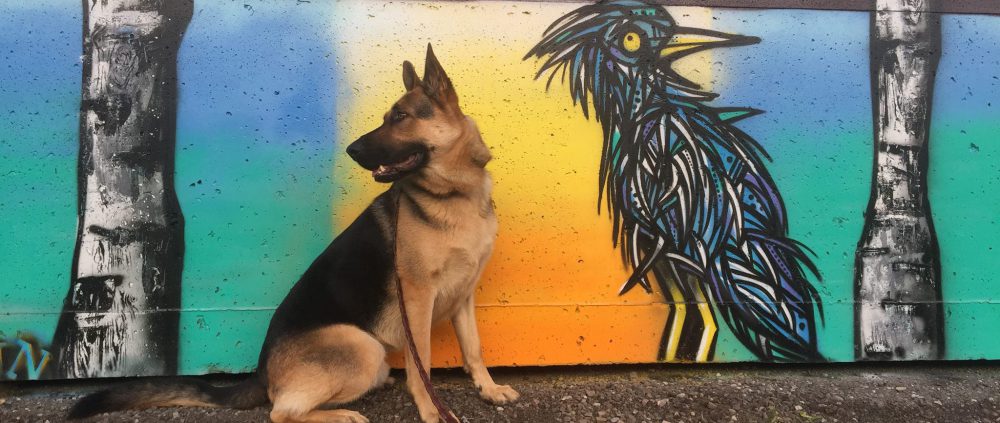
My neighbour took this picture through her living room window as Milo and I were leaving for our first stop at Killbear Provincial Park.

and we're offShe had a lot of time to get her camera because I wasn’t that efficient getting out of the driveway. My Fitbit told me that I put on about 2000 steps just hooking up the trailer.

There are lots of steps to go through to get that thing hitched up:

  • back up to the hitch

    a trailer hitch with chains, break connections, and a weight distribution bar

    lots of things to attach properly…

  • attach the hitch
  • attach the weight distribution bars
  • put up the main jack
  • attach the chains
  • attach the wiring
  • attach the break-away brake line
  • put up the stabilizer jacks
  • pick up the wheel chocks
  • test the signal and brake lights
  • turn off the propane
  • make sure everything is locked
  • put up the step (easy to forget this one)

None of these steps are difficult. They just take time and a bit of elbow grease.

The drive to Killbear was successfully and wonderfully uneventful. I even let my hands stray from 10 and 2 by the end of the trip. I had a pull through campsite, so I didn’t need to do anything tricky like backup my rig.

After the hitching, driving, unhitching, and taking Milo for a walk, I spent my first camping afternoon napping. An appropriate end, I think, for a non-adventurous day.

Good things to bring on a long RV trip with your dog

Milo and I have only been on the road for three days and there are already a few things I’m really glad I brought:

Hands-free leash. It’s nice to have both hands free for taking pictures, carrying things, or just comfortable hiking. When we’re attached I can sit at a picnic table and read without worrying about him.

I have a Kurgo K9 Excursion Running Belt. I bought this particular brand because it happened to be in the store and I didn’t have time to shop around. If you’re crafty you could easily make one. The Kurgo is good but not perfect. I like that it’s stretchy and the wide waistband is comfortable. The pockets for keys and poop bags are convenient, but the water bottle is too small to be useful. Milo could break the leash clips if he put his mind to it. But, I’m OK with this unintended break-away option. I don’t want him pulling me over any cliffs! If there is a situation where he might lunge, I can thread the loop of his leash through the belt itself. A hands-free leash makes setting up camp easier.

campsite with picnic table, blue suv, camper trailer and German shepherd dog in a pen

Milo lounging in his xpen

Exercise pens. I brought two 48-inch-tall exercise pens and an aluminum shade cloth. These make an easy to assemble and secure home for Milo. I can put him in there with a bed, a bowl of water and a frozen Kong and he is good for an afternoon of lounging and listening to the birds.

Frozen Kong fixings. My camper has a freezer and I brought some high quality wet dog food and two Kong toys. A can of food is enough to fill two toys, with just enough left over for a little snack for The Boy. Freeze those Kongs solid and you have a long-lasting, highly engaging dog snack—great for rainy afternoons or days when I am done walking before he is.

Not all the good things are for Milo. Some of them are just for me:

Olives.  You know what is better than salty olives after a long hike? Nothing. Total yum.

A nice plastic beer glass. This was an impulse buy at a box store just before we left. A nice cold beer in a pilsner glass goes well with the olives.

Happy camping!

Dogs in MRIs: Science, brains, and love

Dr. Gregory Berns and his team at Emory University are trying to figure out how dogs’ brains work by training them to lay perfectly still inside a MRI machine. The researchers measure the way a dog’s brain ‘lights up’ when she thinks about different things. I just read an article about this research by Gregory Berns and Peter Cook called “Why did the Dog Walk into the MRI?” What grabbed me most about this article was the justification for doing this research in the first place.

Berns and Cook point out a bunch of good reasons for studying dog cognition and neurobiology.

They note that humans and dogs have evolved to be partners and learning about dog brains can help us understand these evolutionary processes.

They also note that dogs are a good study species because humans are part of dogs’ ‘natural habitat.’ Most of the species we study, rats, pigeons, and monkeys, are in unnatural conditions, which can have a big impact on their behavior and lead to unreliable scientific results. In this respect Berns thinks we can actually do better science on dogs than on species that we don’t naturally interact with.

While I think that the idea of a ‘natural habitat’ is not very clear, and there certainly isn’t much that is natural about putting a dog in an MRI machine, humans do have a long history, an evolutionary history, of collaborating with dogs. In this sense, the training that is part of these experimental protocols is more ‘natural’ for dogs than for likely any other non-human species. I find this interesting.

Finally, Berns and Cook think that because of the close relationship between our species dogs could provide useful models for research on human social behavior, and they might even be useful models for studying human medical disorders such as depression or anxiety.

Dog brain question

my rendition of Milo’s brain

Given all of these scientific benefits, it is surprising that we don’t know much about dog brains. The authors suggest two reasons for this gap in our knowledge. First, dogs are our friends and so there is a cultural aversion to conducting invasive experiments on them. And second, most dog research is based on a citizen science model—everyday people bring in their pets to take part in the experiments. So, of course we can’t actually look in those dogs’ heads.

“Mommy, why is Fido laying so still?”

“We donated his brain to science dear.”

Not a research model likely to get much traction. [Although, I have to admit on days when Milo is engaging in what I call ‘high-jackassery’ this seems tempting. “You want to look at Milo’s brain? Go ahead and take it, he’s not using it. By the way, you’ll need tweezers.”]

MRI lets researchers check out what is going on with a dog’s brain while it is still inside the dog’s head. In other words, it is a non-invasive research method and Fido can go home, play fetch, and cuddle when the experiment is finished.

What’s love got to do with it?

One of the things that philosophy of science investigates is what makes scientific research a good way of producing knowledge. The philosopher of science in me is intrigued because the reasons Berns and Cook give for using their method of studying dog brains arise from the relationships between dogs and people, relationships that can include engagement, respect, and love. There is a tendency for people to assume that good science, objective science, requires that researchers be emotionally detached from whatever they are studying.

But, here is a case where our relationships with dogs, as a group, and as individual creatures, drove scientific creativity. Because we love them, we want to know about them and don’t want to hurt them. This lead researchers to develop a new experimental protocol (the whole dogs in MRIs thing) that has the potential to help us learn interesting and important new things. Love lead to good science. I wonder what different things we might know if we loved rats and monkeys like we love dogs?


For the love of god leash your darn dog

A post like this is silly because it has already been written about 14 million times. Pretty much all the dog trainers and all the dog professionals and all the municipal codes tell people to leash their dogs. leash

I’m writing it again because Milo and I were charged by a little schnauzer. I scared the little dog off and the schnauzer’s person got angry at me for yelling at their dog. What the what? I know that people respond weirdly when flustered. But seriously, that little dog charged my German Shepherd and I intervened before my dog did. That, my friend, deserves thanks. In fact, it deserves ice cream. Heck, it deserves a bottle of scotch.

This is not a rare event. Milo and I have been charged by Golden Retrievers, Poodles, little terriers, and a bunch of other pups.

I don’t care if the pup is a Yorkie or Mastiff, a puppy or senior dog, or a dog that’s an angel straight from heaven. I really don’t care if the dog is friendly. Even if the handler knows their dog can heel past a butcher shop, I don’t know that, and off leash dogs worry me.

Milo and I worked very hard, for years, to help him stay calm around other dogs. He is gigantic and now his behavior is, mostly, pretty good and so a person might not expect him to be stressed by a charging dog. He is. And so am I.

  • A little dog who reacts to Milo and me is not cute or brave, and does not think it is a big dog. It is probably scared, or perhaps stupid.
  • Yes, I know that Milo could ‘take care of himself,’ but I don’t want him to have to. And, who would want that to happen?
  • No, I don’t want the dogs to ‘work it out.’ That’s a project that could cost 1000’s of dollars.
  • And actually, I don’t want our dogs to say ‘hello.’ If we’re friends and I know your dog, then maybe. But my dog doesn’t play with strangers.

Where there are leash laws, please leash your dog. It’s the decent thing to do.

Training outcomes June 25 – July 1

As I predicted, this was a fun week. Milo and I worked hard on engagement. It amuses me to imagine saying the last sentence in a serious voice because the ‘hard work’ was playing with him all over town. He was a Good Boy! in Victoria Park. Yippee! He was a Good Boy! on King Street. Yippee! He was a Good Boy! on the soccer field. Yippee! As you can see, it was extremely difficult work. tug 2

A while ago I went to a few training sessions with an extremely well respected Schutzhund competitor and trainer, and she mentioned at the end of the first workshop that Milo really loved me. I didn’t know what to make of that. I suspected it was sort of like complimenting a job candidate on his suit–you know, when you need to find something nice to say and have to dig deep to find it.

“At least your dog loves you…”

But it wasn’t that at all. A strong bond with your dog makes training easier.

When I was a student, I had some professors who I was very fond of. I looked forward to going to their class, I wanted to learn from them, and I wanted them to think well of me. It is not surprising that those were the classes where I earned some of my best grades.  These days I try to be one of those professors when I teach university students.

And funnily enough, this is what I’m going for when I teach Milo too. I want him to want to learn.

My advice? Go play with your dog!


My method is scientific 5: Responsible use of science

There is a very high bar for claiming that a dog training method is scientific. Not only does there have to be peer-reviewed research studies, but there also has to be a bunch of them, and they need to directly refer to the training method in question. It is a difficult standard to meet.

Just because it is difficult to meet this standard, it most certainly doesn’t mean that we should abandon scientific research on dog training. What the high standard does mean is that we need to be careful, responsible, about how we use scientific information.

In the rest of this post, I’ll explore just how high that bar is, and give you an alternative way, a responsible way, to think about and use scientific information about dog training methods.

What the heck is a body of evidence anyway?

The idea is that there needs to be a bunch of studies and that you need to be on the lookout for studies that support your training method AND studies that don’t. It’s not immediately clear how many studies make a bunch, or how to balance the studies that support and that don’t support a particular method. Most of the time a person has to rely on scientific experts to get an overall idea of the degree of support for particular methods.

Philosopher Heidi Grasswick has argued that it should be part of the job of science to sift through the evidence it generates and provide us with usable, significant information. However, there is not much motivation for individual scientists to do this time-consuming work. Thankfully, when it comes to veterinary and human medicine and public health, there are professional and government organisations we can turn to for this sort of expertise.

For example, the Canadian Veterinary Medical Association has a Humane Training Methods for Dogs position statement. In this statement, they recommend reward-based methods, and discourage aversive methods, and do not recommend aversive methods unless reward-based methods have failed and unless the aversive methods are used by a skilled person. They provide citations to the scientific literature supporting their claims, and you can use those citations to track the research papers down for yourself. However, even this position statement is not especially specific about particular training methods. It pretty much advises us to be as humane as possible.

Is the evidence ever directly about what you do with your dog?

If a person wants to call a dog training method scientific, then the scientific research should be about the dog training method they are actually talking about. This seems obvious, but in fact, there is rarely, some might even say never, a direct connection between the research and dog training practice. One reason for this mismatch is that studies are conducted under controlled experimental conditions, and dog training happens ‘in the wild,’ or at least in the more complicated everyday situations that we find ourselves in. The context the dog-handler team is working in, the skill of the trainer, the temperament and experience of the dog, all make a difference. Also, sometimes, a lack of communication between scientists and dog trainers can result in them using the same name to describe what are, in practice, different training methods.


The bottom line is that it is difficult to be justified in claiming that a training method is scientific. But don’t give up on scientific approaches to dog training.


A matter of degree

Instead of thinking of the scientific nature of a training method as an all or nothing sort of thing, we need to think of it as a matter of degree. Some training methods are supported by more evidence than others, and the scientific research can be more or less like what we actually do with our dogs.

When we point to a method as being scientific, our usual goal is to justify our use of it or recommend it to others. More evidence that is closer to our training method, justifies us in giving a stronger endorsement or recommendation of the method as scientific. It’s not an on/off switch; it’s a volume control knob.

Take care though, because scientific evidence can’t give us 100% certainty that a method is the best possible method. In addition to the tricky nature of evidence and the fraught relation between science and practice, science can only test what we have dreamed up in the first place. It is completely possible that someone will come up with a new method that is better than anything we have right now. Also, science is trustworthy because it depends on the experiments we’ve actually done and the measurements we’ve already taken. This means that we always need to be open to changing our minds in the face of new experiments and new evidence.


Responsible use of scientific information means calibrating our endorsement of a method as scientific to the quality of the evidence supporting that method.


Note: this is my fifth post in a series on scientific dog training methods.

  1. “My method is scientific” 1: “That’s right, I said ‘SCIENTIFIC’!”
  2. “My method is scientific” 2: What does this even mean?
  3. “My method is scientific” 3: The trouble with clicker training
  4. “My Method is scientific” 4: Science, goodness, and goals
  5. “My method is scientific” 5: Responsible use of science

Dock diving

Yesterday our human friends Jess and Liz, and dog friends Stark and Zefra, invited Milo and I out for an adventure. It was a lovely afternoon, let’s take the dogs dock diving! Hurray dock diving!

Picture a 20 by 40 foot salt-water pool with warm, crystal clear water. A 40 foot dock, and two exit ramps, both covered in astroturf, abut a short side of the pool.

Milo takes one look at this setup and goes bonkers, pulling like an ox toward what he knows is a fun time. Ideally, I put him in a sit-stay at the far end of the doc, walk to the waters’ edge, release him, toss a toy in the water as he thunders down the dock and flings himself through the air and into the pool. I say ‘ideally,’ because that sit-stay is exceedingly difficult for a dog who is part German Shepherd and part otter.

dockdivingBut no matter how he hits the water, he swims out, retrieves the toy, swims back, hauls his panting, dripping self onto the dock and is ready to go again. Not before, of course, striking a pose, head up, chest out and grinning, at the top of the ramp giving all of us a chance to compliment his powerful jumping and excellent swimming. He’s smart, but the joy of jumping drives any sense of self-preservation out of his doggy mind, and eventually I have to force him to take a break.
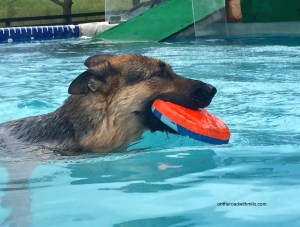
dock diving 2After all the dogs had a few turns, we enjoyed a little swim together and then it was time to dry off, pile back in the van, and take ourselves home. The laughing, cheering, dog wrangling, and of course jumping, leaves everyone pooped. Well, not everyone.
As we were chatting and loading the van Milo leaned into his leash toward the pool, clearly suggesting that there might be time for another dive.

I had to remind him “Milo, you just had a long swim. You’re tired.”

But he explained, “Mom, I was tired 6 minutes ago. It is now a whole new day, and I don’t know if you remember, but there is a pool, right there. If you wouldn’t mind opening that gate, we could, you know, swim.”

I pretended not to understand, a trick he knows well.

A moment later I was distracted and Milo saw his opening. He was off! It was a full on lung toward the pool. I leaned back, and holding on to that leash like a waterski towrope left heel tracks in the gravel in the direction of the pool. Dang dog. I didn’t have the heart to tell him that he was being a bad bad boy. Once I got us both anchored again, he figured out that there was definitely no more swimming that day, and settled back into being a good dog.

One the way home we stopped for burgers and fries at a roadside stand, Milo, Stark, and Zefra laying angelic at our feet. They were happy and tired, and clearly enjoying a steady stream of fries. This is the kind of thing Saturdays were made for. When Milo and I are on the road, we are going to miss these good friends.

Training plan June 25 – July 1

My goal this week is to foster engagement in new situations. I want Milo to actively pay attention to me and want to work, even when we’re in novel or distracting places.

I’ll be following Micheal Ellis’ advice in his video “The Power of Playing Tug with your Dog.” The plan is to take Milo to a new environment, wait for him to look at me, and reward him with a spectacular game of tug when he does. We’ll do this twice a day.

I’m focusing on engagement, right now in particular, for three reasons:

  1. We’ll be leaving on our gigantic road trip soon and every place we’ll be for the next couple of months will be a new place. Working on engagement in new situations helps Milo associate this novelty with good things. Hopefully, this will help the trip be less stressful for him.
  2. Every obedience and rally trail will be in a new place. While I’ll always start by letting him sniff around, he has to learn that even in distracting places the best thing to do is to engage with me.
  3. I’ve been a bit frustrated with our training for the last few days, and the trouble is lack of engagement. A dog needs to pay attention to you in order to learn from you. Also, I need to remind myself that this is fun for me too! This kind of engagement work is just skillfully, thoughtfully, and wholeheartedly playing with Milo, and there aren’t many things better than that.

I’m looking forward to a fun week!


Travel trailer update

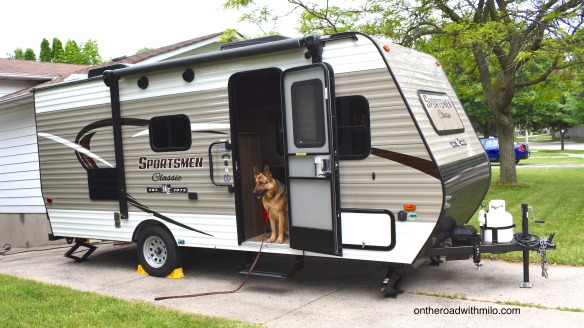
Finally, I have possession of my very first travel trailer! Her arrival means I’m almost ready to actually go on the road with Milo. Eek.

beige and white camper trailer with a black and tan german shepherd dog sitting in the doorway.

It fills up the entire driveway…

I’m thinking she needs a name. Perhaps, “The Serenity?” Or maybe, “Milo’s Den?” What do you think? Suggestions?

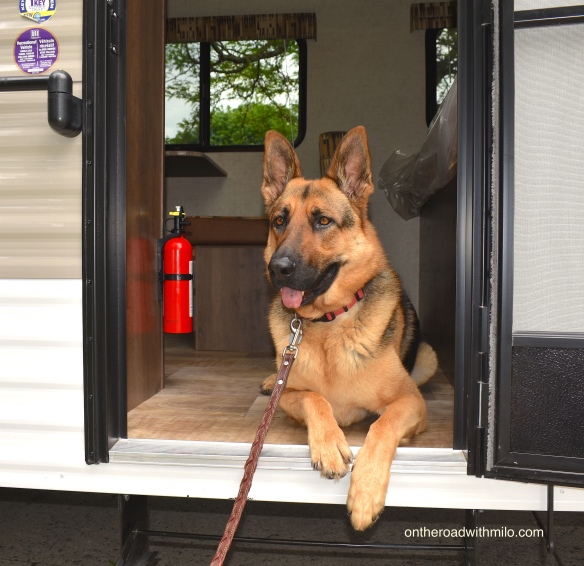
Black and tan german shepherd laying at an open door

Milo seems pleased with the arrangement

One more sleep until my travel trailer arrives!

It’s Christmas in June. Bright and early tomorrow morning I’m off to pick up my Sportsmen Classic travel trailer. By the time I was six, I figured out that fidgeting did not speed the arrival of Christmas morning. But here I am, fidgeting. A person just can’t sit still while this excited. Not biologically possible.

brown and white single axel travel trailer

Tomorrow, while my car gets wired for trailer breaks, I get a camper operation and maintenance lesson. After which, I trundle away with what will be Milo and my home for the next few months.

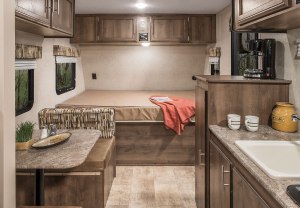
the bed, dinette, and kitchen of a camper,all in shades of brown


I’m planning to stop at a parking lot to practice backing up. Even though I grew up on a farm, where we pulled trailers all the time, I am nervous about the idea of reverse. My goal is to treat learning to park the trailer as a dog training exercise, on myself–split the process into small skills, reward every little success, and treat failures as learning opportunities. If I can remember to treat myself with the same respect that I treat Milo, I think all will be well. Fingers crossed.

I’ve entreated my neighbors to close their curtains tomorrow afternoon. I like that they look out for me, but I don’t need them looking out on my first attempt at backing this behemoth into my driveway.

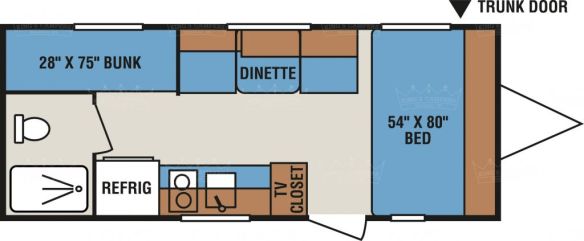
schematic layout of camper trailer

I’ll use the bunk space for Milo’s crate and a desk.