“There is no Nobel Prize for fact checking.”

A particular sort of delightful demoralization washed over me when I saw comedian John Oliver sum up years of my research in 19 hilarious minutes. Here are some things that you will learn from this segment:

  • science is difficult,John_Oliver_November_2016
  • not all scientific research is fabulous,
  • scientists are pushed to publish new and striking results, and are not rewarding for double-checking other peoples’ research,
  • scientific research can be manipulated in ways that sacrifice its integrity,
  • science is often distorted by the media to make it more newsworthy,
  • people tend to be more interested in easily-digested, exaggerated, glamorized science, than in the nuts and bolts of how science actually works,
  • and, farts don’t cure cancer.

These things undermine the credibility and authority of scientific research.  We need excellent, credible, and authoritative scientific research to address public health challenges, environmental problems, climate change, and a host of other significant issues. This is one reason why it is important to think critically about how we produce, share, and use scientific knowledge.

John Oliver says all of this in a way that might not be safe for all workplaces, but is really funny.

RV traveling with your dog: Packing his wardrobe

That’s right, I said wardrobe. Some dapper little pups are always dressed up and looking fine. Milo, however, is more the ruggedly handsome sort. He occasionally sports a bandana to downplay his ferocious image, but most of the time he’s a leash and collar kind of German Shepherd.backpack 1

He won’t be bringing any outfits on this trip, but he will need some gear:

Life Jacket. life jacketMilo is an excellent swimmer. When we swim I can hold his waist and he’ll tow me around the pond. Super neat. He’s a strong enough swimmer to rescue me, but I am not a strong enough swimmer to rescue him. So in the boat we both wear life jackets.

refelctive vest 2

Reflective vest. I might be paranoid, but he blends into the background on a dark evening and he’s big enough for even a barely intoxicated hunter to mistake for prey. A reflective vest sets my mind at ease.

Cooling vest. Milo is tough as beans in the cold, but the summer heat is another matter. He’s big and black, and dogs easily overheat. All they can do to cool down is pant and sweat from their paws (they get stinky feet too). An evaporative cooling vest helps Milo stay safe and comfortable for short walks on hot days.

Backpack. His backpack was a gift and is nicer than mine. After a summer of schlepping snacks and water for the backpack 2two of us I saw someone with a pack on their Shepherd. It was a life changing observation. I don’t like carrying things and Milo doesn’t mind. Also, he’s in better shape than I am. Now, he carries the food and water, and other sundries like bug spray and sunscreen. The dog pack comes with us!

It would be easy to forget this gear because Milo doesn’t use it all the time.

If you’re taking a trip with your dog, it’s a good idea to take a moment to consider the things you might not always need but can be very nice to have once in a while.


This post is part of a series on packing for your dog.

  1. RV traveling with your dog: What to pack
  2. RV traveling with your dog: First aid essentials you hope you never need
  3. RV traveling with your dog: Packing his wardrobe

What do we owe our dogs?

Understanding our moral obligations to another person is tough. Contemplating our obligations to a dog, a member of another species, can be overwhelming.

Sometimes, only occasionally these days, I give Milo a pretty harsh correction. He is big and strong, and we need rules. Bikes are NOT prey. I know some people think these corrections are wrong.

Sometimes I’ve seen people who I like and respect treat their companion animals in ways that strike me as just plain wrong too.

It can be useful to flip our focus from sorting out what might be wrong, to thinking more clearly about what is right.

Philosopher Jean Harvey’s view of our moral obligations to our companion animals resonates with me. Here is the gist of her position:

It is part of the nature of most dogs and cats (yes, cats) to give love and loyalty to the human companion. As with anyone who loves, it makes them vulnerable—to the hurt of not being loved at all, to being manipulated, exploited, or traumatically abused or abandoned. The nature of this relationship is central to the ethics of companion animals, or at least dogs and cats: the deep and abiding affection the animals give and seek, the profound emotional and physical vulnerability they face because of it, and the blunt fact that humans in general control the relationship and have the power either to treasure or betray their animal companions. … The primary moral obligation we have with respect to companion animals is to develop, nurture, respect, and protect this relationship.

Jean Harvey, “Companion and Assistance Animals: Benefits, Welfare Safeguards, and Relationships” 2017

This helps me think more clearly about my obligations, my moral obligations, to Milo. Am I protecting our relationship? Am I being responsible in the face of the power imbalance between us? Am I treating his love and vulnerability with respect?

More and more it seems to me that the project of developing a philosophy of dogs and people boils down to love.


Go forth good people, “develop, nurture, respect, and protect” the relationship between you and your dog!


“My method is scientific” 4: Science, goodness, and goals

brown cartoon dog, standing on hind legs, with a surprised expressionI bet if a person gave their puppy an excruciating correction every time he laid a foot on the carpet, they could train that dog to stay off the rug in a heartbeat. But, I wouldn’t train a puppy that way. And even if I found a hundred scientific papers demonstrating the success of this method I still would not use it, nor would I recommend it to anyone else. I think it’s wrong. It goes against my values.

Often, when we latch onto the ‘scientificness’ of a training method, we’re trying to justify and recommend its use. Why should you use this method? It must be good. Science says so!

What kind of ‘good’ are we talking about?

The connection between science and goodness is complicated. While we’ve used scientific knowledge to cure disease, improve public health, and build bridges, we’ve also used it to build bombs and torture people.

When we’re talking about the scientific goodness of a dog training method, we’re not talking about moral goodness. Rather, we’re talking about practical goodness or effectiveness. Practical goodness or effectiveness demands the question, “Good at what?” In this sense, a person can be a good doctor or a good torturer (or a good dog trainer). It just means that whatever they’re doing, they’re doing it well. This kind of goodness is relative to a set of goals.

By praising a training method for being scientific, we’re justifying it, or recommending it, because there is scientific evidence demonstrating that it meets a set of training goals better than alternative methods.

This doesn’t say anything about what your training goals should be. That is up to you.

What kind of goals are we talking about?

Generally, we want our dogs to be happy and perform their jobs well. But, there is a wide range of specific goals we could pick. Here are just a few ways our goals can vary:

Goals vary with respect to projects

Is someone working on rehabilitating a rescue dog, or training a lap dog, a protection dog, or a guide dog? They’ll definitely teach these dogs different behaviours and might teach these behaviours using different methods. Teaching a good strong bite isn’t a goal of most people training lap dogs. Specific goals depend on the projects a person and their dog are working on.

Goals can vary in terms of mastery: reliability and precision

Trainers can have different goals about the level of mastery their dog needs to attain.

When someone asks a pet dog to heel, they usually want it to walk in the general vicinity of their left side. In an obedience competition a dog that gets a step ahead or behind the handler, or drifts away from parallel to the direction the handler’s facing, loses points. In some cases, precision is more important than others.

Or, imagine teaching a dog ‘out.’ ‘Out’ means drop whatever is in your mouth. When a pet dog hears “out” it usually means “drop that ball.” When a police dog hears “out” it can mean “let go of that person.” In some cases, reliability is more important than others.

Teaching new behaviour is different from extinguishing an entrenched, self-rewarding behaviour

Milo doesn’t really care if he is standing or sitting. I used marker training to teach him to sit on command. It went like this:

Carla: “Milo, sit.”
Milo sits.
Carla: “YES!” Gives Milo a cookie.

Milo learned an easy way to get cookies. Sometimes he walks up and offers a sit and an intent gaze. He’s clearly saying, “Hey lady, I’m sitting here, and I’m short on cookies.”

On the other hand, I had to teach Milo not to chase bikes. He has huge prey drive, which means that, to him, chasing is its own reward. When he chases, he is giving himself his favourite cookie, a cookie better than prime rib.

Teaching Milo to sit and teaching him not to chase are two very different goals that required different methods.

But, aren’t some methods effective at achieving a bunch of different goals?

Yep. Lots of people successfully train agility dogs, protection sport dogs, and pet dogs using clicker training (aka marker training). Clicker training is all the rage. I use this method with Milo whenever I can.

But, funnily enough, there isn’t as much scientific evidence demonstrating clicker training’s effectiveness when applied to dog training in general, or to specific training goals in particular, as you might think. There is scientific theory showing that we expect it to work, but not direct scientific evidence showing that it does with dogs. The evidence that it works in a wide range (but not all) situations doesn’t come from scientists, as much as it comes from expert trainers with a track record of practical success.


The bottom line


Just because scientific evidence shows that a method meets one set of training goals, it doesn’t mean that it must meet a different set of training goals.  

And, even if scientific evidence shows that a training method meets a set of goals, a person can decide not to use, or recommend it, if it conflicts with their values.

You can’t decide what the scientific evidence is, but you must decide on your goals and values.


Note: In these posts on scientific dog training, I’m setting a high standard for calling a dog training method scientific. I’ll explain why in my fifth “My method is scientific” post, “Responsible use of science.”

  1. “My method is scientific” 1: “That’s right, I said ‘SCIENTIFIC’!”
  2. “My method is scientific” 2: What does this even mean?
  3. “My method is scientific” 3: The trouble with clicker training
  4. “My Method is scientific” 4: Science, goodness, and goals
  5. “My method is scientific” 5: Responsible use of science
Training plan June 11-18

This week we’re taking our training outside. I’ll fold a session into our first and last walk of the day.milob1

  • 1 minute sit and down stays.
  • 10 steps of focused heeling that starts and ends with a nice sit.
  • Stand from front position.
  • Clean up 6 toys in one room (I guess this one will have to happen at home).

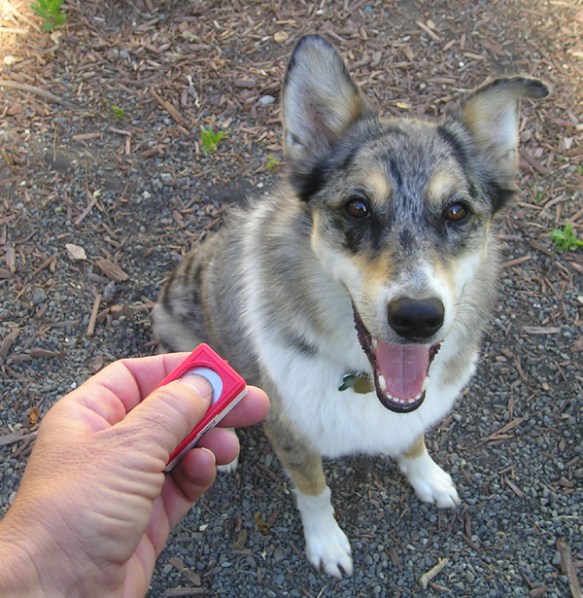
I’ll use a clicker for the heel and stand exercises to help with my timing.


AM PM
10 step heel 10 step heel
Stand from front sit Stand from front sit
1 minute sit stay 1 minute down stay
Clean 6 toys Clean 6 toys

I’ll also track down the first 10 CKC Rally signs and look for a Rally app to help with setting up training courses.

Please comment if you have any suggestions!

Training outcomes: June 4 – 10

I feel pretty proud of my consistency this week. Look at all those X’s.

Milo is great at popping up from a sit to a stand from Heel position. But, he doesn’t get it when he is in Front position. Of course (face palm)–that is a different thing. I’m pretty smart, but I have a heck of a time thinking clearly about generalizing behavior. So, Stand-from-Front is on the docket for next week. Thank Dog Milo is patient.

Our 3-step focused heel looks and feels pretty good to me. I need to get out there with some friends to make sure that our position is good. Next week I’ll try 10 steps!

Milo only broke one Stay. I didn’t see anything different about that situation compared to the others. I’m still rewarding him with “good”and a treat during the stays, and still using distractions like opening the fridge and playing with his toys. Next week we’ll dial back the duration to one minute and take this out of the house to a more distracting environment.

Clean 3-step focused heel Stand 3-min sit-stay 3-min down-stay
Sat X X X X
X X X X
Sun X X X X
X X X X
Mon
Tues X X X X
X X X X
Wed X X X X
X X X X
Thurs X X X X
X X X X
Friday X X X X
X X X X

Do you have any advice for Milo and me?

Please let me know your thoughts and suggestions.

RV traveling with your dog: First aid essentials you hope you never need

I hope, even expect, that Milo and I will both stay healthy and happy for our whole trip. But, of course, he could get stung by a bee, or eat something noxious, or get hurt in some way, and it puts my mind at ease to be prepared. Since I won’t be bringing our veterinarian along it is important to think about first aid.  I’m also looking into taking a St John’s Pet First Aid class. Of course, I’ll let you know how that goes.

We need benadryl because sometimes bees are irresistible 

I’ve organized our first aid kit according to the things we might have to deal with:

Ticks, fleas, and other creepy crawlies

  • Heart worm, tick, and flea meds
  • Tick remover
  • Little jars of alcohol to put the ticks in
  • Latex gloves
  • Antiseptic wipes

Bees and other allergens

  • Benadryl (ask your vet about dosage)
  • Tweezers

Cuts and other injuries

  • Sterile saline
  • Vet wrap (a kind of bandage that sticks to itself)
  • Gauze
  • Bandage scissors
  • Cone of shame
  • Muzzle
  • a child’s sock that is the right size for your dog’s feet
  • Antiseptic wipes (already listed up there with the tick stuff)

Eating bad things and tummy trouble

  • Hydrogen peroxide
  • a can or two of pumpkin
  • pepto (again, ask your vet about dosage and use)

Documents

  • Proof of vaccination
  • License
  • Picture

Emergency numbers

  • my vet
  • a local animal hospital
  • poison control

Skunk odour remover

  • I know this is not really first aid, but it could very well be essential for my mental health. After all we’ll be sharing a car and a camper.

Am I forgetting anything? 


This post is part of a series on packing for your dog.

  1. RV traveling with your dog: What to pack
  2. RV traveling with your dog: First aid essentials you hope you never need
  3. RV traveling with your dog: Packing his wardrobe

RV traveling with your dog: What to pack

So, what to pack for Milo for our upcoming adventure? What does he need for a fun and easy extended road trip? This list has to be short because there are serious space and weight limits in the camper. Perhaps I just need to think through Milo’s daily, weekly, and monthly routines.

Daily, Milo eats, poops, pees, trains, walks, sleeps, cuddles, plays, and hangs out with me while I work and go about my life.

Weekly, we go on a couple of walks with his dog friends and their people, have a couple of serious games of fetch, go to a class, and take a hike or swim.

Monthly, he gets tick, flea, and heartworm control meds, a bath and a brushing. The mention of meds reminds me that I need to include my doggie first aid kit. That would go in the category of things that I hope we never need.

Let’s start by thinking about the every day sorts of things:

Nourishment—Food for Milo is easy at home. I usually get meat, bone and offal from a handsome nearby butcher, pack it up into 1.5-2 pound servings, and freeze them. Every night I take a serving out of the freezer and every morning Milo enjoys a healthy, albeit grizzly, feast. The trouble is on this trip I won’t have access to the handsome butcher (sad) nor a great big freezer. So that means either prepackaged raw food, or kibble. Thankfully he has an iron stomach and is happy as long as it is full.

Excrement—I expect this will be the same as at home. The only difference is that I won’t be able to just let him out in the backyard. So that means I need to invest in some pajamas that look like regular clothes. That, and hopefully make some headway on teaching him to relieve himself on command. Lots of working dogs are taught this. It would not be cool, for example, if the beagle searching for contraband at the airport left a steaming pile-o-poo in passport control. But as far as I can tell, the only reliable way to get Milo to poop is to have someone on the street tell me that he is a very handsome dog. Maybe I’ll just record my friends saying “handsome dog” and I can play a randomly selected version back as needed.

Training, walking, sleeping, and cuddling—These will all be the same. I just need to pack a bed and crate for him, and of course his leashes, collars, treats, and toys. Well, not all the toys. Milo is NOT spoiled, but some might call him indulged, particularly when it comes to toys. I think that for this trip he just needs one to tug, one to chase, one to cuddle, and one to disembowel. That last one will, of course, need to be replaced regularly.

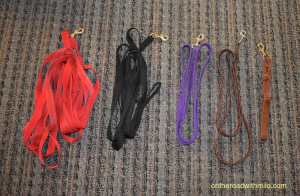
Playing—We won’t have access to a yard, and I won’t take him to public dog parks. So that means I need to bring a long line for him to wear while we are goofing around. I usually keep a couple of these in the truck anyway, and so I just need to remember not to take them out.

Hanging out with me while I work and go about my life—He really is with me pretty much all the time that I’m not at work. This won’t be a problem in the camper. He is good

five coiled leashes and lines arranged in a row

leashes and lines

company when I’m cooking, studying, reading, writing, or knitting. But what about sitting by the fire or eating at a picnic table in a campground? You might think that the answer to this is a tie out. But, that would underestimating Milo’s capacity to wreak havoc. I tried it, once. He nearly strangled me with the line (several times), dragged the line through the fire, and finally broke the line while trying to say hello to a cyclist. Tying him out (aside from being a very bad idea for dogs in general) would still require my constant attention, which defeats the purpose. The other possibility is an Exercise Pen, or X-Pen. Picture a German Shepherd sized playpen and you get the basic idea. So, that’s one more thing to research and buy for this trip. And they say that traveling with kids is a pain in the neck. At least you don’t have to worry about them chasing bears or bicycles.

Checklist of everyday things

Continue reading

On the road in what? Buying a SUV for Milo and me.

Once I decided that Milo and I would be taking a travel trailer on this trip, it was clear that we needed to go car shopping. My 2006 Honda Civic served me well for 11 years, but it was getting old and tired, and even in its heyday would not have been up to pulling a trailer. Not to mention the fact that it was neither big nor safe enough for Milo, and its years of being a dogmobile left it smelling really bad.

I read reviews, blog posts, and articles in Car and Driver about the best vehicles for dogs and their people. All that research didn’t help as much as I had hoped. But, it did make me realize that I needed a clear idea of what would make a good vehicle for Milo and me.

I wanted to be on the road with Milo in a vehicle with:

  • A tow package –no surprise here, it needs to tow the trailer that would be our home for the next few months.
  • Room for a really big dog crate. Milo needs to be safe and comfortable.
  • Excellent climate control. Milo is not the only one who needs to be safe and comfortable.
  • Leather seats. Not because they are fancy, but because I know first hand the impossibility of picking dog hair out of upholstery.
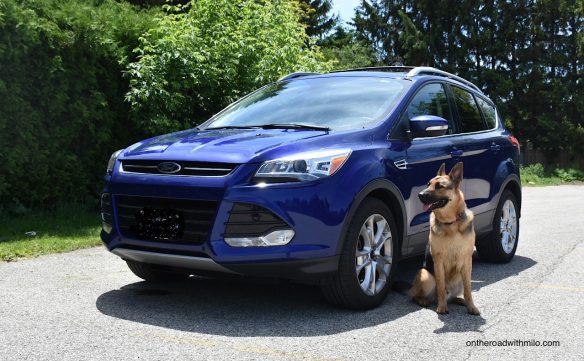
German Shepherd Dog with its tongue hanging out standing in the driver's seat of a blue SUV.

Isn’t this a pretty blue?

Also, it had to be:

  • Not a minivan.
  • Blue.
  • Quiet and comfortable to drive.
  • Reasonably priced and fuel-efficient.

With this figured out, I was off test driving small and medium sized SUVs. Once I actually drove a few vehicles, I learned a few more things:

  • First, “fold-flat rear seats” often do not fold flat. “Flat” can mean angled, slanted, or having a ridge across the storage compartment. Also, while “fold-flat” in a base model of a vehicle can mean “fold-with-a-ridge,” it might actually mean flat in a higher trim model. You need to see that it is actually flat with your own eyes, because a dog crate on an angle or wobbling over a ridge is not OK. Of course you can prop the crate up, or add shims, or do something fancy with duct tape. But it seems wrong to spend a huge amount of money on a vehicle that you must immediately jerry-rig to get it to do what you bought it for in the first place.
German shepherd standing in the back of a blue SUV with its rear hatch open.

Space for Milo’s crate and then some

  • Second, storage compartment dimensions can be deceiving. Slanted roofs, oddly-shaped doors, and wheel wells might change how big a thing (for example, a dog crate) it can conveniently hold. I ended up bringing my crate to the dealership and setting it up in the vehicle to make sure that it fit the way I wanted it to. The sales person was not thrilled about this test, but I asked politely and was careful not to scratch the paint.


  • Finally, while most vehicle sales people are efficient, polite and helpful, others are down right rude. When I asked about monthly payments at one place the  salesperson actually said, “It isn’t worth my while to figure that out unless you are interested in buying.” That’s right, he wouldn’t even tell me the price. Needless to say I moved on and bought a vehicle from an efficient, polite and helpful salesperson. The good ones are out there and are worth searching for.

At the end of the day (actually week) I drove home a Ford Escape. I love it. Milo and I have been happily motoring around in it for a few months. The new car smell is slowing being replaced by big dog smell. That, sadly, seems inevitable.

I was surprised to find vehicle shopping fun. It helped to be clear about what I wanted and what I needed, and to keep in mind that this was getting me one step closer to being on the road with Milo.

a large black and tan German shepherd sitting next to a blue SUV

just a dog and his truck

“My method is scientific” 3: The trouble with clicker training

Clicker training, sometimes called marker training, is all the rage. I use it with Milo all the time. Linda Case, over at The Science Dog, points out that even though clicker training is based on scientific theory, is incredibly popular, and has a track record of success

…there is surprising little published research regarding its application to dog training. … Even more surprising is the fact that the results of the dog studies that are available are not unequivocally in the “Yay, Clicker Training!” camp. Rather, their results have been lukewarm at best, with some showing only limited (or no) benefit.

Dog_clicker_training

So, how do we explain, and what do we do about, this conflict between the scientific evidence and the practical success of using clicker training with dogs? Case examines a scientific paper by Lynna Feng et al. that does an excellent job sorting out this problem. The paper’s title says it all: Comparing trainers’ reports of clicker use to the use of clickers in applied research studies: methodological differences may explain conflicting results.

In her analysis of this paper, Case writes that

One possible reason that dog trainers, many who believe emphatically that clicker training is a highly effective tool, are at odds with the less than stellar results of the published studies is that perhaps we are not talking about the same things. In other words, the way in which clicker training has been studied with dogs (and, one could argue, with other species as well), is not the way in which clicker training is actually used in practice. Several important differences were identified in Lynna’s study. The two most important are: (1) In practice, clicker training takes place over extended periods of time; (2) It almost always includes an established and positive relationship between the trainee (the dog) and the trainer (usually the owner).

The primary point that I came away with from this paper was that despite some continued attempts  to make it so,  clicker training as applied with dogs is not a purely behavioristic methodology. Rather, if one considers all of the new information that we have regarding the dog’s cognitive abilities, including their well-documented ability to read and understand human communication signals, then it is likely that the actual practice of clicker training involves much more than a rigid application of CT without any personal (relationship), cognitive, or emotional component. Since the studies that are in existence have studied clicker training using highly controlled behavioristic methodologies, perhaps they did not effectively measure or capture the depth and complexity of the phenomenon that is taking place when we use clicker training with dogs.

Remember that saying that a training method is scientific means that there is a body of peer-reviewed, publicly available, scientific evidence demonstrating that the method they are referring to meets their training goals better than alternative methods.

Case’s and Feng’s discussion of the science of clicker training shows that there was a mismatch between the research testing the application of this method to dog training, and what the trainers using this method actually do. In other words, the evidence was not referring to the actual method in question.

Scientific experiments often look at what they are studying in a strictly controlled way, and sometimes they look at a part of a training method instead of the whole thing. On the one hand, this is good because it helps researchers figure out precisely what is going on. On the other hand, it means that we need to use our judgement when applying scientific research to real-world situations.


When looking for scientific support for a dog training method, consider how closely the scientific evidence refers to what you are actually doing.


Two things stand out about this research on clicker training. 

First, Feng’s research sorting out this conflict is an example of science working just the way it should. The public availability of the scientific research on clicker training dogs allowed scholars like Feng and Case to evaluate the science and offer suggestions for making it better.

Second, I really like Feng’s study because she treats the expert dog trainers’ knowledge with respect. There are lots of different kinds of experts. Scientists are one kind of expert and people who have successfully trained lots of dogs are another kind of expert. Sometimes, but not very often, a person has both of these kinds of expertise. Most of the time though, scientific and practical experts need to work together.


Note: This is the third post in a five-part series about what makes a dog training method scientific.

  1. “My method is scientific” 1: “That’s right, I said ‘SCIENTIFIC’!”
  2. “My method is scientific” 2: What does this even mean?
  3. “My method is scientific” 3: The trouble with clicker training
  4. “My Method is scientific” 4: Science, goodness, and goals
  5. “My method is scientific” 5: Responsible use of science