Training plan June 11-18

This week we’re taking our training outside. I’ll fold a session into our first and last walk of the day.milob1

  • 1 minute sit and down stays.
  • 10 steps of focused heeling that starts and ends with a nice sit.
  • Stand from front position.
  • Clean up 6 toys in one room (I guess this one will have to happen at home).

I’ll use a clicker for the heel and stand exercises to help with my timing.


AM PM
10 step heel 10 step heel
Stand from front sit Stand from front sit
1 minute sit stay 1 minute down stay
Clean 6 toys Clean 6 toys

I’ll also track down the first 10 CKC Rally signs and look for a Rally app to help with setting up training courses.

Please comment if you have any suggestions!

Training outcomes: June 4 – 10

I feel pretty proud of my consistency this week. Look at all those X’s.

Milo is great at popping up from a sit to a stand from Heel position. But, he doesn’t get it when he is in Front position. Of course (face palm)–that is a different thing. I’m pretty smart, but I have a heck of a time thinking clearly about generalizing behavior. So, Stand-from-Front is on the docket for next week. Thank Dog Milo is patient.

Our 3-step focused heel looks and feels pretty good to me. I need to get out there with some friends to make sure that our position is good. Next week I’ll try 10 steps!

Milo only broke one Stay. I didn’t see anything different about that situation compared to the others. I’m still rewarding him with “good”and a treat during the stays, and still using distractions like opening the fridge and playing with his toys. Next week we’ll dial back the duration to one minute and take this out of the house to a more distracting environment.

Clean 3-step focused heel Stand 3-min sit-stay 3-min down-stay
Sat X X X X
X X X X
Sun X X X X
X X X X
Mon
Tues X X X X
X X X X
Wed X X X X
X X X X
Thurs X X X X
X X X X
Friday X X X X
X X X X

Do you have any advice for Milo and me?

Please let me know your thoughts and suggestions.

“My method is scientific” 3: The trouble with clicker training

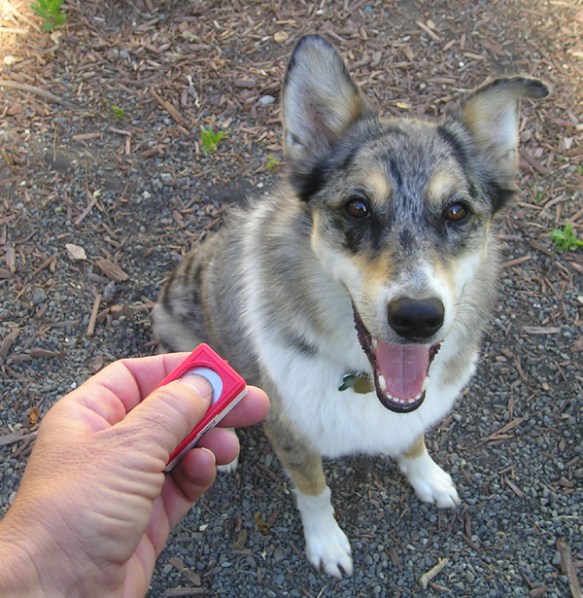
Clicker training, sometimes called marker training, is all the rage. I use it with Milo all the time. Linda Case, over at The Science Dog, points out that even though clicker training is based on scientific theory, is incredibly popular, and has a track record of success

…there is surprising little published research regarding its application to dog training. … Even more surprising is the fact that the results of the dog studies that are available are not unequivocally in the “Yay, Clicker Training!” camp. Rather, their results have been lukewarm at best, with some showing only limited (or no) benefit.

Dog_clicker_training

So, how do we explain, and what do we do about, this conflict between the scientific evidence and the practical success of using clicker training with dogs? Case examines a scientific paper by Lynna Feng et al. that does an excellent job sorting out this problem. The paper’s title says it all: Comparing trainers’ reports of clicker use to the use of clickers in applied research studies: methodological differences may explain conflicting results.

In her analysis of this paper, Case writes that

One possible reason that dog trainers, many who believe emphatically that clicker training is a highly effective tool, are at odds with the less than stellar results of the published studies is that perhaps we are not talking about the same things. In other words, the way in which clicker training has been studied with dogs (and, one could argue, with other species as well), is not the way in which clicker training is actually used in practice. Several important differences were identified in Lynna’s study. The two most important are: (1) In practice, clicker training takes place over extended periods of time; (2) It almost always includes an established and positive relationship between the trainee (the dog) and the trainer (usually the owner).

The primary point that I came away with from this paper was that despite some continued attempts  to make it so,  clicker training as applied with dogs is not a purely behavioristic methodology. Rather, if one considers all of the new information that we have regarding the dog’s cognitive abilities, including their well-documented ability to read and understand human communication signals, then it is likely that the actual practice of clicker training involves much more than a rigid application of CT without any personal (relationship), cognitive, or emotional component. Since the studies that are in existence have studied clicker training using highly controlled behavioristic methodologies, perhaps they did not effectively measure or capture the depth and complexity of the phenomenon that is taking place when we use clicker training with dogs.

Remember that saying that a training method is scientific means that there is a body of peer-reviewed, publicly available, scientific evidence demonstrating that the method they are referring to meets their training goals better than alternative methods.

Case’s and Feng’s discussion of the science of clicker training shows that there was a mismatch between the research testing the application of this method to dog training, and what the trainers using this method actually do. In other words, the evidence was not referring to the actual method in question.

Scientific experiments often look at what they are studying in a strictly controlled way, and sometimes they look at a part of a training method instead of the whole thing. On the one hand, this is good because it helps researchers figure out precisely what is going on. On the other hand, it means that we need to use our judgement when applying scientific research to real-world situations.


When looking for scientific support for a dog training method, consider how closely the scientific evidence refers to what you are actually doing.


Two things stand out about this research on clicker training. 

First, Feng’s research sorting out this conflict is an example of science working just the way it should. The public availability of the scientific research on clicker training dogs allowed scholars like Feng and Case to evaluate the science and offer suggestions for making it better.

Second, I really like Feng’s study because she treats the expert dog trainers’ knowledge with respect. There are lots of different kinds of experts. Scientists are one kind of expert and people who have successfully trained lots of dogs are another kind of expert. Sometimes, but not very often, a person has both of these kinds of expertise. Most of the time though, scientific and practical experts need to work together.


Note: This is the third post in a five-part series about what makes a dog training method scientific.

  1. “My method is scientific” 1: “That’s right, I said ‘SCIENTIFIC’!”
  2. “My method is scientific” 2: What does this even mean?
  3. “My method is scientific” 3: The trouble with clicker training
  4. “My Method is scientific” 4: Science, goodness, and goals
  5. “My method is scientific” 5: Responsible use of science

On watching action movies with sensitive dogs

Last movie night I was looking forward to watching Terminator Genesis. I had the whole evening booked off and was curled up with four pillows and Milo. (No snacks or drink though, you’ll see why in a moment.) Lovely evening right?terminator pic

Wrong. I am a bit of a goof when comes to suspense and action movies. This is probably why I love them. When things are scary I hold my breath and get twitchy. When things are surprising I yell. I’ve been known to jump out of my seat and toss my popcorn over my shoulder (hence the lack of snacks and drink on this evening). Tense, jumpy, twitching, and yelling–not a good way to be when you are the guardian of a recovering reactive GSD.

Movie night was no exception. I held my breath and Milo’s head came up and he started scanning the room. I twitched and he jumped to his feet. I yelled and he was off, pacing through the house, searching for the evil. He was going to find it and end it.

It took some work to get him calm and happy again.

  • I had to call him to me and softly sooth him: “There, there, baby, there, there.”
  • We did some easy obedience to calm his mind: Sit, stand, down, sit, down, stand, down, sit.
  • We did some difficult obedience to refocus his attention. He practiced cleaning up his toys.
  • After that it was a treat and a cuddle and we were good to go watch Gilmore Girls.

So, I have more action movie watching constraints. No snacks, no drinks, and Milo gets a bone to chew on in the other room.

This was a good reminder, you need to stay on top of your state of mind when you’re with a sensitive dog.


Training plan June 4-10

My overall goal is to get Milo titled in CKC Rally Obedience.

This week we will work on:milob1

  • 3 minute sit and down stays (medium distractions when we are at home, and mild distractions when we are out).
  • three steps of focused heeling that starts and ends with a nice sit.
  • still front feet for stand-from-sit (just popping out his butt). We’ll do this on a front foot target at home (which he already knows) or on a picnic table if we are out.
  • clean up 3 toys in one room.

I’ll use a clicker for the heel and stand exercises to help with my timing.

We’ll do two, five-minute training sessions on six of the next seven days.

AM PM
Heel position Heel position
Stand from sit Stand from sit
3 minute sit stay 3 minute down stay
Clean three toys Clean three toys

I’ll also keep going on Ed Frawley’s article, The Power of Training Dogs with Markers.

Check back at the end of the week for an update on our progress!

Training outcomes: May 28 – June 3

I learned more than Milo did this week.

Stay

We worked on stays at home and on a field where we regularly play and train. I ended up using medium rather than small distractions. They included: opening the fridge, throwing a toy around in front of him, dropping a chicken wiener in front of him, and at one session another dog came to our field and played frisbee with its person for a while.

He didn’t break a single stay! Next week we’ll try for three minutes.

Cleaning up his toys

For this trick Milo goes through the house collecting his toys and putting them in his toy box. We’ve been working on this for a while.

We didn’t make any progress for the first part of the week, so I took some time to sit back and think about what we were doing.

I realized I was messing up by asking him to do figure out two things at once. I was asking him to (1) get the idea that he has to clean up all of his toys, and (2) get the idea that he needs to clean up his toys in all the rooms. So, I scaled back to laying out a few of his toys in one room, and gradually increasing the number of toys (all in the same room) that I was asking him to clean up.  After he gets the hang of cleaning up all the toys in one room, we’ll add rooms one at a time.

This trick is teaching me to break up training into little bits, use my markers more accurately, and discipline myself about when I use words and when I use gestures as cues.

Milo did better after I cleaned up my act. Next week, more toys, but still in the living room.

Heel Position

This is going fine.  The next week it will be correct position for three steps.

I didn’t get finished with The Power of Training Dogs with Markers., so that stays on my training to-do list as well.

What we did:

AM PM
clean position 1min sit-stay clean position 1min down-stay
Saturday   x   x   x   x   x   x
Sunday   x   x   x
Monday
Tuesday   x   x   x   x   x   x
Wednesday   x   x   x   x   x   x
Thursday   x   x   x
Friday   x   x   x   x   x   x


“My method is scientific” 1: “That’s right, I said ‘SCIENTIFIC’!”

If you want to see a good internet fight, just toss out the question “What method should I use to train my dog?”  People go all cap locks on each other in no time, no time at all.

internet fightSometimes these fights are about very specific training methods, but most of the time they boil down to disagreements about whether dogs should ever be given corrections or punishments. People want you to train your dog their way.

Why should you do it their way? The same set of answers pop up over and over again. You should do it their way because:

  • your dog will be happier
  • your dog will learn faster
  • your dog will love you more
  • your dog will respect you more
  • your dog will be safer
  • your dog will be less stressed

and then out comes the big gun

  • because SCIENCE says so.

I am a beginner dog trainer, but I am an expert on evaluating and using science—in fact, I’m a philosopher of science and so that’s my day job. And let me tell you, “because science says so,” is a troubling answer.

It bothers me when “science” is thrown into a conversation as a way to end debate. ‘Science says so, smart people defer to science, so take your pick: agree with me or be stupid.’

The trouble is, scientists disagree with each other ALL the time. In fact, one of the main things that scientists do is try to prove other scientists wrong.

Calling something scientific should be an invitation to open and respectful discussion of different kinds of evidence, of our experiences, and of the values and assumptions that are part of scientific practice. When someone demands unquestioning faith in science, something is messed up. Science doesn’t work that way.

Don’t get me wrong. Science is AWESOME. It is a tool we’ve used to figure out all sorts of interesting and useful things. I’m writing this post on a really nice computer. Thank you Science. But, just like any other tool, it takes time and energy to figure out how to use it responsibly. Using it responsibly means using it in a way that is honest, morally good, and practically useful.

We should use all of the tools and resources we can to figure out how to best work with our dogs. After all, we want to do the best we can to treat our dogs with respect, develop good relationships with our dogs, help them be safe, happy, and fulfilled, and to develop public policies and laws that are good for the dogs and people in our communities.

Scientific research can provide excellent resources to help us meet these goals. But, if we are going advocate for scientific dog training methods we need to ask ourselves:

  1. What does it even mean to say that a dog training method is scientific?
  2. Is a scientific method automatically good?
  3. How can you tell if folks are right when they say a method is scientific?
  4. How do you make the jump from scientific theory and evidence to doing what is best for the dog in front of you?

There aren’t foolproof answers to these questions. Philosophers disagree with each other all of the time too.  But, if you are going to use scientific information responsibly, you need to think carefully about these questions.

Note: This is the first post in a five-part series about what makes a dog training method scientific.

  1. “My method is scientific” 1: “That’s right, I said ‘SCIENTIFIC’!”
  2. “My method is scientific” 2: What does this even mean?
  3. “My method is scientific” 3: The trouble with clicker training
  4. “My Method is scientific” 4: Science, goodness, and goals
  5. “My method is scientific” 5: Responsible use of science

Training plan May 28-June 3

This week, Milo and I will focus on three things:

  • Accurate positioning for stationary heel. There is polite leash walking, and then there is formal heeling. Formal heeling involves the dog holding a precise position at the handler’s left thigh, parallel to the direction the handler’s facing and giving the handler its full attention. Sometimes Milo is a little bit ahead of me, sometimes a little bit behind, and sometimes his back end crabs out so that we are not perfectly parallel. That is sloppy, and we need to go back to basics to fix it. This week, all I’m going to do is call Milo to a stationary heel between me and a wall and reward him when he gets it just right. This will help him feel exactly where he is supposed to be.
  • Increasing the duration of sit and down stays with mild distractions. These are tough for Milo because he is vigilant and likes to move. Long stays not only help him learn self control and be a better citizen and companion, they are also are important elements of competition obedience. This week, we’ll work on one minute stays in the presence of mild temptations.
  • Thorough searching when he cleans up his toys. For this trick, maybe better called a skill, Milo goes through the house, collects his many toys, and puts them in his toy box. We’ve been working on this for a while. He gets the finding and putting his toys away part, but he doesn’t get that he’s not done until he’s gathered all of them.  So we’ll work getting him to do a more thorough job.

We’ll do two, five-minute training sessions on six of the next seven days.

AM PM
Heel position Heel position
Clean one box of toys Clean one box of toys
1 minute sit stay 1 minute down stay

I’ll also reread Ed Frawley’s article, The Power of Training Dogs with Markers.

Check back at the end of the week for an update on our progress.