Training log—oops

This past week I was so caught up traveling with Milo that the whole notion of working with Milo fell by the wayside. Oops. That’s OK (right?), everyone needs a vacation. Today we got back in the groove, at least a little bit.

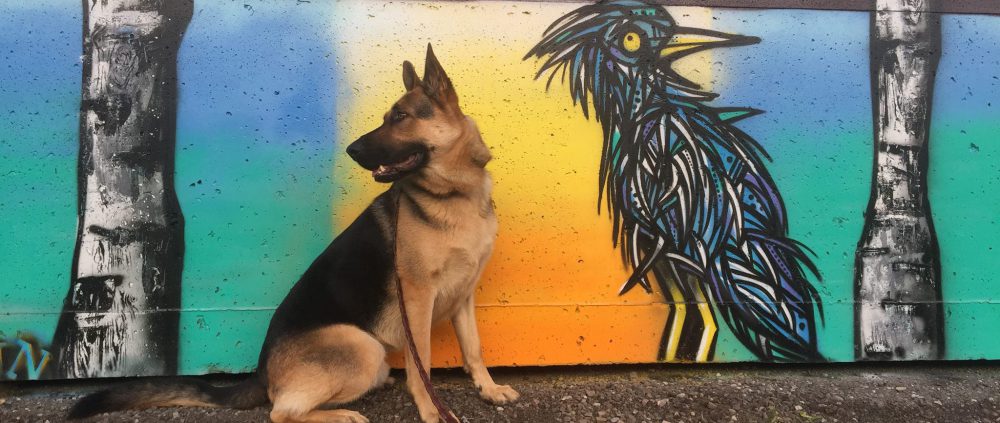
German shepherd dog with intense and happy facial expression.

Milo is very much ready to work.

When I asked him if he was “ready to work,” which is our cue that it’s training time, he lit up like a Christmas tree. Evidently, he was ready to work.

I didn’t have a plan, so this was more like farting around than working. But we had fun.

  • We did some obedience basics: sit, down, stand.
  • We did a few recalls on a long line, which are also practice waiting and coming to front.
  • And then I laid down a couple of tracks and he worked them out.

Training is usually a lot of fun for both of us, I think because it requires that Milo and I pay single-minded attention to one another. It is actually quite a feat of interspecies communication: I ask him to do something, and he figures out what I’m asking and does it. We work hard at understanding each other. When the communication fails, we learn, and when it succeeds, we celebrate. The best thing about today’s session though was Milo’s happy face.

Lookout Point Trail at Killbear Provincial Park

lookout point trail signThis is a lovely short hike. Parts were pretty muddy due to recent rain, but a boardwalk snaked through the wetland area, and there were lots of rocks for scrambling. Milo didn’t mind the mud.

We walked by a cool citizen science project, “iWETLAND: Crowd-Sourced Wetland Science,” inviting hikers to document the water level with a text message. I followed the instructions precisely–I can’t resist science content. Citizen science and wetlands, what’s not to love?

The lookout promised by the name of the trail was breathtaking–a quiet and lovely place to relax and reflect. If I wasn’t so hungry, I could have sat there all afternoon.

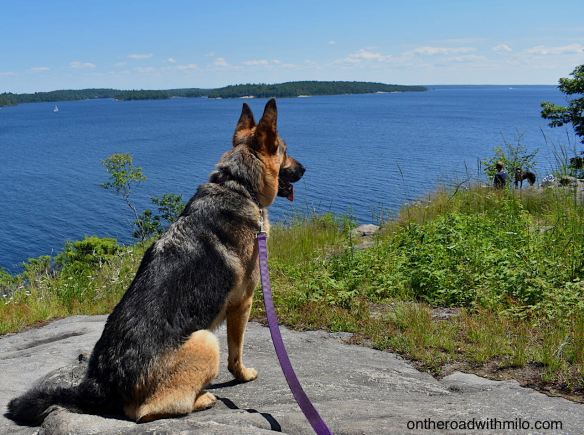
German shepherd sitting on a rock looking out over a deep blue bay

Milo, you know, looking out, at Lookout Point.

I give this trail two thumbs up. Bring a picnic and make a day of it!

Killbear Provincial Park, Ontario, Canada

The best thing about Killbear is the off-leash dog beach. A pine needle covered path winds through mature forest to a nearly deserted black and red sand beach. A perfect place for a frolic and swim.Killbear dog beach 2Milo had a great time–he deserved some fun exercise after a long drive.

silhouette of a German Shepherd Dog against sunset on a lake

sunset frolic at Killbear Provincial Park dog beach

For the love of god leash your darn dog

A post like this is silly because it has already been written about 14 million times. Pretty much all the dog trainers and all the dog professionals and all the municipal codes tell people to leash their dogs. leash

I’m writing it again because Milo and I were charged by a little schnauzer. I scared the little dog off and the schnauzer’s person got angry at me for yelling at their dog. What the what? I know that people respond weirdly when flustered. But seriously, that little dog charged my German Shepherd and I intervened before my dog did. That, my friend, deserves thanks. In fact, it deserves ice cream. Heck, it deserves a bottle of scotch.

This is not a rare event. Milo and I have been charged by Golden Retrievers, Poodles, little terriers, and a bunch of other pups.

I don’t care if the pup is a Yorkie or Mastiff, a puppy or senior dog, or a dog that’s an angel straight from heaven. I really don’t care if the dog is friendly. Even if the handler knows their dog can heel past a butcher shop, I don’t know that, and off leash dogs worry me.

Milo and I worked very hard, for years, to help him stay calm around other dogs. He is gigantic and now his behavior is, mostly, pretty good and so a person might not expect him to be stressed by a charging dog. He is. And so am I.

  • A little dog who reacts to Milo and me is not cute or brave, and does not think it is a big dog. It is probably scared, or perhaps stupid.
  • Yes, I know that Milo could ‘take care of himself,’ but I don’t want him to have to. And, who would want that to happen?
  • No, I don’t want the dogs to ‘work it out.’ That’s a project that could cost 1000’s of dollars.
  • And actually, I don’t want our dogs to say ‘hello.’ If we’re friends and I know your dog, then maybe. But my dog doesn’t play with strangers.

Where there are leash laws, please leash your dog. It’s the decent thing to do.

Training outcomes June 25 – July 1

As I predicted, this was a fun week. Milo and I worked hard on engagement. It amuses me to imagine saying the last sentence in a serious voice because the ‘hard work’ was playing with him all over town. He was a Good Boy! in Victoria Park. Yippee! He was a Good Boy! on King Street. Yippee! He was a Good Boy! on the soccer field. Yippee! As you can see, it was extremely difficult work. tug 2

A while ago I went to a few training sessions with an extremely well respected Schutzhund competitor and trainer, and she mentioned at the end of the first workshop that Milo really loved me. I didn’t know what to make of that. I suspected it was sort of like complimenting a job candidate on his suit–you know, when you need to find something nice to say and have to dig deep to find it.

“At least your dog loves you…”

But it wasn’t that at all. A strong bond with your dog makes training easier.

When I was a student, I had some professors who I was very fond of. I looked forward to going to their class, I wanted to learn from them, and I wanted them to think well of me. It is not surprising that those were the classes where I earned some of my best grades.  These days I try to be one of those professors when I teach university students.

And funnily enough, this is what I’m going for when I teach Milo too. I want him to want to learn.

My advice? Go play with your dog!


Dock diving

Yesterday our human friends Jess and Liz, and dog friends Stark and Zefra, invited Milo and I out for an adventure. It was a lovely afternoon, let’s take the dogs dock diving! Hurray dock diving!

Picture a 20 by 40 foot salt-water pool with warm, crystal clear water. A 40 foot dock, and two exit ramps, both covered in astroturf, abut a short side of the pool.

Milo takes one look at this setup and goes bonkers, pulling like an ox toward what he knows is a fun time. Ideally, I put him in a sit-stay at the far end of the doc, walk to the waters’ edge, release him, toss a toy in the water as he thunders down the dock and flings himself through the air and into the pool. I say ‘ideally,’ because that sit-stay is exceedingly difficult for a dog who is part German Shepherd and part otter.

dockdivingBut no matter how he hits the water, he swims out, retrieves the toy, swims back, hauls his panting, dripping self onto the dock and is ready to go again. Not before, of course, striking a pose, head up, chest out and grinning, at the top of the ramp giving all of us a chance to compliment his powerful jumping and excellent swimming. He’s smart, but the joy of jumping drives any sense of self-preservation out of his doggy mind, and eventually I have to force him to take a break.
dock diving 2After all the dogs had a few turns, we enjoyed a little swim together and then it was time to dry off, pile back in the van, and take ourselves home. The laughing, cheering, dog wrangling, and of course jumping, leaves everyone pooped. Well, not everyone.
As we were chatting and loading the van Milo leaned into his leash toward the pool, clearly suggesting that there might be time for another dive.

I had to remind him “Milo, you just had a long swim. You’re tired.”

But he explained, “Mom, I was tired 6 minutes ago. It is now a whole new day, and I don’t know if you remember, but there is a pool, right there. If you wouldn’t mind opening that gate, we could, you know, swim.”

I pretended not to understand, a trick he knows well.

A moment later I was distracted and Milo saw his opening. He was off! It was a full on lung toward the pool. I leaned back, and holding on to that leash like a waterski towrope left heel tracks in the gravel in the direction of the pool. Dang dog. I didn’t have the heart to tell him that he was being a bad bad boy. Once I got us both anchored again, he figured out that there was definitely no more swimming that day, and settled back into being a good dog.

One the way home we stopped for burgers and fries at a roadside stand, Milo, Stark, and Zefra laying angelic at our feet. They were happy and tired, and clearly enjoying a steady stream of fries. This is the kind of thing Saturdays were made for. When Milo and I are on the road, we are going to miss these good friends.

Training plan June 25 – July 1

My goal this week is to foster engagement in new situations. I want Milo to actively pay attention to me and want to work, even when we’re in novel or distracting places.

I’ll be following Micheal Ellis’ advice in his video “The Power of Playing Tug with your Dog.” The plan is to take Milo to a new environment, wait for him to look at me, and reward him with a spectacular game of tug when he does. We’ll do this twice a day.

I’m focusing on engagement, right now in particular, for three reasons:

  1. We’ll be leaving on our gigantic road trip soon and every place we’ll be for the next couple of months will be a new place. Working on engagement in new situations helps Milo associate this novelty with good things. Hopefully, this will help the trip be less stressful for him.
  2. Every obedience and rally trail will be in a new place. While I’ll always start by letting him sniff around, he has to learn that even in distracting places the best thing to do is to engage with me.
  3. I’ve been a bit frustrated with our training for the last few days, and the trouble is lack of engagement. A dog needs to pay attention to you in order to learn from you. Also, I need to remind myself that this is fun for me too! This kind of engagement work is just skillfully, thoughtfully, and wholeheartedly playing with Milo, and there aren’t many things better than that.

I’m looking forward to a fun week!


Travel trailer update

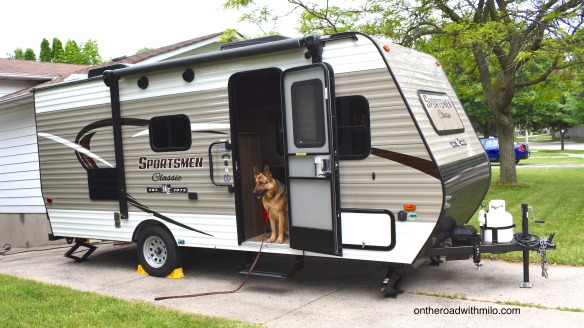
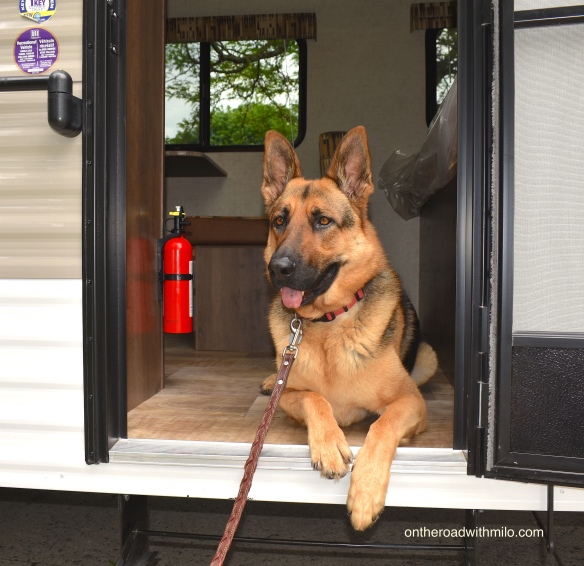
Finally, I have possession of my very first travel trailer! Her arrival means I’m almost ready to actually go on the road with Milo. Eek.

beige and white camper trailer with a black and tan german shepherd dog sitting in the doorway.

It fills up the entire driveway…

I’m thinking she needs a name. Perhaps, “The Serenity?” Or maybe, “Milo’s Den?” What do you think? Suggestions?

Black and tan german shepherd laying at an open door

Milo seems pleased with the arrangement

RV traveling with your dog: Packing his wardrobe

That’s right, I said wardrobe. Some dapper little pups are always dressed up and looking fine. Milo, however, is more the ruggedly handsome sort. He occasionally sports a bandana to downplay his ferocious image, but most of the time he’s a leash and collar kind of German Shepherd.backpack 1

He won’t be bringing any outfits on this trip, but he will need some gear:

Life Jacket. life jacketMilo is an excellent swimmer. When we swim I can hold his waist and he’ll tow me around the pond. Super neat. He’s a strong enough swimmer to rescue me, but I am not a strong enough swimmer to rescue him. So in the boat we both wear life jackets.

refelctive vest 2

Reflective vest. I might be paranoid, but he blends into the background on a dark evening and he’s big enough for even a barely intoxicated hunter to mistake for prey. A reflective vest sets my mind at ease.

Cooling vest. Milo is tough as beans in the cold, but the summer heat is another matter. He’s big and black, and dogs easily overheat. All they can do to cool down is pant and sweat from their paws (they get stinky feet too). An evaporative cooling vest helps Milo stay safe and comfortable for short walks on hot days.

Backpack. His backpack was a gift and is nicer than mine. After a summer of schlepping snacks and water for the backpack 2two of us I saw someone with a pack on their Shepherd. It was a life changing observation. I don’t like carrying things and Milo doesn’t mind. Also, he’s in better shape than I am. Now, he carries the food and water, and other sundries like bug spray and sunscreen. The dog pack comes with us!

It would be easy to forget this gear because Milo doesn’t use it all the time.

If you’re taking a trip with your dog, it’s a good idea to take a moment to consider the things you might not always need but can be very nice to have once in a while.


This post is part of a series on packing for your dog.

  1. RV traveling with your dog: What to pack
  2. RV traveling with your dog: First aid essentials you hope you never need
  3. RV traveling with your dog: Packing his wardrobe

“My method is scientific” 4: Science, goodness, and goals

brown cartoon dog, standing on hind legs, with a surprised expressionI bet if a person gave their puppy an excruciating correction every time he laid a foot on the carpet, they could train that dog to stay off the rug in a heartbeat. But, I wouldn’t train a puppy that way. And even if I found a hundred scientific papers demonstrating the success of this method I still would not use it, nor would I recommend it to anyone else. I think it’s wrong. It goes against my values.

Often, when we latch onto the ‘scientificness’ of a training method, we’re trying to justify and recommend its use. Why should you use this method? It must be good. Science says so!

What kind of ‘good’ are we talking about?

The connection between science and goodness is complicated. While we’ve used scientific knowledge to cure disease, improve public health, and build bridges, we’ve also used it to build bombs and torture people.

When we’re talking about the scientific goodness of a dog training method, we’re not talking about moral goodness. Rather, we’re talking about practical goodness or effectiveness. Practical goodness or effectiveness demands the question, “Good at what?” In this sense, a person can be a good doctor or a good torturer (or a good dog trainer). It just means that whatever they’re doing, they’re doing it well. This kind of goodness is relative to a set of goals.

By praising a training method for being scientific, we’re justifying it, or recommending it, because there is scientific evidence demonstrating that it meets a set of training goals better than alternative methods.

This doesn’t say anything about what your training goals should be. That is up to you.

What kind of goals are we talking about?

Generally, we want our dogs to be happy and perform their jobs well. But, there is a wide range of specific goals we could pick. Here are just a few ways our goals can vary:

Goals vary with respect to projects

Is someone working on rehabilitating a rescue dog, or training a lap dog, a protection dog, or a guide dog? They’ll definitely teach these dogs different behaviours and might teach these behaviours using different methods. Teaching a good strong bite isn’t a goal of most people training lap dogs. Specific goals depend on the projects a person and their dog are working on.

Goals can vary in terms of mastery: reliability and precision

Trainers can have different goals about the level of mastery their dog needs to attain.

When someone asks a pet dog to heel, they usually want it to walk in the general vicinity of their left side. In an obedience competition a dog that gets a step ahead or behind the handler, or drifts away from parallel to the direction the handler’s facing, loses points. In some cases, precision is more important than others.

Or, imagine teaching a dog ‘out.’ ‘Out’ means drop whatever is in your mouth. When a pet dog hears “out” it usually means “drop that ball.” When a police dog hears “out” it can mean “let go of that person.” In some cases, reliability is more important than others.

Teaching new behaviour is different from extinguishing an entrenched, self-rewarding behaviour

Milo doesn’t really care if he is standing or sitting. I used marker training to teach him to sit on command. It went like this:

Carla: “Milo, sit.”
Milo sits.
Carla: “YES!” Gives Milo a cookie.

Milo learned an easy way to get cookies. Sometimes he walks up and offers a sit and an intent gaze. He’s clearly saying, “Hey lady, I’m sitting here, and I’m short on cookies.”

On the other hand, I had to teach Milo not to chase bikes. He has huge prey drive, which means that, to him, chasing is its own reward. When he chases, he is giving himself his favourite cookie, a cookie better than prime rib.

Teaching Milo to sit and teaching him not to chase are two very different goals that required different methods.

But, aren’t some methods effective at achieving a bunch of different goals?

Yep. Lots of people successfully train agility dogs, protection sport dogs, and pet dogs using clicker training (aka marker training). Clicker training is all the rage. I use this method with Milo whenever I can.

But, funnily enough, there isn’t as much scientific evidence demonstrating clicker training’s effectiveness when applied to dog training in general, or to specific training goals in particular, as you might think. There is scientific theory showing that we expect it to work, but not direct scientific evidence showing that it does with dogs. The evidence that it works in a wide range (but not all) situations doesn’t come from scientists, as much as it comes from expert trainers with a track record of practical success.


The bottom line


Just because scientific evidence shows that a method meets one set of training goals, it doesn’t mean that it must meet a different set of training goals.  

And, even if scientific evidence shows that a training method meets a set of goals, a person can decide not to use, or recommend it, if it conflicts with their values.

You can’t decide what the scientific evidence is, but you must decide on your goals and values.


Note: In these posts on scientific dog training, I’m setting a high standard for calling a dog training method scientific. I’ll explain why in my fifth “My method is scientific” post, “Responsible use of science.”

  1. “My method is scientific” 1: “That’s right, I said ‘SCIENTIFIC’!”
  2. “My method is scientific” 2: What does this even mean?
  3. “My method is scientific” 3: The trouble with clicker training
  4. “My Method is scientific” 4: Science, goodness, and goals
  5. “My method is scientific” 5: Responsible use of science