Caliper Lake Provincial Park: Quick notes on the campground​

The campground at Caliper Lake Provincial Park was small and intimate, but better suited for tents than for RVs.

The electrical, pull through sites are smaller than most I’ve seen and don’t give a camper any sense of seclusion. For example, my breakfast view was dominated by my neighbour’s red Dodge Ram pickup. They’re good looking trucks.

If I come back, I’ll aim for sites 9, 17, 19, or 21. They have lots of shade, and given that my camper door opens on the passenger side of the vehicle, they offer pretty good privacy. The pads are a bit rough and not particularly level, but they’re manageable.

If you need a pull through site and can forego electricity, then try to get site 68 or 69. Those sites seem a bit bigger and are surrounded by trees.

And if you’re tenting, then you’re in car camping heaven. Seriously, there are some sites tucked right in beside the lake and you’ll be sleeping closer to your canoe than your car.


caliper lake tent campsite

It was hard to get a good picture in this odd light, but these tent sites are beautiful. Milo and I had a nice swim right here.


I enjoyed my time at Caliper Lake, but mostly because I liked the lake and the trails, and the other campers were quiet.


Caliper Lake Provincial Park: Needs hobbits

I lived in North Carolina for six years, and while I was there, I dated a forester. He was cute, and a kind man, but (not and) was a bottomless well of tree trivia. I guess that my back porch offered a view of about five kinds of oak trees, as well as cedars, spruce, and pines and he was keen on teaching me all about these trees:

“Carla, what kind of tree is this one here? And this one? And that one?”

The trouble was that although my interest in the forester was high, my interest in the forest was low. To amuse myself, I developed my own tree taxonomy:

What kind of tree is this one?

Christmas tree.

What kind of tree is that one?

Not-Christmas tree.

Things didn’t work out with the forester.


As I was hiking along Caliper Lake Provincial Park‘s Nature Trail, I realised that I’d developed another binary taxonomic system, one didn’t involve passive aggressively needling a boyfriend. You see, I saw a spot and thought, “that spot there, would be a perfect place to have a second breakfast.” At that moment I realised that there were Elf forests and there were Hobbit forests and that I was in a Hobbit forest. What made it a Hobbit forest was the abundance of nooks and crannies ready-made for naps and picnics.


4

Milo’s good at finding comfy spots.


This second breakfast spot was a cosy cubby, nestled beside a boulder and blanketed with thick, soft, dark green moss. The sun shone through the leaves of a Not-Christmas tree, creating a dappled shade that promised good napping after breakfast.

This forest has trails winding through a thick understory. If you explore the Nature Trail, you’ll clamber over slippery rocks and scramble up a couple of steep hills, so wear good shoes. And bring a breakfast or two.


2

Although not a hobbit, Milo does enjoy a second breakfast.


Fall RV camping: Staying warm and happy

I’ve been living in my RV for 10 weeks now. I liked every day of it and I’m still happy to be on the road.

In June, when I packed for this trip, I had two comfort concerns: staying cool and keeping the bugs off.

It dropped down to four degrees Celsius last night. It being September, this is hardly unexpected. I saw my first yellow leaf of the season last week and today the trees around my campsite have yellow polka dots. It is beautiful, and sort of sad too since it signals the end of the season.

6

These four-degree nights mean that keeping cool and keeping the bugs off are no longer issues. Staying warm, however, is. I love comfort. I don’t need luxury, but a soft bed, good food, and a good book, all in a safe and simple space are important.

Here are three things keeping me happy during the September chapter of this trip:

  • A little electric heater. I have a ceramic one with a thermostat and it turns off if it gets too hot or tips. You have to use your common sense here and stay safe. Running it, even on a low setting, keeps things toasty when the temperature drops at 2AM. My RV has a furnace that heats the place up quickly. But it burns through a tank propane in a flash. For temperatures like these, that are chilly but not freezing, a little electric heater does a nice job.
  • Fleece. Right now, I’m wearing a fleece tuque, fleece socks, and a fleece sweater. Fleece is lightweight, soft, and dries fast. I also have fleece pjs. Yes, they make them and they are very cozy.
  • A large snuggly dog. If you have such a dog, and you let it sleep on your bed, you’ve got a personal, heartwarming furnace.

September is the month when you can see purple flowers and yellow leaves on the same hike.


Fall camping is great. No bugs, pretty leaves, fewer people, earlier nights for enjoying the stars and northern lights and camp fires, and cocoa tastes better when you wrap chilly hands around a warm mug.

2


All you need to keep warm and happy: a fleece tuque, a fleece sweater, and a big dog!


Keep warm and keep camping!

Riding Mountain National Park: Forget the Bison, it’s the Fescue Prairie that’s cool

Bison are about as charismatic as megafauna get and are an iconic Canadian species. You might remember a series of public service announcements, Hinterland Who’s Who, produced by the Canadian Wildlife Service in the 1970’s. I loved these clips and thinking of their flute soundtrack still makes me smile. Here is the one-minute announcement about Bison.

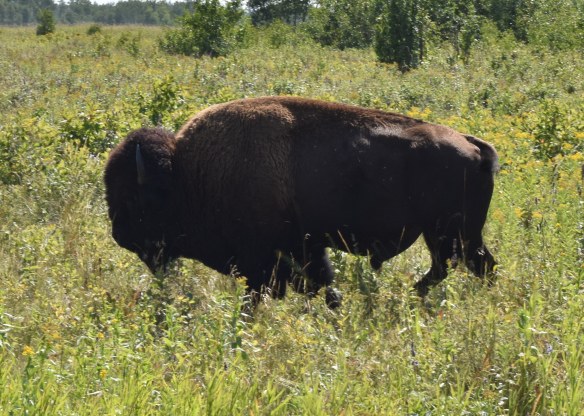
Riding Mountain National Park’s 500-hectare Bison enclosure sits near Lake Audry, Manitoba. The enclosure is a drive-through affair and visitors are warned to stay in their vehicles as they check out the Park’s herd of 40 Plains Bison. You can get a great view of the herd from your car, sometimes they even stop right beside the road.


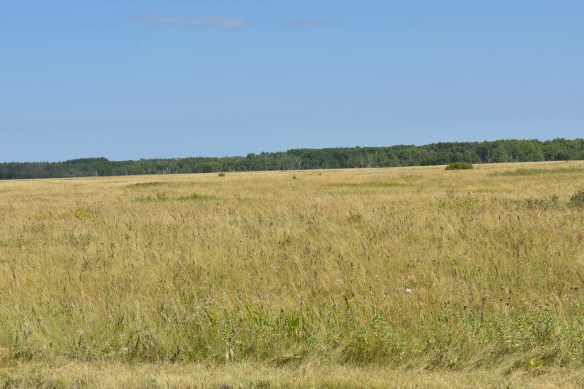
It’s easy for these great big Bison to distract us from an even more exceptional element of this picture, which is the Fescue Prairie they’re standing on. While the Bison are no longer threatened, the Fescue Prairie is.

Yellow grass and blue sky, with a line of green trees at the horizon

I find this picture more interesting than the last one, but then again I grew up in Saskatchewan.

Professor Joe Shorthouse, in his paper “Ecoregions of Canada’s Prairie Grasslands,” writes that

Unfortunately, the fescue grasslands are some of the most threatened plant communities in the Canadian prairies. Concern about their loss as a result of development, woodland encroachment, the introduction of exotic species, and overgrazing has increased because only 5% of the grasslands remain in pre- settlement condition.

However, the fates of the Plains Bison and the Fescue Prairie are intertwined. According to Shorthouse, “[t]hese grasslands have high spring protein and digestible carbohydrate content and are the main reason bison once overwintered here.” This ecological connection is playing itself out in the Bison enclosure at Riding Mountain National Park (RMNP), too. The park website tells us that

[b]ison play a significant role in the natural processes happening within the rough fescue prairie ecosystem in RMNP. Ensuring their protection as well as the protection of the rough fescue prairie goes hand in hand.

About two dozen Bison are laying and standing on a field of yellow grass. There is a blue sky and a line of green trees on the horizon.

You have to put the previous two pictures together to get this sort of ecologically important relationship.

Riding Mountain National Park is big, and there is a lot to do. I’m glad I took some time to check out the Bison and the Fescue Prairie.

P.S. Here’s what the Canadian Wildlife Service has to say about Canada’s Grasslands:

Riding Mountain National Park: It’s big

After being on the road with Milo for nearly eight weeks, I’ve turned us around and we’re meandering back to Ontario. This means we have to traverse Manitoba. I don’t have anything against Manitoba, but if I’m going to be on the prairies I feel like I ought to be at my Mom and Dad’s place in Saskatchewan. So Manitoba ends up being the province I sprint across. On Milo and my trip west, we spent a night at a truck stop outside of Winnipeg. On our way back east I thought it might be nice, instead of trying to sleep to the low rumble of a Peterbilt, to listen to some laughing loons. We traded a sleepless night at the Husky for a few days at Riding Mountain National Park.

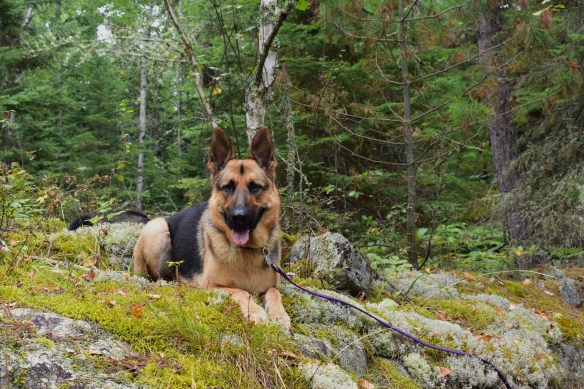
black and tan German shepherd dog standing in profile against a green forestThe first thing to know is that Riding Mountain National Park is big. It covers almost 3000 square km, and has 400 km of hiking trails, a bunch of lakes, and a whole town where you can buy gas, groceries, and ice cream. There are also 14 million cabins. I didn’t actually count them, but if I had to guess I’d say 14 million. The developed part of the park feels like a resort. There is smooth pavement and clear signage, and flower arrangements mark the campground entrance.

Although the park is big, most of the people are in a tiny part of it. Happily, you don’t have to go that far to get away from them. As a result, the dog situation here is really different from other places I’ve visited. I asked at the guy at the campground kiosk about a dog exercise area. He looked at me like I was from Mars.

No there aren’t ‘off leash areas.’ Just go where there’s no people. Of course, you might wanna think twice because of the bears.

Well, OK then. It seemed like I’d have to use my own darn common sense.

The size of the park is overwhelming, almost paralyzing. It’s hard to know where to start, and so it’s hard to start at all. Milo is a big help here. He has to move, has to walk. So we just picked a direction, and went.

I was hoping for solitude and we found it right away. We discovered a warm, clear little lake and spent the whole afternoon playing in the water. By the way, then name of the place is actually Clear Lake.

Milo must have been a retriever in a past life, or maybe a seal. The dog just wants, even needs, to swim.

a

“What on earth is this toy doing just sitting here in the shallow water?”

Finding this spot made the first day of our stay at Riding Mountain a success.


Please, leash your … children

Over the last four days, three children have charged Milo. They squealed, threw their arms in the air, and ran, full tilt, right at him. In the olden days, this is when natural selection would happen.

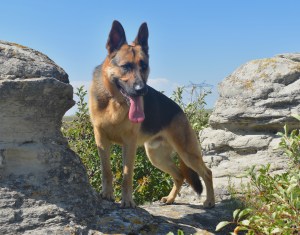
back and tan German Shepherd Dog standing on a rocky outcrop against a blue sky

This is Milo, the dog those children charged.

These situations turned out OK because Milo and I have practiced staying calm around children. I kept the kids off Milo and Milo under control, but those kids gave him a fright. He barked at one of them (so did I actually) and the parent gave me the evil eye as they collected their progeny.

I am proud to say I adulted very well. I ignored  the parent and put Milo through a little obedience routine. I wanted him to remember that although kids can be irritating they are not a big deal, and that he and I have more interesting things to do than attend to them. I also wanted the parent to see that Milo is a serious and well-trained dog.

It is common to be more strongly influenced by bad events than by events that make you happy, so common in fact, that psychologists have named the phenomenon. They call it negativity bias. I bet Milo and I have met hundreds of kids and hundreds of dogs on this trip and that most of them were perfectly fine. However, my memories of the good interactions are not nearly as strong as my memories of the bad interactions.

And you know what? Dogs dogs suffer from negativity bias too. The kids who disrespect and frighten Milo are going to make a disproportionate impression on him. Just like negative interactions are more likely to stick in your mind, they are also more likely to stick in a dog’s mind. A bad experience with a child can make it more difficult for a dog guardian to nurture a dog who is friendly and behaves well around children.

The bottom line is that if you happen to have access to a child, Milo and I would be very grateful if you taught them how to respect dogs. This makes it easier for people like me to teach our dogs to respect children.

To learn more, check out the American Society for the Prevention of Cruelty to Animals webpage where you’ll find information about how to respect dogs and help children and dogs live well together.

The serendipity of travel trailer life, or how Milo and I ended up in the Village of Linden.

One of the best things about pulling a travel trailer is that there is no need to hurry, ever. I keep The Serenity (good name for a trailer eh?) well stocked with beer, chips, and magazines and Milo and I can settle in for the night almost anywhere. I’m like a turtle carrying my home on my back.

So, as I was leaving my brother and sister-in-law’s farm near Calgary, Alberta for my folk’s place, which is just outside of Saskatoon, Saskatchewan, I decided to leave the beaten path. I took advantage of the fact that Prairie roads are laid out in a regular grid and decided to just head East. I’d try to stick to paved roads, but other than that, as long as the setting sun was in my rear-view mirrors I’d consider myself on target.

Early fall on the Canadian Prairies is delightful—there was a sapphire blue sky, golden wheat fields on my right, and fields of fuzzy barley on my left. Ahead someone had their swather out in a canola field. The canola’s green stalks and bright yellow swathes created mile on mile of stripes. This time of year harvest is just starting and there isn’t yet that frenzied feeling of racing to get the crops in before the snow flies. The countryside is a warm picture of peace and abundance that represents what I love most about the prairies. Add some Willy Nelson on the radio and Milo snoozing in back, and I was about as near to heaven as a living prairie girl can get.

Here’s the rub though, pulling a trailer drags your gas mileage into the toilet. And one thing the beaten path offered that my romantic flight from the sunset lacked was an abundance of gas stations. Hmmmm. This thought struck me as I glanced at my fuel gauge and noticed I was down to a third of a tank. If you just thought to yourself that a third of a tank is plenty, you need to do some research on the size of the Canadian Prairies. Also, no gas stations generally mean no cell towers either, so Siri wasn’t there to help me find fuel. Oddly enough I was tempted to turn around, which is completely foolish because it would take me back along the only route I knew for sure had no fuel. Continuing eastward, which I did, was a triumph of reason over instinct.

At about an eighth of a tank I got a bar on my phone and immediately asked Siri to bail me out. She took me straight to the Co-op in the Village of Linden. Phew. But, it was 6:25 in the evening by then. You know what you can’t do in a little prairie town at 6:25 PM? Buy anything. Well, in some towns you can still get beer and Chinese food, but I needed fuel for my truck. I already had lots of human fuel. Campground_Coulee_linden

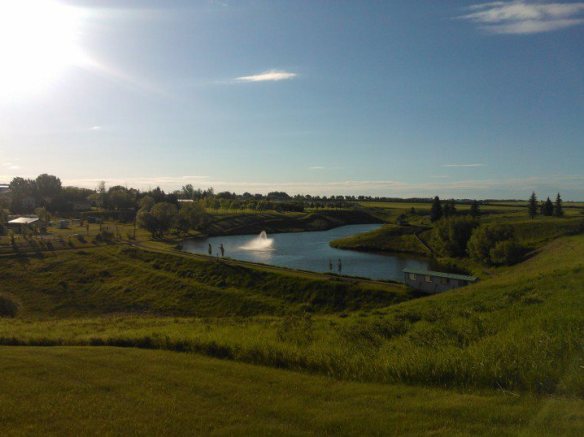
As I realized that I was either tracking down the person who ran the Co-op or staying put, I looked around and saw a pretty little coulee. At the bottom of that coulee I saw a couple of RVs sitting on a neatly manicured lawn beside a pond. What a happy coincidence to find that the Village of Linden has a pristine campground. Its 10 spots are available first come first served for $25 a night. Payment is on the honor system. After Milo and I got settled in, we enjoyed a long walk in the coulee before our dinner of kibble, chips, and beer. No worries, no worries at all.

The next morning, after coffee and more kibble, we tanked up at the Co-op and were back on the road.

Thank you, Linden, for your generous hospitality.


Rowdyism in Provincial Parks

Did you know that “rowdyism” is a thing? It is, and it is also against the law in Ontario’s Provincial Parks.

The Grundy Lake Provincial Park 2017 Information Guide says that you are engaging in rowdyism when you

  • Use discriminatory, harassing, abusive, or insulting language or gestures
  • Make excessive noise
  • Disturb other persons
  • Operate audio device in prohibited area

The minimum fines for the first three items on this list is $150.00. That’s right, a person can be fined $150.00 for using discriminatory language. That is great.

But, a person can also get fined a $150.00 for using abusive or insulting language. @#$% that. Just kidding. I’ve limited the amount of time I spend listening to the news and so have really cut down on my cussing. I’ll be fine.

The Guide explains that

You cannot disturb any other person or interfere with their enjoyment of the park at any time of the day or night.

I am on board with this. I want my parks quiet and discrimination free, and a prohibition against rowdyism pushes, I hope, in that direction.

Milo as GSD ambassador to Big Hill Springs Provincial Park

My sister, Ondrea, took Milo and me hiking at Big Hill Springs Provincial Park, which is just outside of Calgary, Alberta. You can learn more about the park by checking out her blog, Walking Calgary.

A gnarled stick with green moss on it.

After spending the entire summer with Milo, I’ve come to appreciate a pretty stick!

It’s always good to have a local guide, and even better when that guide is Ondrea! As you might guess from the name of the park, it has a big hill and a spring. Ondrea started us out on a steep ascent. This was smart because we got the difficult climbing out of the way right off the bat. Of course, Milo is always a big help on the uphill sections of hikes. I give him a little “hup, hup” and he gladly returns to the days of his leash pulling youth. This makes those steep grades easier for me and has the added benefit of pooping him out just a wee bit more.

As you might expect of a place this close to Calgary, there were quite a few people on the trail. Early in the hike, we passed a woman who froze, clearly terrified, when she laid eyes on Milo. I did what I always do on a narrow path or sidewalk. Milo and I took two steps off the trail and I put him in a sit-stay. As this poor woman slipped by, I made sure she could see that the leash was short and I stood between her and Milo.

school picBeing Canadian, and a woman, I apologized to Ondrea for making her wait for the 20 seconds it took to complete this manoeuver.

All she said, “I appreciate how considerate you are of how other people may react to him.”

That was a kind thing to say.

Even though Milo is the apple of my eye, I know that he is big and strong and can look scary. I also know that there are some irresponsible breeders who produced dogs with nervous and unstable temperaments, and that some German Shepherd guardians never learn to properly handle these powerful dogs. As a result, there are circles in which this breed has a bad reputation. I work hard to help people see that German Shepherds can be great dogs.

Every time Milo is polite, like he was on this hike, it is a win for German Shepherds in general. I try to help him be a first-rate ambassador for the breed.

When Ondrea noticed this, it made my day. And that good feeling stayed with me for the rest of our hike.

big hill springs

Big Hill Springs is full of pretty little waterfalls.

The tail end of the hike was wonderful. Ondrea ushered us along a gentle descent graced by a series of little waterfalls. The stream and the falls are fed by cold, clear spring water and we often stopped, watched, and listened to the water cascading alongside us as we walked down the hill.

If you get the chance, I recommend taking a couple of hours to check out Big Hill Springs.

It is lovely.
The high cost of doggy weight loss

There are a lot of fat dogs out there. The rate of canine obesity, like the rate of human obesity, seems to be climbing. According to the Association for Pet Obesity Prevention 53.9 percent of dogs are overweight or obese, and the Canadian Veterinary Medical Association tells us that the most important thing we can do to lengthen our pet’s lives is to control their weight.

Our concerns about pet welfare easily transform into concerns about pet weight loss. So, perhaps it is not that surprising that human diet cultures and weight loss industries are reiterated with respect to our canine companions.

There are many things that we can do and buy to get a dog’s weight under control, and some of them sound a lot like things we can do and buy to get a person’s weight under control.

You might have heard of the Hollywood Diet, but have you heard of the Show Dog Diet? One article on the American Kennel Club webpage actually recommends the Show Dog Diet, which involves feeding your dog one ‘normal’ meal in the morning, and then feeding her low sodium green beans with a bit of kibble later in the day. After the initial weight loss resulting from feeding your dog beans this diet recommends that owners switch their dogs to commercial weight loss dog food. And there is a plethora weight control and weight loss dog foods to choose from– Science Diet, Royal Canin, Iams, Arcana, Purina One, the list goes on and on.

How can you tell if your dog is a healthy weight? Purina helps veterinarians and pet guardians alike make this determination with their Body Condition Score chart.

A chart showing pictures of dogs ranging from fat to thin from the top and side.

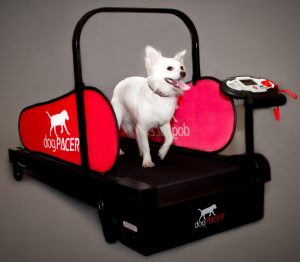
In addition to high quality, and high price, dog food pet guardians can also purchase exercise equipment for their fat dogs. If you have an extra thousand or so dollars laying around you can even invest in a treadmill for your pudgy pooch.

small white dog on a black treadmill with red rails.

We can also buy exercise equipment for our pudgy pups. Canine treadmills are often advertised as tools for canine weight control and obesity prevention.

After trying the diets, special foods, and exercise equipment, dog guardians can turn to pharmaceuticals to help their dog lose weight. “Doggy diet pills: Are they safe?” tells the story of Dirlotapide, a drug that “tricks [a dog’s] brain into feeling the dog is full after a smaller meal.” The article goes on to say that while taking this drug a “high-quality commercial diet is recommended” to ensure the dog gets adequate nutrition. It’s a good thing there are so many high quality commercial diets on the market. This article assures us that “side effects, if any, tend to be mild, and can include vomiting, diarrhea, and lethargy.” Other sources, however, tell us that “All pharmacologic weight-management aids should be considered short-term interventions, may have significant side effects.”

In addition to the products we can buy to help our dogs lose weight, there is a wide range of books available about how dogs and their humans can get thin and fit together. Wouldn’t it be a nice to spend an evening curled up with a bowl of ice cream reading Walk a Hound, Lose a Pound: How You and Your Dog Can Lose Weight, Stay Fit, and Have Fun Together?  

The special food, exercise equipment, drugs, and books all cost money. Some of them cost a lot of money. On one hand, if someone finds a way to separate rich people from their cash that’s fine with me. But on the other hand, I’m sad to see yet another way that a person’s income impacts the health of the creatures (both the humans and the nonhumans) in their lives.